

Direct answer: Field-selectable wattage and CCT switches are a genuine logistics tool, not a gimmick — one SKU covers three or four order codes and distributor dead stock drops accordingly. But every selector adds hardware and an ingress path into the housing, and listing bodies test and list the product at the setting that stresses it most: the highest power setting and the default. Selectable wins on high-volume product families with uncertain site conditions; it loses on price-per-lumen tenders, tightly specified projects, and anything sold into rebate programs you have not checked.
The trick is knowing which of those two situations you are actually in. Most buying mistakes with selectable fixtures are not about the technology — they are about assuming the number on the box applies to the setting you intend to install.
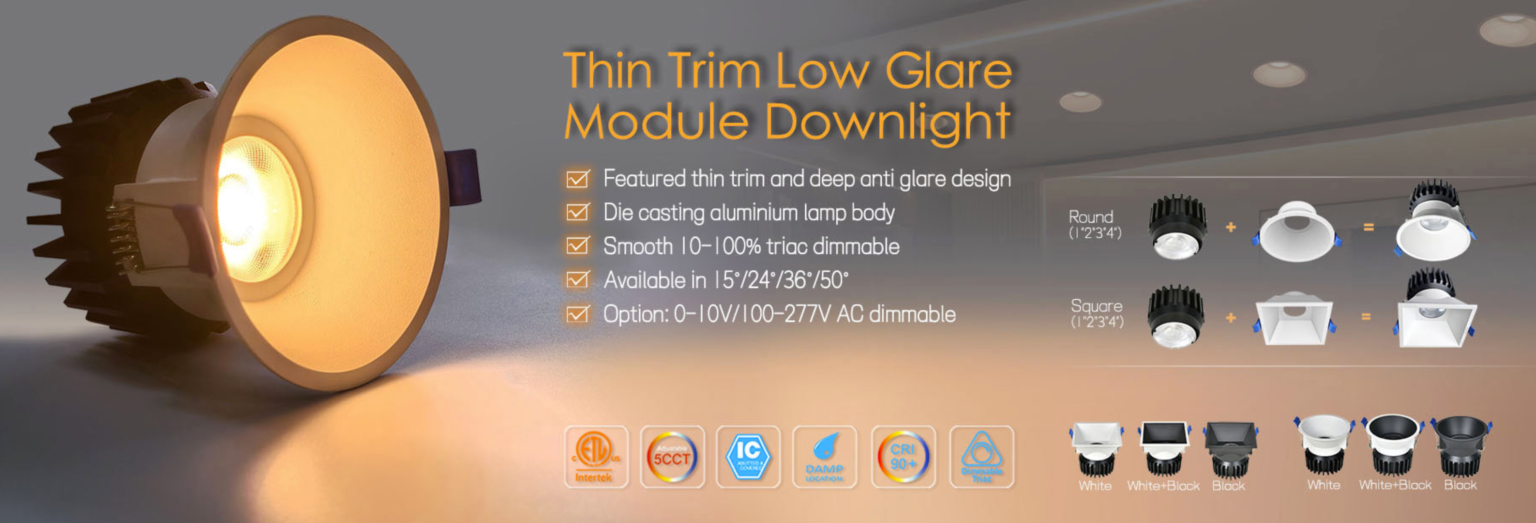
What “field-selectable” actually means
Three different features get sold under the “selectable” umbrella, and they carry very different risk.
- Wattage-selectable (multi-output): a switch or wire selection sets the drive current, so one fixture ships as, say, a 40 W, 30 W or 20 W product. Lumen output, efficacy and heat all move with the setting.
- CCT-selectable (multi-CCT): a selector picks between two or more nominal colour temperatures — commonly 3000 K, 3500 K, 4000 K and sometimes 5000 K — usually by switching between LED channels.
- Colour-tunable: continuous adjustment over a range via a control input. This is a different product category in every listing program, with its own testing and reporting rules.
The distinction matters because the programs treat them differently. The DesignLights Consortium has had a dedicated policy for colour-tunable and field-adjustable products since Technical Requirements V4.3, effective 26 March 2018, and both are tested and reported under rules that do not apply to fixed-output fixtures.
Where selectable wins: the SKU arithmetic
The commercial case is arithmetic, not hype. Take a conventional 4-foot strip light family covering three wattages and two colour temperatures.
| Conventional family | SKUs | Selectable equivalent | SKUs |
|---|---|---|---|
| 3 wattages × 2 CCTs | 6 order codes | 1 fixture with a 3-position wattage switch and a 3-CCT selector | 1 order code |
| Separate packaging and labels per code | 12 stock lines | One package | 1 stock line |
| Forecast risk per code | High — dead stock on the wrong CCT | Risk pooled into one code | Low |
That is the honest version of the pitch: fewer codes to forecast, less dead stock, faster substitution when a site changes its mind during installation. Distributors stocking linear fixtures and downlights in mixed 3000/3500/4000 K markets gain the most, because CCT is the single most common last-minute change order in commercial fit-outs — a pattern we also see in high bay projects, where the sizing rarely matches the drawing; see our warehouse high bay sizing guide.
The less obvious winner is the service van. One selectable spare covers several failed fixtures, which matters more to a contractor than the small price delta on each unit.
Where selectable breaks: listings, rebates and the settings they test
Here is the part the sales sheet does not say. Listing and rebate programs do not test a selectable fixture at the setting you expect to sell. They test the setting that is hardest to pass.
| Program | Setting used | What it means for your spec |
|---|---|---|
| DLC dimmable products (V5.1) | All requirements met at the maximum light output setting; Premium classification at the maximum input control setting | The low-wattage number on the label can look worse than the listing suggests — read the QPL entry, not the box |
| DLC field-adjustable products (policy introduced in V4.3, 2018) | Tested at the default setting and at the highest power setting, if different | Both settings need reports; ask which one was the tested representative |
| DLC SSL V6.0 | Applications accepted from 5 January 2026; previously qualified products stay listed until December 2026; revised field-adjustable reporting | A selectable product qualified under an older version needs a re-check before you commit 2026 volume |
| ENERGY STAR Downlights V1.0 (final 16 November 2023, replacing the Luminaires specification by 1 January 2025) | Certification represented only at the most consumptive setting | The highest-power — and for colour-tunable models the most consumptive white — setting defines the listing |
Two practical consequences follow. First, a fixture whose 40 W setting barely passes can still be sold as a listed product, because the listing lives at the top. If your project is sized around the 20 W position and its efficacy, do not assume the listed number transfers. Second, V6.0 raises minimum efficacy by roughly 14 percent on average across product types and caps outdoor products at 5000 K, so a selectable family with a 5000 K position may survive indoors and fail outdoors.
California JA8: the CCT ceiling selectable makes worse
If any of your volume goes into California residential or mixed-use work, the JA8 qualification requirements in Title 24 apply, and they do not negotiate with the switch position. Among other criteria, a qualifying light source must reach initial efficacy of at least 45 lumens per watt, power factor of at least 0.90 at full rated power, start time of 0.5 seconds or less, CCT of 4000 K or below, CRI of at least 90, R9 of at least 50, rated life of at least 15,000 hours, a minimum dimming level of 10 percent or lower, and flicker below 30 percent at frequencies of 200 Hz and below, measured at both 100 percent and 20 percent light output. Compliant products carry the JA8-2025 mark, or JA8-2025-E where approved for elevated-temperature enclosed use.
The trap is the combination. A 3-CCT selectable downlight must meet the whole table at every CCT it can be switched to — and the code has historically applied a lower 3000 K ceiling to some non-integral source types, so a family with a 5000 K position simply cannot be presented as a JA8 product across its settings. Check the version in force for your project and confirm the certification data covers each selectable position, not just the default.
The engineering costs nobody puts on the quote

Every selector is hardware. A wattage switch adds solder joints, a slider or hole in the housing and one more ingress path for the IP rating to survive. A CCT selector usually means two or more LED channels driven in isolation, so the driver needs either more channels or a switching stage — more components, more thermal load, one more thing to fail.
Thermal design is the quiet cost. A fixture sold as 40/30/20 W must be thermally certified at 40 W, because that is where it will spend its worst hours. The engine and driver are therefore sized for the top setting and run under-stressed at the bottom — safe, but it means the 20 W position is carrying hardware paid for at 40 W. On price-driven tenders that weight is pure margin loss against a competitor selling a dedicated 20 W unit.
Dimming adds another layer. Switchable-wattage drivers dim differently at each setting, and a driver that reaches 10 percent smoothly at 40 W may behave differently at 20 W. If the project has a controls specification, demand photometry and dimming data for the setting that will actually be installed.
What a real selectable spec sheet must show
A supplier who builds selectable products properly shows their work. Before you commit, the datasheet should carry:
- Photometry per IES LM-79 for the default and the highest-power setting — ideally for every selectable position
- Lumen maintenance data per LM-80 with a TM-21 projection, referenced to the highest setting where the LEDs work hardest
- In-situ temperature measurement (ISTMT) at the maximum setting
- Efficacy, CCT and chromaticity per position, declared against a recognised chromaticity standard such as ANSI C78.377
- Colour consistency per position in MacAdam steps, not a vague “matching” claim
- The exact mechanism — rotary switch, wire select or DIP — and whether it is sealed after commissioning
If the datasheet answers none of these, treat the rest of it with suspicion. Our LED spec sheet review guide lists what a complete commercial datasheet looks like line by line.
When to say no to selectable
Skip the selector in three situations. When the project has a fixed photometric specification and an energy target, a dedicated single-setting fixture is cheaper, lighter and simpler to document. When the product goes into a tender scored on price per lumen, you are paying for flexibility nobody will use. And when the whole volume ships into one market with one colour temperature convention, a selectable CCT is a solution looking for a problem.
There is a documentation argument too. Every extra setting is another configuration a compliance file has to describe, verify and keep consistent. Fewer settings means fewer data sheets, fewer declarations and fewer arguments at customs.
How to spec selectable without losing the listing

Ordering selectable products well is mostly about pinning down the defaults in writing.
- Fix the default setting in the purchase order. DLC tests at the default and maximum settings, and your installer will receive whatever leaves the factory.
- Decide who sets the switch — factory, distributor or installing electrician — and put it in the submittal. Field decisions are where listings get broken.
- Request the QPL or certification entry for the exact model number as shipped, including any field-adjustable designator in the model name.
- For rebate programs, confirm with the utility that a selectable product qualifies at the installed setting, not only at the tested maximum.
- For tunable-white projects rather than simple CCT selection, read our tunable white lighting guide — continuous tuning is a different category with different rules.
Frequently asked questions
Does a selectable fixture need a photometric report for every setting?
Listing bodies require the default and highest-power settings at minimum, and a professional buyer should ask for every position they intend to install. Lumen output, efficacy and CCT all move with the setting, so a single-setting report tells you very little about the others.
Can a wattage-selectable high bay keep its DLC listing after we change the setting on site?
The listing belongs to the product as tested and reported, anchored at the maximum light output or maximum input control setting for dimmable products. Changing the setting on site does not delist the model, but the performance you claim in a rebate application should match the installed setting and the data on the QPL entry.
Why is a 5000 K selectable position a problem in California?
The JA8 qualification data filed with the California Energy Commission lists a CCT threshold of 4000 K, so a family that can be switched to 5000 K cannot be presented as a JA8 product across all its settings, and the code has historically capped some non-integral source types at 3000 K. Check the version in force for your project.
Do selectable settings change anything under the EU rules?
Regulation (EU) 2019/2020 applies to light sources and separate control gears, including when they are placed on the market inside a containing product. A selector does not change the classification of the product — it only adds configurations that the technical documentation must describe honestly.
