
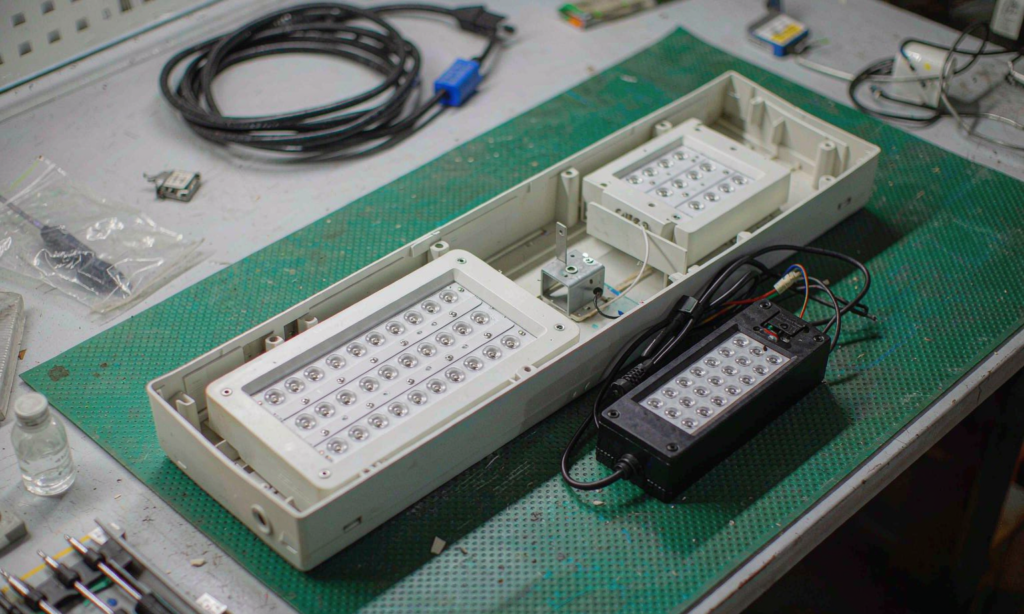
Direct answer: Under Regulation (EU) 2019/2020, which applies from 1 September 2021, a luminaire is treated as a containing product — not as a light source — exactly as long as the light source and driver inside can be removed for verification. Article 4 then puts three separate duties on you: replaceability with commonly available tools and without permanent damage unless a written technical justification exists, public information about replaceability, and dismantlability at end of life. The replaceability rule lives in Article 4; the annexes only carry efficiency limits and information duties.
Get the classification wrong and either your whole fixture must meet the efficiency limits written for light sources, or you ship a product whose documentation cannot survive a market surveillance visit. Most of the non-compliance we see in the EU supply chain is not about the efficiency tables — it is about Article 4.
The rule lives in Article 4, not in the annexes
Regulation (EU) 2019/2020 — the “single lighting regulation”, or SLR — replaced Regulations (EC) No 244/2009, (EC) No 245/2009 and (EU) No 1194/2012 with one text covering light sources and separate control gears. Annex II carries the requirements buyers usually talk about: energy efficiency limits in point 1, functional requirements in point 2 and information requirements in point 3, applying from 1 September 2021.
Replaceability is not in there. It sits in Article 4, “Removal of light sources and separate control gears”, and it binds manufacturers, importers and authorised representatives of containing products — a product containing one or more light sources or separate control gears, or both, including luminaires that can be taken apart for separate verification of the contained light source.
Article 7 also prohibits placing on the market products designed to detect that they are being tested and to alter their performance accordingly — in force since 25 December 2019, and the reason a “test mode” that quietly changes driver behaviour is not a compliance strategy.
First, decide what you are actually selling
Article 2 defines a light source by what it does and how it can be verified: an electrically operated product — LED, OLED, incandescent, fluorescent or high-intensity discharge — with chromaticity inside the defined range, flux between 60 and 82,000 lumen, below 500 lumen per square millimetre of projected light-emitting surface area and a colour rendering index above zero, verifiable under the Annex IV procedure.
Light sources do not include products containing light sources from which these light sources can be removed for verification. If a market surveillance authority can take your fitting apart and verify the module inside without destroying it, your fitting is not a light source. It is a containing product, and Article 4 applies to it.
If the engine is glued, potted or permanently wired so that verification without permanent damage is impossible, the classification flips: the whole fixture becomes the light source, and the efficiency and functional limits of Annex II points 1 and 2 apply to the complete fitting — a much harder bar than for a bare module designed to pass them.
| Design decision | Classification | What applies |
|---|---|---|
| Light engine and driver removable for verification without permanent damage | Containing product | Article 4 duties; the contained light source and control gear carry the Annex II requirements and the EPREL registration |
| Engine potted, glued or otherwise inseparable | The fixture itself is the light source | Annex II points 1 and 2 apply to the complete fitting; labelling and registration duties follow the light source rules |
| Only the engine is removable, driver stays integrated | Depends on the removal test for the light-emitting parts | Classify by whether the light source can be verified undamaged, then apply Article 4 or Annex II accordingly |
The three duties inside Article 4
Article 4 is one short article with three paragraphs, and each one asks for different evidence.
- Paragraph 1 — replaceability. Light sources and separate control gears must be replaceable with commonly available tools and without permanent damage to the containing product, unless the technical documentation contains a technical justification, related to the functionality of the containing product, explaining why replacement is not appropriate — plus instructions for removing them undamaged so market surveillance authorities can verify them.
- Paragraph 2 — information. You must state whether light sources and control gears are replaceable, and by whom — end-users or qualified persons — without permanent damage. It must be on a free-access website, and for products sold directly to end-users also on the packaging, at least as a pictogram, and in the user instructions.
- Paragraph 3 — end of life. Light sources and separate control gears must be dismantlable from the containing product at end of life, with dismantling instructions available on a free-access website.
| Duty | What you must be able to show | Where it bites |
|---|---|---|
| Article 4(1) | A design that opens with common tools, or a written technical justification in the technical file | Product structure, fasteners, connectors, potting decisions |
| Article 4(2) | A free-access website stating replaceability; pictogram and manual text for direct-to-end-user sales | Website content, packaging artwork, instruction manuals |
| Article 4(3) | End-of-life dismantling instructions on a free-access website | Recycler relationships, WEEE documentation |
The technical justification is a file, not a sentence
The “unless” in Article 4(1) is the most misused clause in the regulation. It does not let you declare a fitting non-serviceable in a covering letter: the justification must be written, related to the functionality of the containing product and kept in the technical documentation, which must still explain how the parts come out undamaged for verification.
Separately, point 3 of Annex III lists applications where light sources are exempt from most requirements — signalling, image capture and projection, germicidal sources with peak radiation around 253.7 nm, high-UV disinfection sources and similar. The exemptions are narrow: the product must be specifically designed and marketed for the stated use, the technical file must list the parameters that make the design specific to the exemption, and the intended purpose must appear on packaging, product information and advertising with an explicit statement that the product is not intended for other applications. Under Annex II point 3(e), the information duties survive even for exempt products. A warehouse high bay does not qualify because it is “industrial”.
What the technical documentation file must contain
Article 5 makes the technical file the centre of gravity of the regulation — and the document your customer will be asked for when their import is audited.
| Requirement | What it means for your file |
|---|---|
| Article 5(2) | The file must contain the information in Annex II point 3(d) and the details and results of the calculations under Annex II points 1 and 2 and Annex V |
| Article 5(3) | If data comes from an equivalent model or by extrapolation, the file must show the calculations, the accuracy assessment and a list of all equivalent models with their model identifiers |
| Article 5(4) | The file follows the order and content set out in Annex VI of Regulation (EU) 2019/2015 — the structure importers already know from energy labelling |
| Article 6 | Market surveillance applies the Annex IV verification procedure and tolerances, so declared values need headroom |
One more item comes from the labelling side: under Annex V point 2 of Regulation (EU) 2019/2015, the technical documentation of a containing product must clearly identify the contained light source including its energy efficiency class, and the user manual must carry the sentence “This product contains a light source of energy efficiency class”, with the class inserted — repeated per light source where there is more than one. Our earlier EPREL registration guide covers the database side.
How Article 4 changes fixture design
For an OEM buyer, Article 4 is a bill of materials instruction hiding inside a legal text.
Serviceability wants connectors instead of soldered leads, a driver on a bracket rather than potted into the housing, and fasteners instead of adhesive. A captive gasket and a tool-removable lens preserve an IP rating while still letting the engine come out. What it rules out is the cheapest construction on the quote: engine soldered to the driver, driver potted into the housing, housing glued shut.
“Commonly available tools” is the phrase to watch: crosshead screws, hex keys and standard Torx are fine, while a proprietary bit or a special jig pushes you toward the written-justification route and a removal procedure your service partner must follow.
How to check a supplier before you place the order
If the light source is replaceable, someone will eventually want the replacement. Before the order, ask what the replacement engine or driver part number is, how long it stays available, and whether a revised board keeps the same model identifier or becomes an equivalent model under Article 5(3) — the regulation itself demands the list of equivalent models. A supplier who cannot answer has not written the file yet. The sourcing model matters too: our component versus complete fixture procurement guide explains why.
You do not need a laboratory to find out whether Article 4 is handled. You need half an hour and four questions.
- Ask for the classification in writing. One sentence: is this product placed on the market as a light source or as a containing product, and why.
- Ask for the removal procedure. The file must describe how the light source and control gear come out undamaged for verification. If the answer is “that is not possible”, ask where the technical justification is.
- Ask for the website links. Articles 4(2) and 4(3) hinge on free-access websites — check that the replaceability statement and the dismantling instructions actually exist, in a language your market uses.
- Open a sample. Count the tools needed to get the engine out. If the answer is “none, it is welded”, you have your classification answer too.
None of this replaces a compliance provider.

The documents importers usually collect are listed in our LED lighting certification checklist — Article 4 evidence belongs in the same folder.
Frequently asked questions
Does Article 4 apply to B2B-only luminaires that never reach consumers?
Yes. The replaceability and dismantling duties apply to all containing products. Only the packaging pictogram and user-instruction text are tied to products sold directly to end-users; the free-access website information is unconditional.
We glue the lens for IP66. Can we claim a technical justification?
You can, but it must be written, related to the product’s functionality and kept in the technical documentation — and it cannot remove the ability to take parts out undamaged for verification. A gasketed, tool-removable lens usually achieves the same ingress protection without the justification.
Is the driver inside my fitting a “separate control gear”?
A separate control gear is one that is not physically integrated with a light source and is placed on the market as a separate product or as part of a containing product. The definitions exclude power supplies covered by Regulation (EC) No 278/2009, and a Power over Ethernet switch is not a control gear. A removable driver inside a fitting is treated as a separate control gear within that fitting.
Which dates matter for a shipment leaving the factory this quarter?
Article 11 of Regulation (EU) 2019/2020 applies the regulation from 1 September 2021, with the anti-circumvention rule in Article 7 applying from 25 December 2019. The Annex II information requirements date from the same day, and some efficiency steps in Table 1 tighten later — check the row for your product type.
This article is a procurement guide, not legal advice. Confirm requirements for your specific product and market with a qualified compliance provider.
