
Sports Field & Stadium LED Lighting: What Professional Buyers Actually Pay For
When you’re spec’ing LED for a sports venue, the difference between a competent installation and a disaster comes down to about six decisions most suppliers won’t walk you through. After two decades watching stadium projects go right and wrong, here’s what separates the buyers who get it right.
The Wattage Lie That Costs You $200K
Every supplier leads with wattage. “Our 1500W fixture is brighter!”
Here’s what they won’t tell you: lumen output at operating temperature matters more than raw wattage. Run that same 1500W fixture at 35°C junction temperature—standard in enclosed sport lighting housings—and you’re looking at 15-20% lumen depreciation before year one.
Real spec: Look for Thermal Performance Data measured at ambient temperatures, not lab conditions. A fixture derated to 85% at 40°C ambient is fundamentally different from one tested at 25°C.
The Glare Problem Nobody Talks About Until Game Day
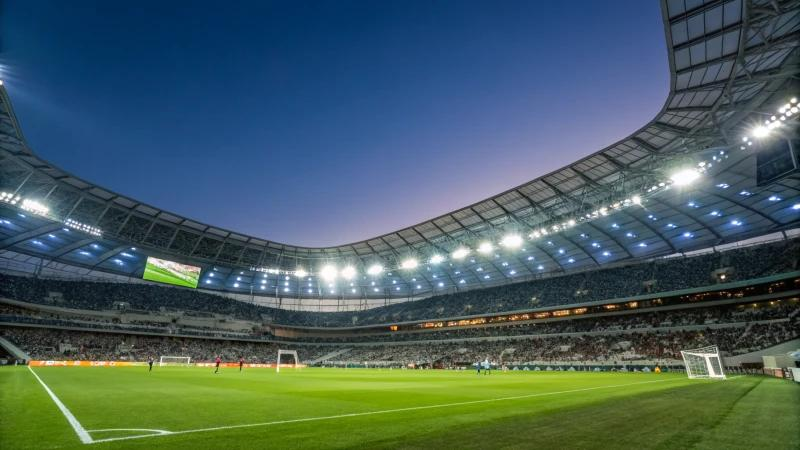
Spill light and glare aren’t just neighbor complaints—they’re liability issues. A poorly designed stadium lighting system can make night games unwatchable for players and dangerous for spectators.
The metric that matters: Unified Glare Rating (UGR). Most suppliers don’t publish this. They should.
For training facilities and community fields, UGR below 22 is acceptable. For professional broadcasts and televised events? UGR below 19 with precise aiming angles.
What actually works:
– Precision optics with beam angles matched to mounting height
– House-side shielding mandatory on any fixture within 50m of residential areas
– Glare testing reports from independent labs, not supplier-provided numbers
Color Rendering: The Broadcast Factor That Drives Spec Decisions
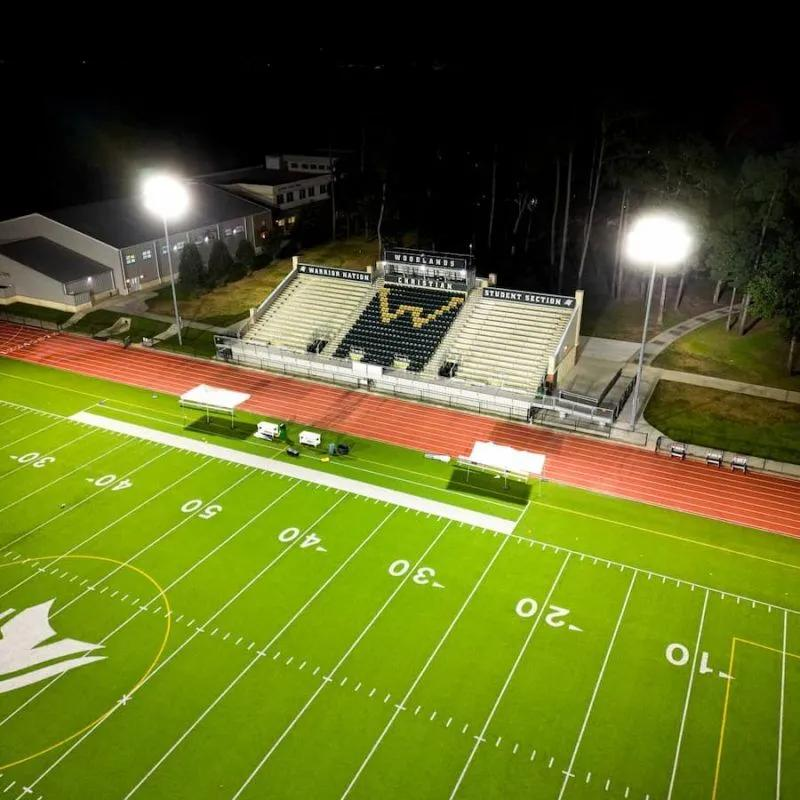
If your venue hosts televised events, color rendering isn’t optional—it’s contractually specified. NFL, NCAA, and international federation broadcasts require:
- CRI (Ra): Minimum 65 for general sports, 80+ for broadcast-quality
- TVI (Television Lighting Consistency Index): Must exceed 85
- CCT: 5600K-6500K for natural daylight simulation
The gap: Most commercial-grade LED fixtures hit CRI 70-75. That works fine for training facilities. For Friday night lights broadcast to 10 million households? You need fixtures specifically engineered for broadcast applications.
Controls That Actually Make Economic Sense
Smart controls on stadium lighting get oversold. Here’s the reality:
What’s genuinely useful:
– Zoning for practice vs. game mode (saves 40-60% on operational costs)
– Remote monitoring for maintenance scheduling
– Dim-to-warm for pre-game atmosphere
– Instant-on capability (metal halide takes 15-20 minutes warm-up)
What’s marketing fluff:
– Full RGB color changing on a pole-mounted sport fixture
– Integration with building management systems you don’t have
– “Predictive maintenance” based on operating hours alone
The ROI math: Controls add 8-15% to fixture cost. At a 200-fixture stadium with $50K annual energy savings, that’s a 3-year payback. Don’t let suppliers upsell you on features your operations team won’t use.
Mounting Heights and Maintenance Reality
Stadium light poles typically run 80-150 feet. Maintenance isn’t optional—it’s a line item that kills poorly-specified projects.
Critical spec language:
– Minimum L70 at 50,000 hours (that’s 12+ years at 10 hours daily)
– Tool-free driver access
– IP65 minimum for all exposed fixtures
– Surge protection built in, not add-on
A fixture that costs $400 less but requires tower climbing every 3 years isn’t cheaper. It’s a budget trap.
The Quanitity vs. Quality Decision
Standard procurement logic: More fixtures at lower cost beats fewer fixtures at premium pricing.
For sports lighting, this breaks down. A proper photometric design typically uses 20-30% fewer fixtures than amateur installations because:
- Higher mounting heights allow wider beam spreads
- Precision optics eliminate overlap waste
- Uniformity requirements drive fixture placement, not price optimization
Get a photometric analysis before you spec quantity. The analysis costs $2,000-5,000. The savings on reduced fixture count and structural load typically exceed $50,000 on medium-sized venues.
What You Should Actually Require From Suppliers
Every RFQ should include:
| Requirement | Standard | Premium |
|---|---|---|
| Warranty | 5 years | 10 years |
| L70 rating | 50,000 hrs | 100,000 hrs |
| Surge protection | 10kV | 20kV |
| Operating temp | -20°C to 45°C | -40°C to 55°C |
| Photometric files | .IES | .IES + AGI32 |
| TM-30 reporting | Optional | Required |
The Procurement Trap That Bites Every Buyer Once
The lowest price bid always has adjustments. Watch for:
- Mounting hardware excluded (adds 15-25% to installation)
- Photometric design quoted separately (should be included)
- Controls as line items (verify what’s actually needed)
- Replacement parts pricing (fixture cost means nothing if drivers cost $800 each)
Get all-inclusive pricing with scope definitions locked before issuing purchase orders. Scope creep on stadium lighting projects routinely adds 30-40% to base bid.
Final Spec Checklist
Before signing any purchase order for sports venue LED:
- [ ] Photometric analysis completed by qualified lighting designer
- [ ] TM-30 color fidelity and chroma shift data provided
- [ ] Thermal testing at actual operating conditions documented
- [ ] UGR calculations for all viewing positions
- [ ] Controls scope defined and validated with operations team
- [ ] Maintenance access method confirmed with installation contractor
- [ ] Warranty terms covering full replacement, not prorated
- [ ] References from minimum three similar installations
Stadium lighting isn’t a fixture purchase—it’s a 20-year infrastructure decision. The spec work upfront determines whether you’re managing a lighting system or managing lighting problems.
Browse YoubeeLight’s commercial LED catalog for verified sport lighting specifications, or connect with our procurement team for project-specific consultation.
