
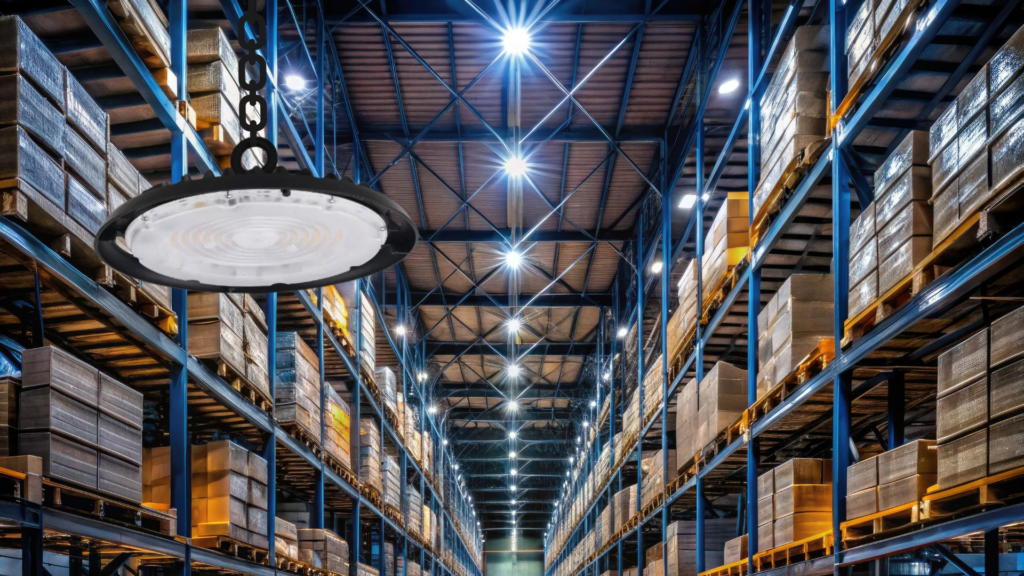
Article 1: The High Bay Lighting Sizing Mistake That Costs You $50K
Why Most Buyers Get High Bay Specs Wrong
I still remember the project in Birmingham where a client spent $48,000 replacing warehouse lights—then called me three months later because workers were complaining about glare and dark spots between fixtures.
The problem wasn’t the fixtures themselves. It was the sizing.
Here’s the uncomfortable truth: most buyers select high bay lights based on wattage alone. They see “400W LED high bay” and assume it will perform like the 400W metal halide they replaced. It won’t. And that assumption costs money.
The real question isn’t “how many watts do I need?” It’s “what’s the mounting height, and what Uniformity ratio do I actually need for this space?”
The Mounting Height Problem Nobody Talks About
High bay typically means ceiling heights above 20 feet. But a 25-foot ceiling and a 40-foot ceiling are completely different animals.
Here’s my rule of thumb after 15 years:
– 20-25 feet: 100-150W LED, 120-140° beam angle
– 25-35 feet: 150-200W LED, 90-120° beam angle
– 35+ feet: 200-400W LED, 60-90° beam angle
Go too wide on beam angle at height, and you get overlap. Go too narrow, and you get shadows.
At 40 feet, we tested a 200W fixture with a 60° beam angle versus the same fixture with a 90° angle. The narrow beam hit 45 foot-candles directly below. The wide beam gave us 28 foot-candles—technically acceptable by code, but workers noticed the difference.

Lumens vs Foot-Candles: Pick One Metric
Here’s where buyers get confused.
Lumens = total light output from the fixture
Foot-candles = light actually hitting the work surface
A fixture might put out 20,000 lumens, but if it’s mounted at 35 feet with a poor beam pattern, you might only get 20 foot-candles on your warehouse floor.
Minimum foot-candle requirements vary by application:
– General warehouse aisles: 10-15 fc
– Active picking zones: 20-30 fc
– Detailed inspection areas: 50+ fc
Always ask your supplier for a photometric layout. A professional supplier should be able to run a DIALux or AGi32 simulation showing you foot-candle distribution before you buy.
We had a project in Rotterdam where the architect specified 30 fc throughout a 30,000 sqm distribution center. The original specification called for 200W fixtures at 25-foot spacing. After photometric review, we adjusted to 150W fixtures at 18-foot spacing. Same target fc, but 25% less energy consumption.
The Spacing-to-Mounting-Height Ratio
This is the formula nobody puts in product listings:
Spacing-to-Height Ratio (SHR) = Distance Between Fixtures / Mounting Height
For uniform lighting without hot spots or dark zones, target SHR between 1.5 and 2.0.
Example:
– Mounting height: 30 feet
– Target SHR: 1.5
– Spacing: 45 feet between fixtures
Most high bay fixtures list a “recommended spacing” without mentioning mounting height. That’s useless. A fixture with “15-foot spacing” at 20 feet mounting is completely different from the same fixture at 30 feet.

Glare: The Complaint That Drives RMA Requests
Workers won’t tell you they’re under-lit. They’ll tell you the lights are “too bright” or “giving headaches.”
That’s glare.
For warehouse environments, target UGR (Unified Glare Rating) below 22. Most standard high bay fixtures with diffusers rate around UGR 19-22. If you need lower glare—say, for detailed assembly work—look for fixtures with frosted lenses or indirect lighting designs.
We lost a project in Munich because the facility manager rejected our initial spec as “too harsh.” The fixtures met all the foot-candle requirements, but the glare was brutal at work station level. We ended up switching to a fixture with a directional lens that pushed more light downward rather than sideways. Same wattage, same lumens, much happier workers.
IP Rating: Don’t Overbuy, But Don’t Underbuy
Warehouse environments are dusty. Sometimes damp.
- Dusty but dry: IP40/IP50 is fine
- Dusty with occasional moisture: IP65
- Wash-down or freeze-proof requirements: IP66/IP67
Over-specifying IP rating adds cost without benefit. Under-specifying creates maintenance nightmares and potential safety issues.
A client in Barcelona insisted on IP67 for their standard warehouse. Within a year, they were dealing with condensation issues inside the fixtures—IP67 traps moisture. We replaced with IP65 units and the problem disappeared.
Final Checklist Before You Buy
- Confirm mounting height – measure it, don’t estimate
- Calculate required foot-candles for your specific application
- Request photometric layout – any supplier who can’t provide one, walk away
- Check SHR ratio – verify fixture spacing works at your mounting height
- Verify UGR if glare is a concern
- Match IP rating to actual environment, not worst-case scenario
The $48,000 lesson from Birmingham taught me one thing: high bay lighting isn’t a commodity. The specification process matters more than the fixture price.
Get the specs right, and you’ll never have to explain to your client why the new lights are worse than the old ones.
Looking for a supplier who runs photometric layouts before you commit? At YoubeeLight, we provide DIALux simulations for every high bay project over 50 fixtures. No guesswork.
For product specs, check our LED catalog covering 100W-400W high bay solutions with detailed photometric data.
