

Direct answer: A luminaire is legal on a California project for two separate reasons: the product must be certified to the California Energy Commission with the full performance data set Title 24 requires — efficacy, power factor, start time, CCT, CRI, R9, flicker, dimming depth and audible noise — and the installed lighting controls must pass documented acceptance testing by a certified technician. A DLC listing satisfies utility rebate programs; it does not satisfy Title 24. Buyers who discover this at plan check usually pay for it twice, once in redesign and once in schedule.
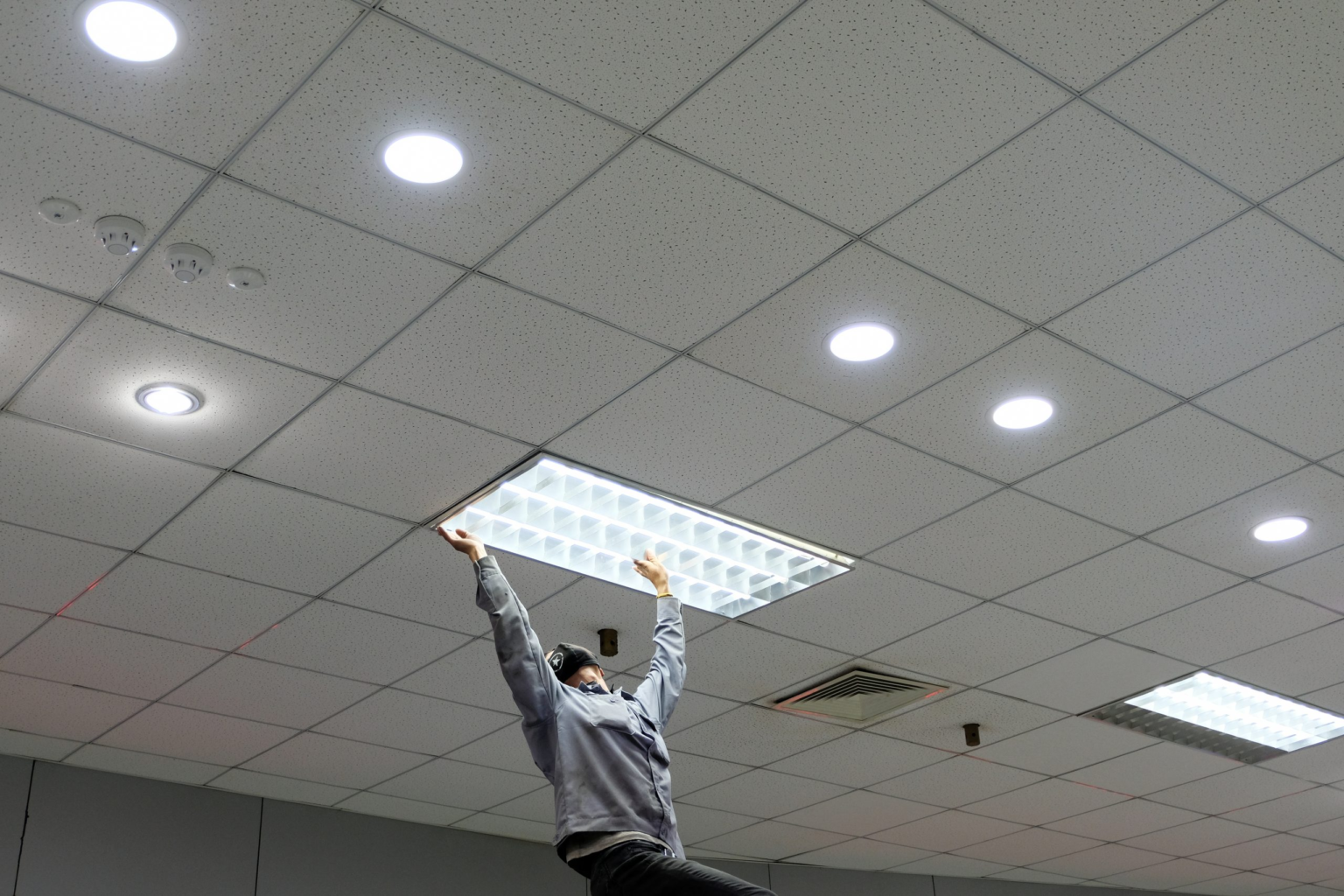
Which part of Title 24 actually touches your luminaire
Title 24 is the California Building Standards Code. Part 6 of it — the Building Energy Efficiency Standards — is written and maintained by the California Energy Commission and updated roughly every three years. The current 2025 standards apply to permit applications submitted on or after January 1, 2026; projects permitted before that date are judged against the 2022 code. Because compliance is enforced by local building departments at plan check and inspection, the code has teeth that most state energy codes never develop.
Lighting requirements live in two places. The standard itself sets mandatory measures and power allowances — Section 130.1 for indoor lighting controls, Section 130.4 for acceptance testing, Section 150.0(k) for residential lighting, Section 140.6 for prescriptive indoor lighting power. The Reference Appendices then define what qualifies: Joint Appendix JA8, “Qualification Requirements for High Efficacy Light Sources,” is the technical specification a light source must meet to count as compliant.
Read JA8.1 carefully, because this is where most sourcing confusion starts: JA8 provides the qualification requirements for high efficacy light sources installed to comply with Section 150.0(k) — the residential lighting section. So JA8 is formally a residential specification. In practice it bleeds into commercial work for three reasons: specifiers copy it into nonresidential jobs as a quality floor because it is the only North American specification that bundles color, flicker, dimming and noise into one certifiable data set; multifamily buildings mix residential and nonresidential provisions depending on the space; and hotel and motel projects pull residential rules into guestrooms. Know which regime your permit falls under before you quote anything.
The JA8 data set: what a compliant product must prove
JA8 is technology-neutral, but in the LED era it functions as a de facto quality specification. A manufacturer must have an NVLAP-accredited laboratory — or one accredited under ISO/IEC 17011 — test the product, then certify the results to the Energy Commission. These are the thresholds as published for the current code cycle:
| JA8 metric | Requirement | Where cheap product fails |
|---|---|---|
| Initial luminous efficacy | At least 45 lm/W | Rarely the failure point — most LED passes easily |
| Power factor at full rated power | At least 0.90 | Cost-cut drivers on small decorative and linear fittings |
| Start time | 0.5 seconds or less | Drivers with slow soft-start routines |
| Correlated color temperature | 4000 K maximum | 5000 K warehouse stock installed in residential spaces |
| CRI | At least 90 (82 for T20 lamps) | Standard 80 CRI modules |
| R9 red rendering | At least 50 | 80 CRI chips almost universally fail this row |
| Minimum dimming level | 10% of output or lower | Drivers that drop out or flash below 20% |
| Flicker (JA10 test method) | Under 30% percent flicker at frequencies of 200 Hz and below, at both 100% and 20% output | Low-cost drivers with high amplitude modulation at low dim levels |
| Audible noise | 24 dBA or less at 100% and 20% output | Transformer and driver hum in quiet rooms |
Every one of those numbers must be filed with the Commission, and the certification is signed under penalty of perjury under California law. That is not a marketing claim you can walk back.
Marking rules buyers misread
Compliant products must be physically marked per Section JA8.5. The current designations read JA8-2022, with JA8-2022-E marking products that additionally passed the elevated-temperature life test required for light sources installed in enclosed or recessed luminaires. Inspectors look for this mark on the product, not in the catalog. Older stock marked JA8-2016 or JA8-2019 still circulates in distribution, and version mismatches are a recurring reason a substitution gets rejected.
Three installation rules trip up projects repeatedly. Recessed downlight housings must be insulation-contact rated and gasketed or caulked where the housing meets the ceiling, and recessed downlights may not use screw bases. Screw-base luminaires must arrive with JA8-certified lamps already installed, because that is how the inspector will see it. And the 2025 code cycle also tightened residential control requirements — sensing controls in bathrooms, garages, laundry rooms and utility rooms, dimming control where JA8 dimmable fixtures are installed in living spaces, and photocontrol plus motion sensing or time-clock control outdoors.
Certification lives in a state database, not on the carton
The Energy Commission maintains the public database of certified appliances and light sources, and building departments verify compliance against that listing. The manufacturer must keep all underlying test data for at least two years from the certification date and produce copies to the Commission within ten days of a written request. Two consequences follow. First, a model number must match exactly — a “same family, different SKU” answer does not survive plan check. Second, Title 20, the Appliance Efficiency Regulations, overlaps this territory: a lamp can be Title 20 compliant and still not be JA8 certified, so the two listings have to be checked separately.
Nonresidential projects: the fixture passes, the controls decide
Above the residential line, Title 24 cares less about the luminaire’s color numbers and more about how the lighting behaves. Every nonresidential project carries mandatory control requirements regardless of the compliance path chosen: manual on-off control for each space, multilevel control, automatic shutoff, daylight-responsive control in daylit zones, and demand-responsive controls in larger buildings. The multilevel requirement deserves attention at procurement time — the 2025 code expects continuous dimming from 100% down to 10% of lighting power, with a step-based exception only for HID and induction sources. That effectively writes 0-10V or digital dimming into the driver specification for most projects.
The 2025 cycle tightened the rest of the frame as well: lighting power allowances dropped roughly five percent across many nonresidential space types, the old Tailored Method compliance path was removed and folded into the area category allowances, the daylight-zone threshold was lowered, and demand response controls must meet a qualifying communications standard. None of this changes what is printed on a spec sheet’s front page — it changes what the controls must be able to do after installation.
Acceptance testing is where finished projects fail
Section 130.4 requires acceptance testing of installed lighting controls, with the procedures in Reference Nonresidential Appendix NA7.6 covering shutoff controls, occupant sensing, daylighting controls, demand response and institutional tuning. When required under Title 24 Part 1, Section 10-103.1, those tests must be performed by a Certified Lighting Controls Acceptance Test Technician — trained, examined and certified by a Commission-approved provider — and the certificate of acceptance is signed and filed with the enforcing agency. Occupant sensing controls, for example, are documented on form NRCA-LTI-02-A, and the functional test checks that the sensor turns lighting off at a time delay no greater than 20 minutes and that partial-on control activates between 50 and 70 percent of controlled power.
For a fixture supplier, the practical meaning is blunt: your driver has to be commissionable. The technician must be able to verify dimming behavior, sensor settings and shutoff response on your hardware. Drivers with undocumented dimming curves, sensors whose time delay cannot be set below 20 minutes, or fixtures that cannot report their state will surface as acceptance test failures — after the ceiling is closed and the schedule is gone.
Why a DLC Premium listing does not make a fixture Title 24 compliant
The DLC Qualified Products List and the CEC certification database answer different questions, and confusing them is expensive. DLC exists because utility rebate programs need a screening mechanism for energy performance; the CEC database exists because California law requires it. The data sets barely overlap.
| Question | DLC QPL | CEC / Title 24 JA8 |
|---|---|---|
| Who runs it | A utility consortium | The California Energy Commission, by statute |
| What it screens | Efficacy and quality metrics for incentive eligibility | The full JA8 data set, certified under penalty of perjury |
| Flicker, audible noise, R9, start time, minimum dimming | Not part of the listing | Required filing data |
| Controls acceptance testing | Out of scope | Section 130.4 / NA7.6, mandatory where triggered |
| Consequence of absence | You lose the rebate | The installation does not pass inspection |
A fixture can sit in DLC Premium with a strong efficacy number and still carry a driver that fails the JA8 flicker limit at 20% output, or an R9 of 12. Conversely, a JA8-certified residential downlight tells you nothing about whether it belongs in a DLC-listed commercial retrofit. Ask for each listing by name, for the exact model number, every time.
A pre-order checklist for California projects
- Pull up the CEC listing yourself and match the full model number, not the product family.
- Get the JA8 data set in writing: power factor, flicker results, R9, start time, minimum dimming level, audible noise.
- Confirm the physical marking version — JA8-2022 or JA8-2022-E on current production, and watch for older markings on stock.
- For anything dimmed or sensor-controlled, demand the driver protocol and dimming curve documentation that an acceptance test technician will need.
- Pin down which code cycle your permit date triggers before you price the job.
Power factor is a good example of why the checklist matters. A driver that scrapes past 0.90 at full load and collapses at partial load will pass a casual spec review and then fail the acceptance test on a dimmed circuit — the same failure mode we cover in depth in LED Power Factor: The Invisible Spec That’s Silently Costing Your Commercial Project Thousands.
Frequently asked questions
Does JA8 apply to commercial office lighting?
Not formally. JA8 is the qualification spec for residential high-efficacy lighting under Section 150.0(k). Nonresidential projects are governed by the controls, acceptance testing and lighting power provisions instead. Specifiers increasingly write JA8 compliance into nonresidential documents anyway, as a shorthand quality floor, so treat it as a specification question, not a code question.
Is DLC Premium equivalent to JA8 certification?
No. DLC listing screens products for utility incentive programs; JA8 certification is a statutory filing with the California Energy Commission covering flicker, noise, color rendering, dimming and more. A product can hold one, both, or neither.
What does the E in JA8-2022-E mean?
The product passed the elevated-temperature life test for light sources intended for enclosed or recessed luminaires, where heat buildup is worst. If your fixture is enclosed or recessed, the E designation is the one to demand.
Who is allowed to sign the lighting controls acceptance test?
Where certification is required, a Certified Lighting Controls Acceptance Test Technician who holds a certification number from a Commission-approved provider, typically working under a certified acceptance test employer. Field technicians can gather the data, but the responsible person signing the certificate carries the license and the liability.
Does swapping lamps in an existing California building trigger Title 24?
Alterations can trigger code requirements even in decades-old buildings, and the scope depends on what the permit covers. A lighting alteration that touches controls or circuits usually pulls in current-cycle requirements, so check with the building department before quoting a retrofit as a simple lamp swap.
This article is a procurement guide, not legal advice. Confirm requirements for your specific product and market with a qualified compliance provider.
