
Direct answer: For a building with a few dozen emergency points, integral battery backup is almost always cheaper over ten years. For large floor plates and high-rise buildings with hundreds of emergency luminaires, a central inverter wins on testing labor and battery replacement, which are the two cost lines that actually dominate the decade. Unit price is the smallest line in this comparison; the architecture decision should be made from the testing walk schedule and the replacement calendar, not the fixture quote.
Two architectures, defined precisely
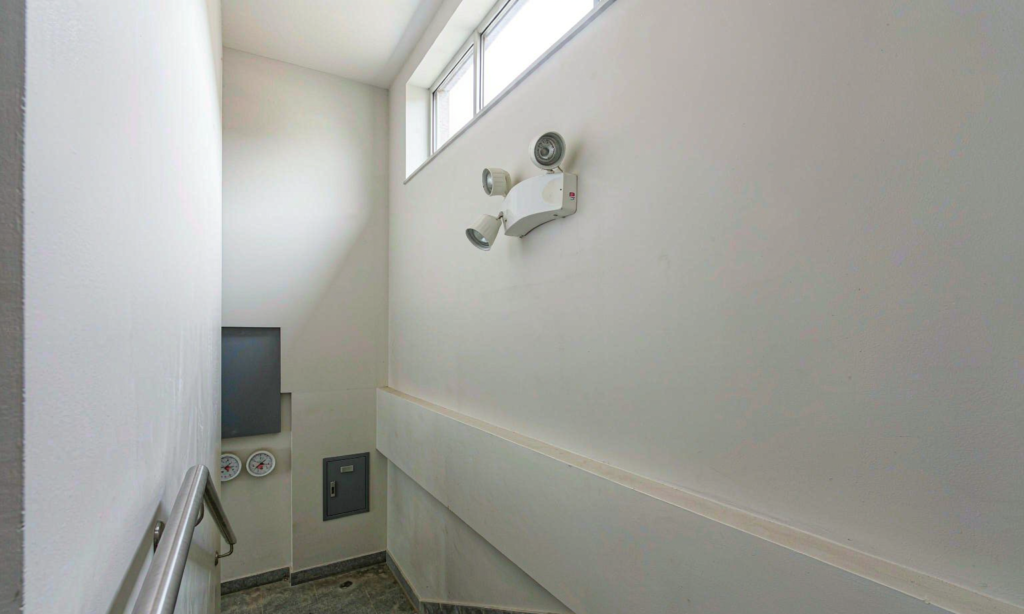
A self-contained emergency luminaire, called unit equipment in the NEC, carries its own battery, charger, and changeover relay inside the housing. When normal power drops, the fitting transfers itself to battery and runs its own lamp for the rated duration. Each unit is listed as an independent power source, typically to UL 924 in North America.
A central inverter, or central battery system, keeps one battery bank and one inverter in a dedicated space and feeds designated emergency circuits throughout the building. The luminaires on those circuits can be ordinary drivers, because the emergency capability lives upstream. A third, hybrid arrangement uses a listed automatic transfer device to switch a normal circuit onto an emergency source, which is common when a generator rather than an inverter provides the backup.
The code floor both must clear
The architecture choice never lowers the performance floor; it only changes who has to deliver it. In the United States, IBC Section 1008 and NFPA 101 require emergency illumination for at least 90 minutes after loss of normal power, reaching an initial average of at least 1 footcandle along the egress path with no point below 0.1 footcandle, and permitted to decline to about 0.6 footcandle average and 0.06 footcandle minimum at the end of the 90 minutes. Illumination must come on within 10 seconds. Under NEC 700.12, battery supplies and unit equipment must sustain the connected load for at least 90 minutes without battery voltage falling below 87.5 percent of nominal, and unit equipment must be fed from the same branch circuit as the normal lighting in the area, ahead of any local switch, so a tripped room breaker actually triggers the backup.
In Europe, EN 1838 sets the performance targets: at least 1 lux on the floor along the escape route center line, at least 0.5 lux in anti-panic open areas excluding a 0.5 meter perimeter band, and 10 percent of normal illuminance or 15 lux, whichever is greater, in high-risk task areas. The route must reach 50 percent of required illuminance within 5 seconds and full illuminance within 60 seconds. EN 50172 governs the system side, requiring a monthly function test and an annual full-duration test with a logbook, and the luminaire product standard IEC 60598-2-22 expects batteries to recover their rated duration within 24 hours of recharge.
| Requirement | United States (NFPA 101 / IBC / NEC 700) | Europe (EN 1838 / EN 50172) |
|---|---|---|
| Duration | At least 90 minutes | At least 1 hour; 3 hours is the common national default |
| Transfer or response | Illumination within 10 seconds | 50 percent within 5 s, full within 60 s |
| Illuminance | 1 fc average / 0.1 fc minimum initially, decaying to 0.6 / 0.06 fc | 1 lux escape route center line, 0.5 lux anti-panic areas |
| Testing | Monthly 30-second functional test plus annual 90-minute discharge, written records for the AHJ | Monthly function test plus annual full-duration test, logbook retained |
| Equipment listing | UL 924 for unit equipment and inverters | IEC 60598-2-22 for self-contained luminaires |
Two NEC provisions shape the central option specifically. Emergency wiring must be kept entirely independent of all other wiring with narrow exceptions under 700.10(B), and in tall or large-occupancy buildings, generally those above 75 feet, assembly occupancies for 1,000 or more persons, and educational occupancies above 300 occupants, emergency feeder wiring must achieve a 2-hour fire rating through one of the methods listed in 700.10(D). Those feeder requirements are real money, and they attach to the central architecture.
Where integral battery backup wins
Integral units spread the risk. Each fitting is its own power system, so one failed battery darkens one fixture, not a corridor. Installation is simple: no dedicated battery room, no fire-rated feeders, no separate distribution design, and the fixture lands on the same branch circuit as the room lighting, which the code wants anyway. For small retail, restaurants, offices, and single-tenant industrial buildings where the emergency count runs in the tens, integral backup with self-test diagnostics is the pragmatic default, and battery swaps happen fixture by fixture on a rolling schedule instead of all at once.
Where a central inverter wins
Scale flips the economics. A hospital, airport terminal, high-rise office, or large distribution center can carry several hundred emergency points. Walk-testing 300 integral fittings every month, then discharging every one of them for 90 minutes each year, consumes real labor, and that labor repeats every year for the life of the building. A central inverter replaces all of that with one panel to test, one battery bank to replace on a single schedule, and one monitoring point that can log results automatically and feed the building management system. It also lets ordinary, better-quality luminaires serve as emergency fixtures, which matters where the architect rejects wall-mounted twin-head units.
The costs of centrality are a larger first outlay, dedicated space with ventilation, a genuine single point of failure unless the design includes redundancy, and, in tall buildings, the 2-hour fire-rated feeder work described above. Central systems also concentrate chemistry: the bank ages out all at once.
The ten-year cost stack
Published price ranges vary by region and specification, so treat the figures below as order-of-magnitude planning numbers rather than quotes.
| Cost line | Integral battery backup | Central inverter |
|---|---|---|
| Equipment first cost | Self-contained units commonly quoted from roughly 80 to 250 dollars each, with the battery included | Cabinets commonly quoted from roughly 2,000 to 15,000 dollars feeding tens to around a hundred heads, plus the normal luminaires |
| Installation | Wire like a normal fixture, same branch circuit, no special room | Dedicated ventilated space, independent emergency wiring, possible 2-hour rated feeders in tall buildings |
| Monthly testing | Every fitting walked and logged, one by one, forever | One panel check; automated monitoring can collapse this to a report review |
| Annual discharge test | 90 minutes at every single fitting, plus the walk to verify each one | One 90-minute system test at the inverter |
| Battery replacement | Rolling replacement per fixture on roughly 3 to 5 year cycles for sealed lead-acid | One bank on a single schedule; lithium systems stretch the interval substantially |
| Failure exposure | Localized; a dead battery affects one point | Concentrated; an inverter fault can darken many points at once unless designed with redundancy |
Battery chemistry decides the maintenance bill
Most integral units still ship with sealed lead-acid or NiCd packs. Sealed lead-acid typically delivers three to five years of service at a moderate 25 degrees Celsius ambient, and heat is the killer: a battery that lives in a hot ceiling plenum or an unventilated electrical room can lose half its life for a rise of well under ten degrees. NiCd tolerates cold down to around minus 20 degrees and ages more gracefully, which is why cold stores specify it. Lithium-based packs, increasingly common on premium units, are typically quoted at seven to ten years or more, and central inverter batteries on lithium chemistry are marketed with service lives well beyond traditional VRLA strings. Lead-acid and NiCd are hazardous waste with recycling obligations, so the disposal receipt belongs in the project file.
One recharge detail catches facility managers on both architectures: after the annual full-duration test, the batteries need up to 24 hours to recover their rated duration. A building discharged at mid-morning runs with degraded emergency cover for the rest of that day, so schedule the annual test when the building is least occupied.
Testing burden, self-test, and the paperwork
NFPA 101 Section 7.9.3 sets the American rhythm: a functional test of at least 30 seconds every month and a full 90-minute discharge every 12 months, with written records available to the authority having jurisdiction. Multiply a manual regimen across 300 fittings and the arithmetic is brutal. This is why self-test diagnostics are now standard on quality units: the fitting runs its own function test and reports by LED status, or, on addressable systems, reports centrally. DALI emergency variants push test scheduling, result logging, and fault reporting into one addressable loop, which we compare in DALI-2 and D4i certification. The logbook obligation does not disappear with self-test, but the labor to satisfy it drops by an order of magnitude.
A decision framework by building type
| Building type | Emergency points, typical | Better fit | Why |
|---|---|---|---|
| Small retail or restaurant | Tens | Integral, self-test | Lowest first cost, no special space, failures stay local |
| Single-tenant office | Tens to low hundreds | Integral with self-test or addressable reporting | Testing labor manageable with automation |
| Warehouse, few routes | Low tens | Integral | High-bay fittings with integral packs avoid remote-head wiring |
| Hospital or care facility | Hundreds | Central | Continuous occupancy, strict logging, one battery bank to maintain |
| High-rise office | Hundreds | Central | Feeder fire-rating rules and centralized monitoring favor it; integral packs remain for local coverage |
| Airport, mall, campus | Many hundreds | Central, often with redundancy | Testing labor at this scale is the dominant lifetime cost |
Mixed architectures are legitimate and common: a central inverter serving the corridors and stairs, integral packs covering remote outbuildings or spaces beyond practical circuit reach. The AHJ cares that every point meets the performance floor, not that the building chose one team.
Frequently asked questions
How often do integral emergency batteries need replacing?
Sealed lead-acid packs typically last three to five years at moderate ambient, less in hot ceilings. A failed annual 90-minute duration test mandates immediate replacement, and the monthly function test only proves the fitting switches on, not that it will still be lit at minute ninety.
Does a central inverter mean the luminaires need no emergency listing?
The inverter itself must still be listed for emergency use, and any remote heads or transfer devices must carry their own listings. What changes is that the luminaires fed by the inverter can be ordinary drivers, because the listed emergency capability lives in the upstream equipment.
What size building justifies a central inverter?
A useful planning threshold is the point where monthly manual testing becomes a scheduled labor line: commonly somewhere around a hundred or more emergency points, or large floor plates where many fittings sit on a handful of egress routes. Below that, integral units with self-test usually cost less over ten years.
Can integral units and a central system coexist in one building?
Yes. Mixed architectures are routine, for example a central inverter on the core egress routes with self-contained packs in remote areas. Each part of the installation must independently meet the duration, illuminance, and testing requirements, and the wiring must follow the rules for whichever source feeds it.
Who performs the monthly and annual tests?
The building owner is responsible under the fire code, and the work is typically delegated to facility staff or a maintenance contractor. Whoever does it, the written records, monthly and annual, are what the authority having jurisdiction will ask to see.
