
Unified Glare Rating: The Spec That Determines Whether Your Office Lighting Is Legal in Europe
Most commercial lighting buyers I work with know their way around CCT, CRI, and lumens. They’ll argue for 20 minutes about whether 4000K or 3500K looks better, and they’ll hold out for CRI 90+ on a retail project without blinking. But ask them what UGR their fixture hits, and you get a blank stare.
Unified Glare Rating — UGR — is one of the most misunderstood and most frequently ignored specs in commercial LED lighting. And in Europe, it can literally determine whether your installation passes inspection or gets flagged for rework.
I’ve seen it happen. A UK office fit-out project — 4,000m², £800,000 lighting package — failed building regulations because nobody had verified the UGR of the specified downlights. The solution: rip out 600 fixtures and replace them with units that had proper indirect lighting diffusers. Cost to the contractor: £180,000 and a three-week delay. All because nobody asked a simple question during the specification phase.
What UGR Actually Measures (And Why It Matters More Than Your Spec Sheet Lumens)
UGR was developed by the International Commission on Illumination (CIE) to quantify the discomfort glare experienced by occupants in a given lighting installation. It’s not about whether the light is bright — it’s about whether the light source appears uncomfortably bright relative to its surrounding background, creating visual discomfort.
The UGR scale runs from 5 to 40:
– < 13: Imperceptible — only in very specific optical labs
– 13–16: Just noticeable discomfort — acceptable for some task areas
– 16–19: Noticeable but generally acceptable for most office work — this is the common spec target
– 19–22: Distinct discomfort — problematic for prolonged computer work
– 22–25: Strong discomfort — unacceptable for office environments
– > 25: Intolerable — will cause headaches and rapid fatigue
The European standard EN 12464-1 mandates UGR ≤ 19 for most office and educational tasks. Most building inspectors in the EU will fail an installation that exceeds UGR 19 in computer workstations. This isn’t optional guidance — in many jurisdictions, it’s a hard compliance requirement.
Here’s what most buyers miss: UGR isn’t a fixture spec, it’s a system spec. A fixture with a low listed UGR can still create high glare in an actual installation depending on mounting height, spacing, room surface reflectance, and task surface brightness. You calculate the installed UGR, not just read it off a datasheet.
The UGR formula is:
UGR = 8 log₁₀ (0.25 × Σ (L² × ω) / Lb²)
Where:
– L = luminance of each light source (cd/m²)
– ω = solid angle of the light source as seen by the observer (steradians)
– Lb = background luminance (cd/m²)
In plain English: the more bright spots you have in your field of view, the higher the glare. A single high-luminance downlight directly above a monitor creates significant glare. The same total light output distributed as a large, low-luminance panel creates almost none.
Why LED Makes UGR Problems Worse (And Why Most Specifiers Don’t Realize It)
Traditional fluorescent fixtures distribute light uniformly across a large surface area. Even a 2×4 fluorescent troffer might have a surface area of 2,000cm², which naturally diffuses the light and keeps individual luminance values low.
A typical LED downlight, by contrast, concentrates its output through a small lens or reflector — often less than 100cm². The luminance values at the LED chip level can exceed 1,000,000 cd/m². Even with an opal diffuser, you’re working with a much smaller, higher-intensity light source.
The result: LED downlights that “look fine” at floor level can create significant UGR issues at desk height. I’ve measured UGR values of 22–25 in offices that used bare LED downlights without proper diffusers or indirect lighting components.
This is particularly acute in modern offices with exposed ceilings and suspended LED fixtures. The trend toward minimal, industrial-style ceiling aesthetics has directly conflicted with the need to control glare — and most interior designers prioritizing aesthetics never ask the lighting engineer to verify UGR compliance.
In one project I reviewed — a Berlin co-working space — the architect specified exposed track lighting with bare reflector fixtures throughout a 600m² open-plan office. The space looked stunning in the renders. The UGR measured at workstation height: 23–26. The client’s employees started complaining about eye strain within two weeks of occupation. The fix — adding opal diffusers and supplemental indirect linear fixtures — cost €45,000 and completely changed the aesthetic the architect had designed around.
The UGR Categories That Actually Matter for Your Project
Different spaces have different UGR requirements. Here’s what the standards actually say, and what it means for your fixture selection:
UGR ≤ 16 — Required for detailed visual tasks with high accuracy requirements: electronic workshops, drawing studios, inspection areas, precision assembly. If you’re lighting a quality control area or a design studio, don’t accept anything above 16.
UGR ≤ 19 — The standard for general office work, computer workstations, classrooms, conference rooms. This is the floor for any commercial project in Europe. If your fixtures can’t be validated to hit ≤ 19 at the installation’s working plane, they’re not suitable for office use.
UGR 19–22 — Acceptable for some circulation areas, corridors, stairways, and storage. Not acceptable for any space where people work for extended periods at computer screens.
UGR 22+ — Storage areas, plant rooms, and outdoor lighting only.
The practical problem: most Chinese LED fixtures sold as “office lighting” have datasheets that either don’t list UGR at all, or list theoretical UGR values calculated for idealized conditions (dark ceiling, light walls, standard room geometry) that don’t match real-world installations.
I always ask suppliers for IES LM-79 photometric data — the full photometric file with goniometer measurements — so I can run the UGR calculation in software like DIALux or AGi32 with the actual room geometry. A fixture that’s UGR 16 in a dark-room calculation might be UGR 22 in a bright, open-plan office with white ceilings and light-colored furniture.
How to Read a UGR Datasheet Without Getting Fooled
If a supplier provides UGR data, here’s what to look for:
The measurement conditions: UGR tables in datasheets are typically calculated for specific room dimensions, surface reflectances, and mounting heights. Common reference conditions are rooms like 4H/2H/2.5m (room height, room width, desk height). If the supplier’s UGR value doesn’t specify the reference room, be suspicious. A fixture rated “UGR < 19” might be calculated for a 4H x 4H room — in a wider, shorter room with the same fixture, the UGR could be substantially higher.
Spacing-to-height ratio (SHR): UGR is highly dependent on fixture spacing relative to mounting height. Many datasheets show UGR at the “nominal” SHR (typically 1.5 for many downlights). If you’re spacing fixtures more widely — which buyers often do to reduce fixture count and cost — UGR increases. Ask for UGR data at your actual planned spacing.
Multiple UGR values for different configurations: Good datasheets will show UGR for a range of room sizes and spacings. If you only see one UGR number with no conditions attached, request the full table.
Direct vs. indirect components: For fixtures that provide both direct (downward) and indirect (upward reflected) lighting, the indirect component significantly reduces UGR. A linear pendant with an upward light component will always score better on UGR than a bare downlight delivering the same downward light.
Here’s a practical example: a 40W LED panel (600x600mm) mounted flush in a standard 2.7m ceiling office typically produces UGR of 16–18 depending on room reflectivity. The same panel mounted as a suspended indirect fixture (with 30% upward light) can achieve UGR of 13–15 with equivalent or better task illumination. The indirect component dilutes the luminance contrast that causes glare.
Real Project: What UGR Failure Actually Costs
Let me give you a concrete example from a project I consulted on last year.
A Scandinavian office building developer was sourcing LED fixtures for a 12,000m² new-build project across three floors. Their procurement team had sourced what appeared to be a competitive offer: a European brand fixture at €62 per unit, compared to a Chinese-manufactured alternative at €38 per unit.
The European brand’s datasheet showed UGR < 19 for their reference room. The Chinese fixture didn’t provide UGR data at all — when pressed, the supplier said “it’s similar.” The developer went with the cheaper option to save approximately €288,000 across 8,000 fixtures.
On the first floor, during pre-occupancy testing, a third-party lighting engineer measured UGR of 22–24 at workstation height. The fixtures were rejected. The developer ended up spending €340,000 on replacement fixtures from the original European brand — plus €90,000 in delay costs and re-commissioning fees. Total extra cost: €430,000, versus the €288,000 they thought they were saving.
The lesson: UGR non-compliance isn’t a small risk. In regulated European markets, it’s a contract-level compliance failure that your client can demand you rectify at your cost.
How to Specify UGR Compliance Without Limiting Your Options
Here’s my practical framework for ensuring UGR compliance when sourcing fixtures for European projects:
Step 1: Define your room geometry first. Before you select a fixture, have the architect or lighting designer provide the actual room dimensions, surface reflectances, and workstation layout. You can’t validate UGR without this data.
Step 2: Request UGR data from every supplier. The minimum acceptable response: UGR values for the standard CIE reference rooms (4H/2H, 4H/4H, 8H/4H) at nominal spacing. The ideal response: a full IES/LDT photometric file so you can run calculations in DIALux or AGi32 with actual room geometry.
Step 3: Validate the claims. Run the photometric file through DIALux evo — it’s free software that calculates installed UGR accurately. If the supplier’s UGR < 19 claim doesn’t hold up in the actual room geometry, you know before you order.
Step 4: Get it in writing. Add a UGR compliance clause to your purchase specification: “All fixtures for computer workstation areas shall be validated to produce installed UGR ≤ 19 per EN 12464-1 at the specified mounting height, room geometry, and spacing.” This gives you contractual recourse if the fixtures don’t perform.
Step 5: Test samples. On large projects (1,000+ fixtures), order samples and measure UGR with a luminance meter before committing to a full order. A €500 sample test can prevent a €400,000 mistake.
The UGR Myth I See Most Often
There’s a persistent misconception in the market that “lower CCT” or “warmer color temperature” fixtures produce lower UGR. This is wrong.
UGR is purely a function of luminance and solid angle — it has nothing to do with color temperature. A 3000K LED downlight and a 5000K LED downlight with identical optical properties will produce identical UGR values.
What does affect UGR is luminaire surface area at a given output. A fixture with a large diffuser surface (like a panel light or linear indirect pendant) will always produce lower UGR than a fixture with a small light-emitting surface (like a high-output LED downlight with a narrow reflector), even at the same total light output and same CCT.
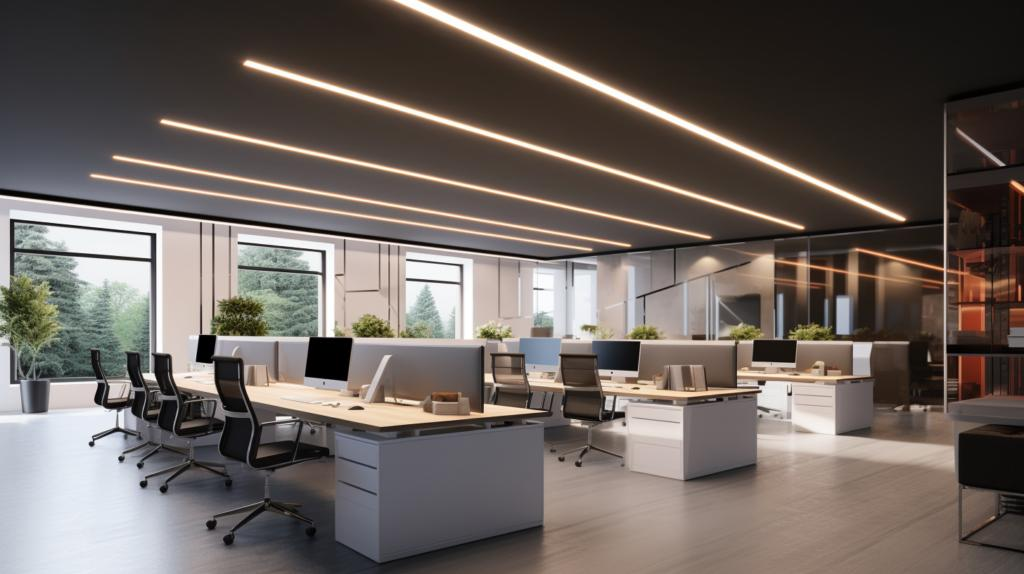
This is why I consistently recommend linear indirect lighting systems for open-plan offices where UGR compliance is critical. The elongated, large-surface pendant creates a wide, low-luminance luminous element that scores far better on UGR than any downlight array — regardless of how good the downlight’s optics are.
What This Means for Your Sourcing Decisions
If you’re buying LED fixtures for European commercial projects and you’re not checking UGR, you’re taking on significant risk that your installation could fail inspection — at your cost.
My advice: make UGR validation a standard part of your fixture specification process, not an afterthought. For projects in Germany, Scandinavia, or the Netherlands — where building inspectors actively check for EN 12464-1 compliance — this isn’t optional.
At YoubeeLight, we provide full UGR data for all commercial-grade fixtures, including IES photometric files and validated UGR calculations for standard European room geometries. For projects where UGR compliance is critical, we can also provide mock-up testing data from independent labs. Because the cheapest fixture that fails inspection is the most expensive fixture in your project.
The spec sheet that doesn’t mention UGR isn’t giving you complete information — it’s giving you plausible deniability. Don’t accept it.
