
Direct answer: The lux figure in a lighting standard is a maintained value, not a measurement on day one. It is the floor the installation must never drop below, which means the design has to start higher by the inverse of the maintenance factor. When a supplier’s lumen depreciation assumption is optimistic, the design passes at handover, the photometric report looks compliant, and the space falls below the required level years later – usually after the retention payment has been released.
This is the least glamorous failure mode in commercial lighting, and one of the most common. Nobody argues about it at tender stage: the assumption sits in a single cell of a calculation sheet nobody opens.
The number in the standard is a floor, not a target
EN 12464-1:2021 specifies maintained illuminance. Its values must not be undercut at any point during the operating period, which is why the standard also requires the designer to state the maintenance factor and the assumptions behind it. The relationship is unforgiving: initial illuminance equals maintained illuminance divided by the maintenance factor.
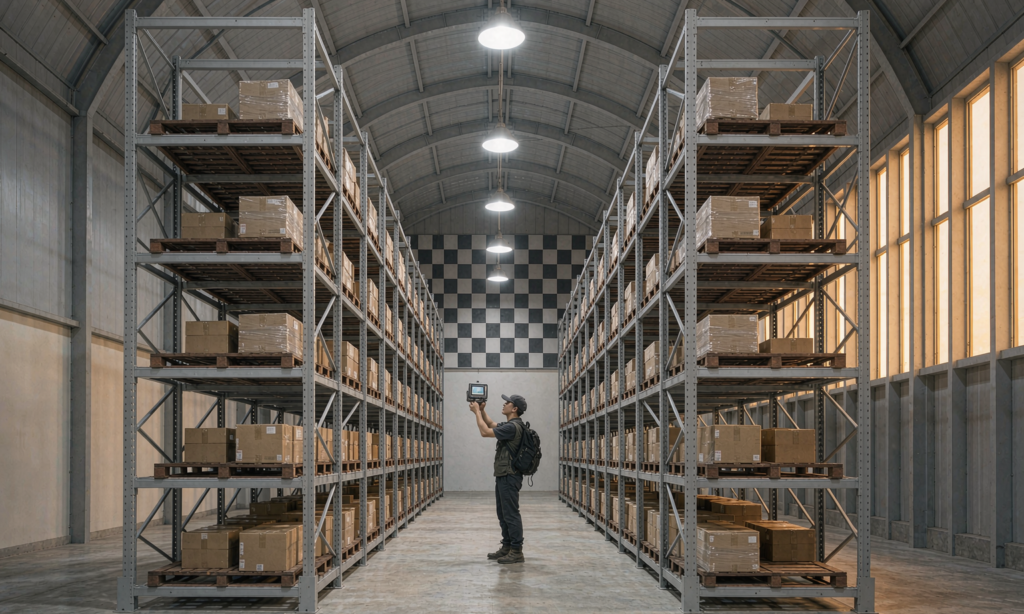
A 300 lx packing area with a maintenance factor of 0.80 has to be designed at 375 lx. With a factor of 0.60, the same area needs 500 lx of installed performance. Same standard, same room, same target – a 33% difference in fixture count, driven entirely by an assumption.
North American practice uses the same arithmetic under different names: light loss factor built from lamp lumen depreciation, luminaire dirt depreciation and room surface dirt depreciation. IES RP-20 and RP-1 treat it the same way. The terminology changes at the border; the trap does not.
The four factors inside the maintenance factor
In the European framework the maintenance factor is the product of four terms. Each has a different owner, and each can be argued down on a datasheet.
| Factor | What it accounts for | Range to expect | Who really controls it |
|---|---|---|---|
| LLMF – lamp lumen maintenance | Output decay of the LED module over the maintenance cycle | 0.80-0.95 over a 50,000 h cycle | Module quality and drive current; verified by LM-80 data at the in-situ temperature |
| LSF – lamp survival | Units that fail and are not immediately replaced | 0.95-1.00 with group relamping | Driver quality and the maintenance regime |
| LMF – luminaire maintenance | Dirt on the lens, reflector or diffuser between cleans | 0.85-0.95 with IP-rated optics and a two-year clean | IP rating, optic geometry, cleaning interval |
| RSMF – room surface maintenance | Loss of reflectance on walls, ceiling and racking | 0.90-0.98 | Environment and housekeeping, not the fixture |
Those are design ranges, not standard values. The standard does not prescribe them; it requires the designer to declare them. That is exactly why they are worth interrogating in a tender: an undeclared assumption is an unpriced risk.
As a sanity check, published guidance for reference maintenance factors sits around 0.80 for clean interiors, 0.67 for normal conditions and 0.50 for dirty ones. If a calculation for a foundry or a cement plant uses 0.80, the number was chosen to win the job, not to describe the building.
What L70 hides, and why it is the wrong number for design
L70 means the point where output reaches 70% of initial. It is a reporting convention, not a failure point, and not the number a lighting design needs. A design with a 50,000 hour maintenance cycle needs the depreciation at the end of that cycle – the LLMF – not the hour at which output happens to cross 70%.
The difference matters because of how the number is produced. IES LM-80 measures lumen maintenance of the LED package at controlled case temperatures, typically 55 C, 85 C and a third manufacturer-selected point, over a minimum of 6,000 hours with 10,000 preferred, sampled at least every 1,000 hours. IES TM-21 then projects that data, and the projection is capped at six times the test duration. Six thousand hours of data supports L70(6k) greater than 36,000 hours – not 50,000, and certainly not 100,000.
So a datasheet reading “L70 50,000 hours” is either backed by at least 8,333 hours of LM-80 data, or it is a number TM-21 does not support. The notation tells you which: L70(6k) and L70(10k) are different claims with different confidence, and the DLC submission requires the worksheet, not the marketing line.
There is a second layer. LM-80 tests the package, not the luminaire. The temperature that selects which LM-80 curve applies is measured inside your housing by an in-situ temperature measurement test. If the real measurement point runs hotter than the tested condition, the projection is not valid for that fixture, however good the LED is. For the reliability side of these ratings, our piece on L70 and B50 ratings goes deeper; this article stays on the design number.
Which document supports which claim
| Document | What it establishes | What it cannot tell you |
|---|---|---|
| IES LM-79-19 | Whole-luminaire flux, efficacy, chromaticity, CRI at time zero | Nothing about time; it is a single-point measurement |
| IES LM-80-15 | Package-level flux maintenance at controlled case temperatures, 6,000 h minimum | Nothing about your housing, driver or ambient |
| ISTMT | The actual temperature measurement point inside the luminaire | Nothing on its own; it selects the LM-80 dataset |
| IES TM-21 | Projection of LM-80 data to L70/L80/L90, capped at 6x the test duration | A luminaire lifetime; driver and optical losses sit outside it |
| IES LM-84 | Luminaire-level flux and colour maintenance over time | Nothing quickly; it takes months of test time |
| IES TM-28 | Projection of LM-84 data at luminaire level | Nothing about the room or the maintenance regime |
The DLC accepts either route: LM-80 plus ISTMT plus a TM-21 worksheet, or LM-84 plus a TM-28 worksheet. Both are legitimate. What is not legitimate is a TM-21 projection from a package tested at a case temperature your fixture never reaches.
A worked example: 12,000 m2 of warehouse
Take a 12,000 m2 distribution centre with a packing and sorting area that has to hold 300 lx maintained, a utilisation factor of 0.65, and 20,000 lm high bays. Two maintenance factors are submitted for the same building.
| Assumption | Optimistic submission | Realistic submission |
|---|---|---|
| LLMF at end of cycle | 0.90 | 0.80 |
| LSF | 1.00 | 0.98 |
| LMF | 0.95 | 0.92 |
| RSMF | 0.97 | 0.95 |
| Maintenance factor | 0.829 | 0.685 |
| Initial illuminance required | 362 lx | 438 lx |
| Fixtures at 20,000 lm | 334 | 404 |
| Delivered at end of cycle | 248 lx | 300 lx |
The gap is 70 fixtures, and at a landed cost of roughly USD 100-130 per fixture it is about USD 7,000-9,000 of capital. That is precisely why the optimistic number wins tenders: it is cheaper, and it looks compliant on the page.
Now run the failure forward. Commissioning happens at hour zero, at the 362 lx the optimistic design predicted. It passes. Five to seven years later output has decayed along the realistic curve and the space delivers 248 lx – 52 lx, about 17%, below the maintained level the specification required. If the tenancy or the building permit references 300 lx, that is a non-compliance with a capex fix attached: 70 more fixtures, installed, in an operating warehouse.
The power density argument cuts the other way too. The 334-fixture scheme uses less connected load, so it also looks better against an LPD allowance – not a reason to accept it, but a reason to check which factor the LPD calculation assumed. Our guide to high bay sizing covers the spacing arithmetic underneath this.
Three spec-sheet traps
L70 quoted at 25 C. A projection at an ambient the fixture never sees in service is a laboratory curiosity. Ask for the case temperature, the drive current and the LM-80 duration behind it. If any of the three is missing, the life claim is not a specification.
Tc confused with in-situ. The case temperature on the LED datasheet is measured on the package under LM-80 conditions. The temperature your fixture produces is measured by ISTMT at the same point in the real housing. A 15 C difference is normal and it changes the projection materially.
Lumen figures without a maintenance basis. “20,000 lm” and “300 lx” are not the same kind of number. One is initial output at a stated current; the other is a maintained value on a work plane. A quote that mixes them without a maintenance factor cannot be compared with one that does.
How to write the maintenance factor into the specification
The fix is procedural, and it costs nothing at tender stage:
- Require the maintenance factor in the design submission, with all four components listed separately and the basis for each named.
- Require the LLMF to be derived from an LM-80 report at the in-situ temperature measured by ISTMT, and require the Lp(Dk) notation so the projection limit is visible.
- Require a maintenance schedule as a deliverable: cleaning interval, relamping policy, and the LSF that policy assumes.
- Set the commissioning acceptance criterion as the maintained value divided by the maintenance factor, not the maintained value itself.
- For incentive-funded projects, check that the wattage submitted to the programme matches the fixture count the honest maintenance factor produces.
Pair that with a proper photometric file and the layout can be checked independently rather than taken on trust – our note on photometric files for lighting designers explains what a usable IES file contains.
What this means when you are the one specifying
You are not buying lumens. You are buying a floor that has to hold for a defined period, in a defined environment, with a defined cleaning regime. The maintenance factor is where those three things become a number, and it is the one number in the calculation a buyer can move without changing a single fixture.
Ask for it in writing. When two suppliers quote the same fixture count with maintenance factors of 0.83 and 0.69, they are not quoting the same building.
Frequently asked questions
Is a higher maintenance factor always better?
No – a higher factor is only better if it is true. It reduces fixture count and capital cost, and it is the easiest number in a calculation to inflate. Ask which cleaning interval, IP rating and LM-80 dataset make it achievable in this building.
What maintenance factor should I use for a warehouse?
Published reference values put clean interiors near 0.80, normal conditions near 0.67 and dirty conditions near 0.50. Most LED warehouses land between 0.70 and 0.80 depending on racking density, dock traffic and cleaning. The designer has to declare the components, not just the product.
Does L70 mean the fixture stops working at 70% output?
No. L70 is a reporting threshold, not a failure point. LED luminaires keep producing light well below 70%, and in practice driver failure, not lumen decay, ends service life. L70 is simply the convention the industry uses to describe depreciation.
Why can a 6,000 hour test support a 50,000 hour claim?
It cannot, under TM-21. Projections are capped at six times the test duration, so 6,000 hours supports up to 36,000 and 10,000 hours supports up to 60,000. A 50,000 hour L70 claim needs at least 8,333 hours of LM-80 data, or it sits outside what the method allows.
Do I need LM-84 data for a project specification?
Usually not. LM-84 measures the whole luminaire over time and takes months, so most commercial specifications rely on LM-80 plus ISTMT plus a TM-21 projection. LM-84 with TM-28 is stronger evidence when a client asks for luminaire-level rather than package-level maintenance.
