
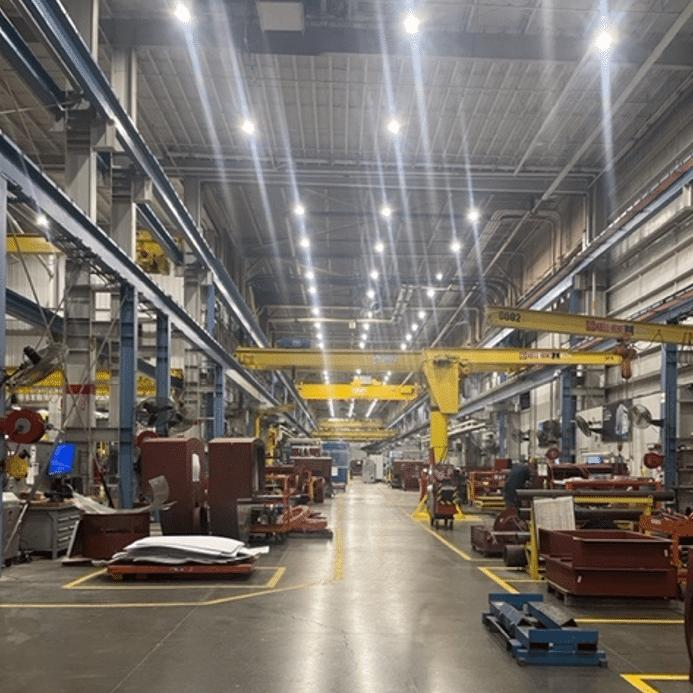
Industrial Workshop & Factory Floor Lighting: The Specifier’s Honest Guide
The Lux Level Myth That Costs You Real Money

Every week, I get buyers asking me about “the standard 500 lux for workshops.” That’s not a spec—that’s a starting point that will get you fired if you treat it as gospel.
Here’s what actually matters: the task determines the lux, not the space type. Precision assembly at a workbench? You’re looking at 1000-1500 lux minimum, and most European buyers spec 2000. General circulation areas? 150-200 lux is fine. That “500 lux standard” everyone quotes? It’s for corridors, not workstations.
The real money gets spent when you have to retrofit because someone spec’d linear high bays everywhere and now your quality inspectors are squinting at solder joints.
Why High Bay Fixtures Are Usually the Wrong Answer for Workshops
The knee-jerk response to “factory floor lighting” is UFO high bays or linear high bays at 40ft mounting heights. Makes sense on paper. But here’s what I’ve seen kill budgets: workshops aren’t warehouse ceilings.
Most workshops have:
– HVAC ductwork at 25-30ft
– Crane rails taking up mounting space
– Multiple ceiling heights from equipment platforms
Your 150W high bay at 35ft gives you 30-40 footcandles on the floor and 15 on the workbench. That’s backwards. Workers need light where they’re standing, not where no one is.
The better approach for most workshops: medium bay at 20ft + task lighting at workstations. Yes, it costs more upfront. Yes, it saves money on workers’ comp claims for eye strain. Do the math.
The Three Specs That Actually Differentiate Quality
Forget lumen output for a minute. These are the specs that separate fixtures that’ll run 8 years from ones that’ll fail in 18 months:
1. TM-21 Projected L70 Lifespan
Every Chinese factory claims 50,000 hours. Ask them for LM-80 test data and TM-21 projections. If they can’t produce it, assume 30,000 hours real-world. We’ve tested samples from 12 different manufacturers claiming the same 50K hours—the actual lumen maintenance ranged from 36K to 58K hours.
2. Driver THD (Total Harmonic Distortion)
Industrial environments have heavy motor loads. Low-quality drivers with THD >20% will flicker under load, create interference with sensitive equipment, and burn out faster. Spec THD <10%, preferably <5% for any space with inspection or quality control.
3. Surge Protection Rating
Factory floors have motors, welding equipment, and variable frequency drives. Minimum 10kV surge protection. If you’re anywhere near a substation or have CNC equipment, go 20kV. A $200 driver replacement costs way more than the $30 premium on surge protection.
Color Temperature: The 4000K vs 5000K Battle Is Wrong
Here’s a statement that’ll get pushback: color temperature choice for workshops is mostly psychological, not performance.
The science: at equal lux levels, 4000K and 5000K provide equivalent visual acuity. The 5700K people prefer feels “brighter” only because it skews toward the peak sensitivity of our visual system—but that’s a perception trick, not actual illuminance.
What does matter:
– Match adjacent spaces to avoid jarring transitions (your break room at 3000K next to 5700K workshop is brutal)
– 5000K+ for color-critical QC areas where you’re matching samples
– Workers doing night shifts need warmer temps to maintain circadian rhythm—don’t spec 5700K for 24-hour facilities
The real decision factor: get worker feedback before specifying. I’ve seen facilities spec 5000K based on “energy” perception, then spend $40K on complaints and lighting modifications.
Glare Control: The Spec Nobody Reads Until Workers Complain
UGLR (Unified Glare Rating) is in every spec sheet. Nobody reads it until you have 40 workers complaining about headaches.
For precision workstations: UGLR <19
For general assembly: UGLR <22
For storage/equipment areas: UGLR <28
High bay fixtures with shallow reflectors and no diffuser will fail UGLR requirements at any mounting height above 25ft in workshop applications. Budget for fixtures with proper optical design, not just raw lumen output.
The Retrofit Reality Check
If you’re coming from metal halide, the ROI calculation is straightforward: payback in 2-4 years on energy alone. Add in reduced maintenance (no more annual relamping at 30ft) and you hit 3-5 years.
The complication: existing layout may not match LED distribution patterns. Metal halide throws light in a 360° pattern; most LED high bays are 120°. Your existing spacing might leave dark spots. Do a photometric analysis before ordering fixtures.
One more gotcha: existing mounting points often can’t handle LED fixture weights. LED drivers add 2-5 lbs per fixture vs metal halide ballasts. Check your structure.
What Most Buyers Get Wrong About Pricing
The fixture cost is maybe 40% of your total project cost. Here’s the breakdown we see consistently:
- Fixtures: 35-45%
- Installation labor: 30-40%
- Electrical modifications: 10-15%
- Controls/sensors: 5-10%
- Contingency: 5%
If you’re comparing quotes based only on fixture price per unit, you’re doing it wrong. Ask for:
1. Total project cost including installation
2. Warranty coverage (fixture vs driver vs complete system)
3. LM-80 test data for lumen maintenance claims
4. Installation labor rate and hours estimated
The Controls Conversation
Smart lighting controls in workshops get oversold. Here’s the honest take:
Motion sensors: Work for storage areas, restrooms, break rooms. Not for production floors where people are constantly moving.
Daylight harvesting: Only relevant if you have significant skylights or translucent panels. Otherwise you’re dimming to match electric lighting to… electric lighting.
Tuning/dimming: This is the legitimate use case. Setting lights to 80% output during initial installation (lights perform better and last longer at reduced current), then bumping to 100% as LEDs age to maintain target lux levels. Smart controls make this automatic; manual dimmers work too if workers will actually use them.
Scheduling: Worth it for facilities with shift differential. Cut the overnight shift areas to 50% when nobody’s there. Pays back in 2-3 years on energy alone.
Final Checklist Before You Buy
Before issuing that PO:
- [ ] Lux level verified for each work zone, not just “standard”
- [ ] UGLR calculated for task areas
- [ ] Driver THD specified <10%
- [ ] Surge protection rated for facility load
- [ ] LM-80 test data requested and received
- [ ] Mounting weight verified against structure
- [ ] Photometric layout done if retrofitting from MH
- [ ] Controls strategy matches actual facility usage patterns
- [ ] Total project cost quoted, not just per-fixture
Get these right and you’ll have lighting that workers don’t complain about, maintenance crews don’t curse, and your CFO signs off on without three rounds of value engineering.
At YoubeeLight, we supply industrial LED fixtures tested to IEC standards with full documentation packages for project specs. Browse our complete LED catalog or contact our technical team for project-specific recommendations.
