
Aviation Hangar & Airport Terminal Lighting: The Demanding Specs Nobody Talks About
Why Aircraft Facilities Break the Normal Lighting Rules

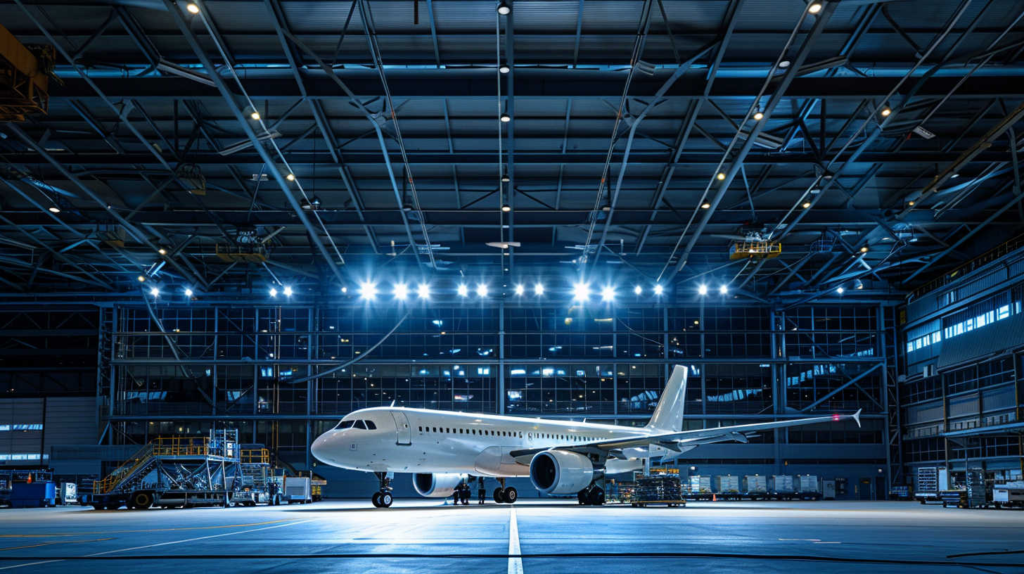
Walk into a commercial hangar and you’ll notice something: it’s bright. Not office-bright. Not warehouse-bright. Stadium-bright. And there’s a reason.
Maintenance hangars need 100-150 footcandles at floor level for inspection work. Not 50. Not “adequate.” 100+. Because inspectors are looking for hairline fractures in fuselage skin, corrosion under rivets, and paint defects at 3am under artificial light. Get this wrong and you fail regulatory inspections—not user preference, FAA or EASA will fail you.
Airport terminals? Different animal entirely. You need high lux for wayfinding and security zones, but dramatic dimming for departure lounges where passengers are trying to sleep at 6am. Same building, same lighting system, completely different requirements.
This is why aviation lighting specs require actual engineering, not catalog shopping.
Hangar Lighting: The Technical Requirements That Matter
Lux Levels by Zone
The basic regulatory requirements (ICAO, FAA, EASA all align roughly here):
- General hangar floor: 100-150 fc (1000-1500 lux)
- Inspection bays: 200-300 fc (2000-3000 lux)
- Paint booths: 500+ fc (5000+ lux) – separate systems
- Component repair areas: 150-200 fc
- Office/break areas within hangar: 30-50 fc
These aren’t suggestions. Your maintenance approval depends on adequate illumination levels for sign-off inspections.
Mounting Height: The Critical Factor Nobody Considers
Hangars typically have 25-40ft clear ceiling heights. This creates two problems:
1. Glare at working heights
At 30ft mounting height with 150W high bays, you get severe glare at floor level where workers are looking up. Solution: fixtures with >30° cutoff angles, or linear low-bay at 20ft where possible.
2. Maintenance access
You’re not changing these fixtures from a ladder. Either budget for catwalks (adds $50-80K to project) or spec fixtures with >100K hour rated life and remote driver accessibility.
Our recommendation for most commercial hangars: LED linear high bay at 20-25ft mounting height with 120° beam angle. Covers more floor area per fixture, better uniformity, lower glare at working height.
The Color Temperature Question Gets Serious Here
Aircraft paint jobs reveal defects at specific color temperatures. Most regulatory bodies require 4000K-5000K for inspection lighting. Here’s why:
- 4000K shows surface defects clearly without color distortion
- 5000K+ makes everything look “cleaner” but can hide certain coating defects
- Varying temperatures across a hangar creates false color comparison issues
Spec consistent 4000K or 5000K throughout inspection zones. Mixed temperatures will create arguments during sign-off inspections.
CRI Requirements Are Non-Negotiable
Minimum CRI 80 for general areas, CRI 90+ for inspection zones. You’re looking for coating defects, hairline cracks, corrosion. A CRI 70 fixture will hide issues that CRI 90 catches.
This is where cheap fixtures fail. The cost difference between CRI 70 and CRI 90 at 150W is maybe 15%. The cost of re-doing an inspection because your lighting missed a defect is 100x that.
Airport Terminal Lighting: Different Problems, Higher Stakes
The Human Factor Is Everything
Terminal lighting serves two purposes: wayfinding and circadian regulation. These pull in opposite directions.
Wayfinding needs:
– High contrast at security checkpoints
– Bright, even illumination in queuing areas
– Clear signage lighting (backlit panels need specific lux levels)
– Dramatic lighting at architectural features for brand identity
Circadian needs:
– Cool (5000K+) light in morning to energize
– Warm (2700K-3000K) light in evening to prepare for sleep
– Minimal blue spectrum in late evening for overnight operations
Tunable white systems solve this. Fixed 4000K throughout? You’re compromising both needs.
Emergency Lighting Is Tested Relentlessly
Airport emergency lighting gets inspected more rigorously than almost any other building type. Requirements:
- 1 footcandle minimum along egress paths (10 lux)
- 10% of normal lighting must function as emergency backup
- Battery backup duration: typically 90 minutes minimum
- Regular testing: monthly function tests, annual 90-minute full discharge tests
This isn’t “install and forget.” Specify fixtures with reliable battery packs and testable circuits. We’ve seen too many projects where the emergency system fails first inspection because nobody checked the battery backup function during installation.
The Controls Complexity Is Real
Modern terminal lighting needs:
1. Daylight harvesting
Large terminal windows create significant variation. Zone controls based on photo sensors maintain consistent lux levels while saving energy.
2. Occupancy-based dimming
Late-night operations don’t need full terminal lighting. Zone-based occupancy sensing dims areas without activity while maintaining security minimums.
3. Scene control
Different operations need different lighting: boarding, deplaning, security alert, after-hours maintenance. Preset scenes with one-button activation for each scenario.
4. BMS integration
Terminal HVAC and lighting are controlled together. Specify DALI or BACnet interfaces that integrate with building management systems. Proprietary protocols create integration nightmares.
The LED Advantage Nobody Questions Anymore
The LED vs. metal halide debate in aviation facilities is over. LED wins on:
- Instant on/off (no warm-up time for inspection lighting)
- Controllability (dim to 10% without color shift)
- Longevity (100K hours vs. 15-20K for MH)
- Heat output (critical in hangars where temperature control is expensive)
- Maintenance (no relamping at 30ft)
The real consideration now: specify for serviceability. LED fixtures in hangars and terminals are difficult to access. Fixtures should last 15-20 years. Specify:
– Removable gear trays for driver replacement
– Surge protection rated 20kV minimum (airport electrical systems are noisy)
– Thermal management designed for enclosed fixture housings
– IP65+ rating for hangar environments (dust, fuel vapor, cleaning chemicals)
What Inspectors Actually Check
Based on feedback from aviation maintenance facilities we’ve supplied:
EASA/FAA inspections typically verify:
1. Lux levels at inspection stations (photometer measurement)
2. Emergency lighting function and duration
3. Color temperature consistency in inspection zones
4. Glare levels at working heights (not just floor level)
5. Control system backup modes function correctly
Common failure points:
– Fixtures specified at 4000K but actual product is 4200K (out of spec tolerance)
– Emergency lighting on dimmed circuits that don’t provide full output in backup mode
– Controls programmed incorrectly after installation
– Battery backup systems not exercised or tested
Procurement Advice for Aviation Buyers
Get photometric layouts done before ordering. Aviation facilities have complex geometry—mezzanines, aircraft door heights, equipment locations. A single layout drawing prevents over-specification in some areas and under-specification in others.
Request LM-80 data and TM-21 projections. If a supplier can’t provide IES LM-80 testing reports from an accredited lab, assume the 50,000 hour claim is marketing, not engineering.
Verify IP rating in writing. Hangars have dust, fuel vapor, and cleaning chemicals. IP65 is minimum. Specify IP66 for wash-down zones.
Controls need commissioning. The biggest post-installation problem we see: sophisticated lighting controls systems that were never properly programmed or commissioned. Budget for post-installation commissioning as a line item, not an afterthought.
Consider total cost, not fixture cost. A $300 LED fixture with 150,000 hour rated life and 10-year warranty beats a $150 fixture with 50,000 hours and 3-year warranty over a 20-year facility life.
The Hangar vs. Terminal Summary
| Requirement | Hangar | Terminal |
|---|---|---|
| Primary lux | 100-150 fc | 30-100 fc varies by zone |
| Color temp | 4000-5000K strict | Tunable 2700-5000K ideal |
| CRI minimum | 90+ inspection, 80 general | 80 general, 90 signage |
| Controls | Simple on/off, dimming | Complex scene control |
| Emergency | Standard + inspection mode | Standard + circadian integration |
| IP rating | IP65 minimum | IP20 typical |
| Mounting | High bay, difficult access | Mixed, more accessible |
Different spaces, different requirements. But both need lighting that doesn’t fail when regulators show up.
YoubeeLight supplies LED fixtures for aviation and transportation facilities meeting international quality standards. Our technical team provides photometric layouts and project-specific specifications. Browse our LED catalog or contact us for facility requirements.
