
Direct answer: The linear-vs-UFO high bay argument is settled by one thing: the shape of the space under the fixture. A UFO high bay throws a round, symmetric beam, which is the cheapest way to light open floor. A linear high bay stretches the light along a line, which is the right tool for racking aisles, because the beam can run down the aisle and wash the vertical shelf faces where pickers actually read labels. Put simply: open floor at low-to-mid mounting heights goes UFO; racked aisles, row layouts, and high ceilings go linear. If your building has both, the best answer is usually both.
Buyers get this wrong because the two form factors look interchangeable on a datasheet. Same wattage, similar lumen packages, both “high bay.” The difference is not how many lumens the fixture produces — it is where those lumens land, and that is decided by optics, not wattage.
Distribution decides, not the datasheet
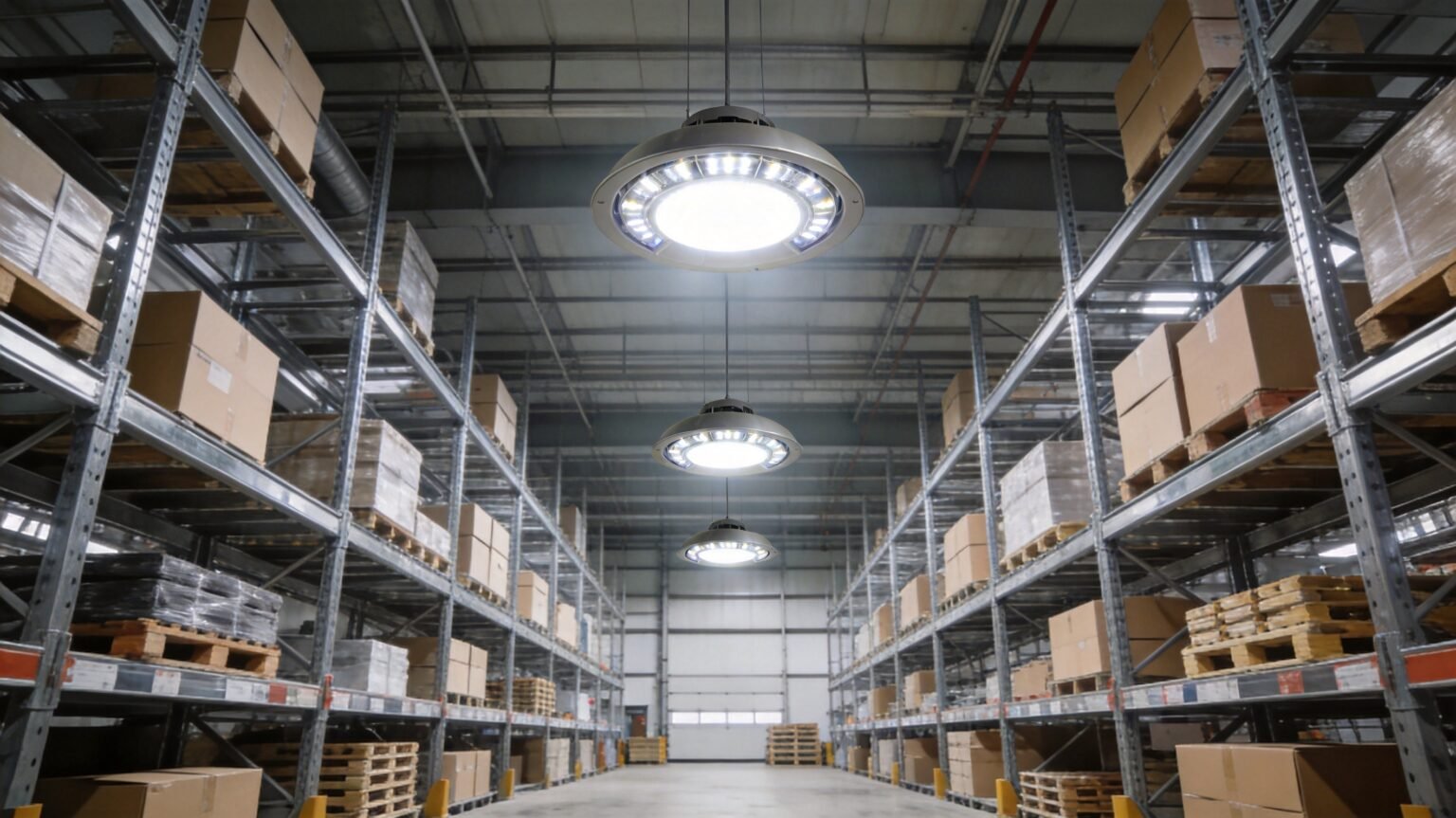
A UFO high bay is a compact round body, typically with a symmetric beam that spreads light in a circle. Over open floor, overlapping circles from a grid of fixtures produce even horizontal illuminance with minimum fixture count. That is why UFO bodies dominate open warehouses, gymnasiums, workshops, and big-box back-of-house.
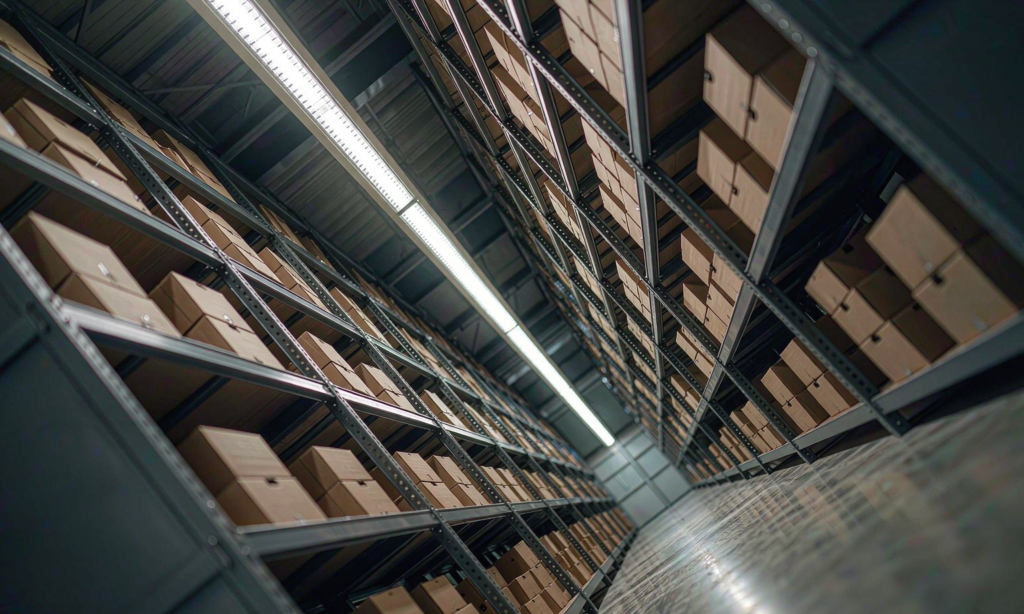
A linear high bay is an elongated body, usually suspended at two points, and its optics are designed to push light in a rectangular pattern — wide across the aisle, long along the aisle. In a racking aisle, a circular beam wastes its edges on the tops of racks and the tops of shelves while leaving the vertical faces under-lit. An aisle optic aims those lumens at the shelf faces instead, which typically improves vertical illuminance where it matters. Pickers, forklift cameras, and barcode scanners all work off vertical surfaces, not the floor.
So the first question for any RFQ is not “UFO or linear?” It is: “What is between the fixtures — open concrete, or racking?”
What each form factor does to an aisle
| Attribute | UFO high bay | Linear high bay |
|---|---|---|
| Body and optics | Round, compact; symmetric circular beam, commonly 60 to 120 degrees | Elongated; rectangular distribution, often with aisle-specific optics |
| Natural fit | Open floor, bulk storage, gyms, workshops | Racking aisles, production lines, row-mounted layouts |
| Vertical illuminance on rack faces | Depends on fixture position; circular beams light aisle faces unevenly | Typically stronger when fixtures run on the aisle centerline |
| Mounting | Single-point hook or pendant; fast to hang and level | Two-point suspension; must be aligned with the aisle axis |
| Row continuity | Discrete points of light | Continuous or near-continuous lines of light |
| Glare from the side | Compact bright source; side glare can be noticeable in long sightlines | Longer source, and shielding options; typically lower perceived glare along the row |
Mounting height and the spacing rule buyers get wrong
Mounting height does not pick the form factor by itself — layout does — but it changes the math. Higher ceilings make the circular-beam overlap of UFOs harder to maintain without tightening spacing, while linear rows hold uniformity along an aisle more naturally. The rule of thumb that actually gets used on site is the spacing-to-mounting-height ratio: for a given beam, fixture spacing should stay at or below some multiple of the mounting height above the work plane, or the layout develops dark bands between fixtures.
As a planning shortcut, many specifiers work with roughly one-to-one spacing for wide-beam UFOs over open floor, and slightly wider spacing along the axis of a linear row. Treat these as screening numbers only: the S/MH ratio depends on the beam angle and the photometric file, and the only honest answer comes from running the actual IES files in a layout tool before the purchase order.
| Situation | Typical starting point | Why |
|---|---|---|
| Open floor, low-to-mid bay ceilings | UFO, wide beam, spacing around 1.0x mounting height | Cheapest coverage; circular beams overlap cleanly on open floor |
| Open floor, higher ceilings | UFO with narrower beam or tighter spacing; high-output linear is a common alternative | Beam overlap gets harder to hold as height grows |
| Racking aisles, mid-to-high bay | Linear with aisle optics on the aisle centerline | Puts lumens on vertical shelf faces instead of rack tops |
| Very narrow aisles, tall racks | Linear, narrow across-aisle distribution | Avoids splashing light on racking steel |
For maintained illuminance targets, most specifiers reference the IES recommended practice for industrial lighting, and common targets for active storage and picking areas typically land somewhere in the 20 to 50 footcandle range depending on task. Do not buy fixtures to hit a number you have not modeled — buy the layout first, then the fixture.
Sensors and controls: not the same on both shapes
Controls integration is where the form factors genuinely diverge. On a UFO, an integral motion sensor screws or plugs into the top of a single compact body, and its detection cone is designed around that one point. On a linear high bay, sensors can be mounted per fixture or paired across a row, and occupancy detection in a narrow aisle needs to cover a long, thin zone rather than a circle — a geometry mismatch that shows up as lights that switch off while a picker is still in the aisle, or stay on all night.
Whichever shape you choose, check the sensor’s rated mounting height against your actual ceiling, and confirm dimming behavior with your driver: a fixture that dims to a stated minimum is only as good as the driver behind it. This matters commercially too — under the current DLC requirements, controls capability now drives the Premium classification and its higher rebate tiers, so a controls-ready variant can pay back its small price premium on the first rebate cycle.
Install labor, mounting hardware, and long-run costs
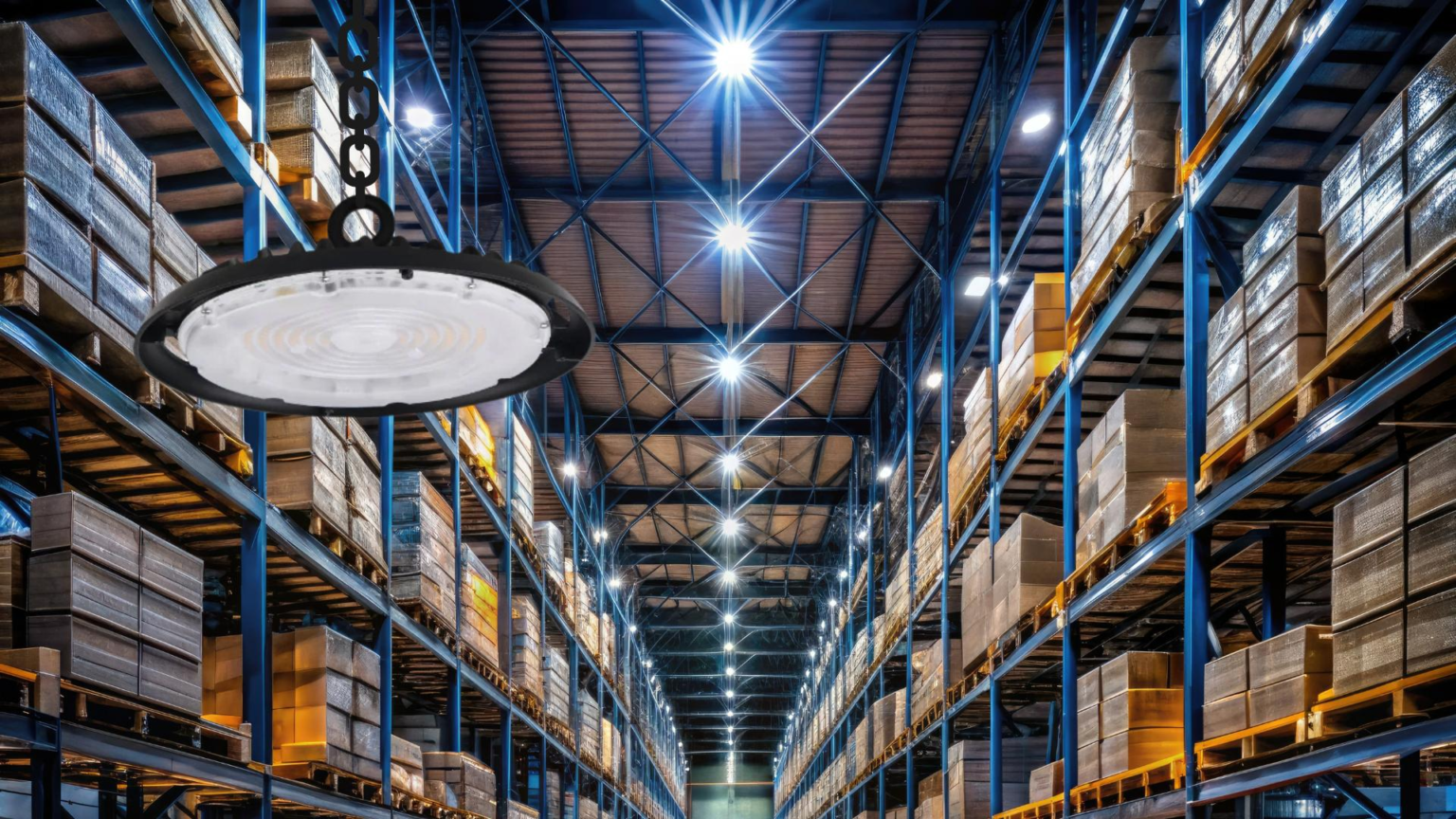
Installation is a real line item on a multi-hundred-fixture project. A UFO hangs from a single hook and levels itself; crews routinely hang them in a few minutes each. A linear high bay needs two suspension points, and in a racking aisle it must be aligned with the aisle axis — a slightly rotated fixture sends its asymmetric beam into the racking steel instead of down the aisle. Budget the extra minutes, and budget the second suspension point’s hardware.
Against that, the linear format usually wins the fixture count in aisles: fewer, longer-throw fixtures can cover a row that would take several UFOs to light unevenly. Maintenance crews also tend to prefer whichever shape matches their lift workflow — a compact UFO drops out of a single hook quickly, while a linear fixture needs both points handled. Neither is “cheaper” in the abstract; the honest comparison is fixture count plus install time plus rebate tier for your specific layout.
A decision table you can use on your next RFQ
| Your building | Default choice | Before you order, confirm |
|---|---|---|
| Open warehouse, floor-stacked pallets, ceiling under roughly 30 ft | UFO high bays, wide beam | Spacing model from actual IES files; sensor cone covers the plan |
| Racked aisles with picking | Linear high bays, aisle optics | Fixtures on aisle centerline; vertical illuminance on rack faces modeled |
| Very high ceilings, hangar or cross-dock scale | High-output linear rows | Structural suspension points; beam reach at height |
| Mixed open floor plus racking | UFO over open zones, linear down the aisles | Consistent CCT and controls platform across both shapes |
| Cold storage | Either, matched to layout | Rated low-temperature operation and IP rating for washdown |
One more buyer’s note: if your lighting layout lives or dies on rebates, ask for the DLC listing details of the exact configuration early. A variant with a different optic or lumen package can sit outside the qualified listing, and the surprise usually arrives after the order.
Frequently asked questions
Is a linear high bay always better for racking?
Not always, but it is the usual answer. What matters is whether the beam reaches the vertical shelf faces along the whole aisle. If your racking is short and widely spaced, UFOs can still do the job; model the layout before committing.
Can I mix UFO and linear in the same building?
Yes, and it is often the best answer: UFOs over open staging and dock areas, linear rows down the aisles. Keep the CCT, driver platform, and controls system consistent so maintenance and controls commissioning stay simple.
Which form factor is cheaper?
Per fixture, UFO bodies are often cheaper and faster to install. Per project, the answer flips with layout: fewer linear fixtures with better-aimed lumens can beat a larger UFO count in racked aisles. Compare fixture counts from a real layout, not unit prices.
Do sensors work the same on both?
The hardware is similar, but the detection geometry differs. UFO sensors cover a circular cone; aisle detection wants a long, thin zone, which linear fixtures paired across a row handle more naturally. Always check the sensor’s rated mounting height against your ceiling.
What should I ask a supplier before ordering either?
Ask for the IES photometric files of the exact configuration, a layout for your floor plan, the DLC listing status of that configuration, and sensor options rated for your mounting height. A supplier who answers all four quickly is a supplier who has done this before.
