Commercial Sports & Stadium Lighting: Why Major Projects Are Ditching Metal Halide for LED
If you’ve been sourcing commercial lighting for more than a decade, you remember the stadium lighting standard: metal halide. 1,500-watt lamps, 10,000-hour lifespans that always seemed to burn out right before the championship game, maintenance crews with forklifts replacing lamps at 3 AM.
That world is gone. Not gradually — LED replaced metal halide in commercial sports lighting the way smartphones replaced flip phones: fast, complete, and with a step-change in capability that made the old technology look embarrassing in retrospect.
This article is for the wholesale buyers, facility managers, and procurement teams who need to source stadium and sports field lighting in 2026 — and who need to understand why the lighting your supplier is pushing might already be the wrong recommendation.
Why Metal Halide Stopped Making Sense
Metal halide has one thing going for it: initial purchase price is low. That’s it.
Everything else is a liability. A 1,500W metal halide fixture puts out meaningful light, but it takes 15-20 minutes to reach full output after startup. Hit the stadium with a power surge or a brief outage, and you’re restarting in the dark. The lamp depreciates fast — by 50% output within 2,000 hours. Maintenance cost for a 30-meter pole, tower climbing, specialized equipment: you’re looking at $400-800 per fixture per year in maintenance alone on a professional field.
I worked with a regional soccer federation in Southeast Asia in 2019. Their training complex had 24 metal halide fixtures on 12 poles. Annual maintenance cost exceeded the original fixture cost in year 3. They finally replaced everything with 600W LED in 2023. Their electricity bill dropped 58%. No contest.
What LED Changes for Sports Lighting
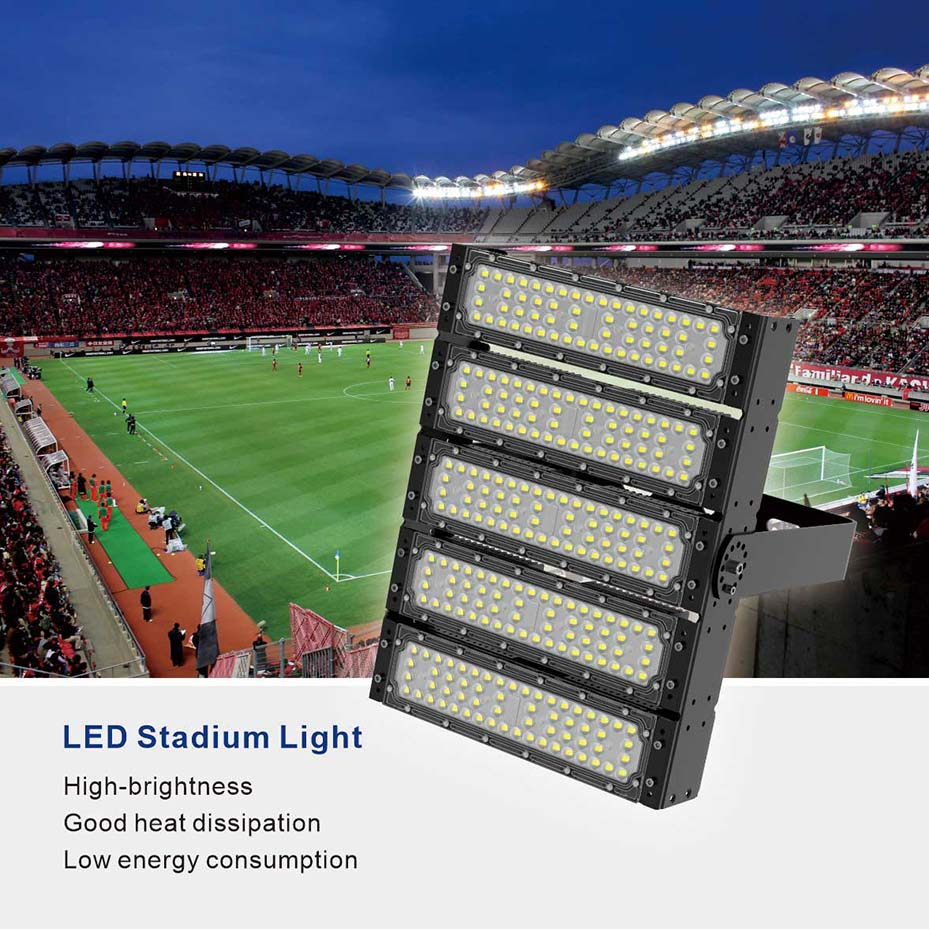
LED delivers what metal halide promised but couldn’t deliver: instant-on, consistent output, directional control.
Instant-on matters more than people think in sports applications. When a match goes into injury time and the floodlights need to stay at full output during a power fluctuation, LED doesn’t blink or restart. When a venue has multiple events in a day — a daytime game and an evening concert — LED hits full output immediately without a warm-up window that kills scheduling flexibility.
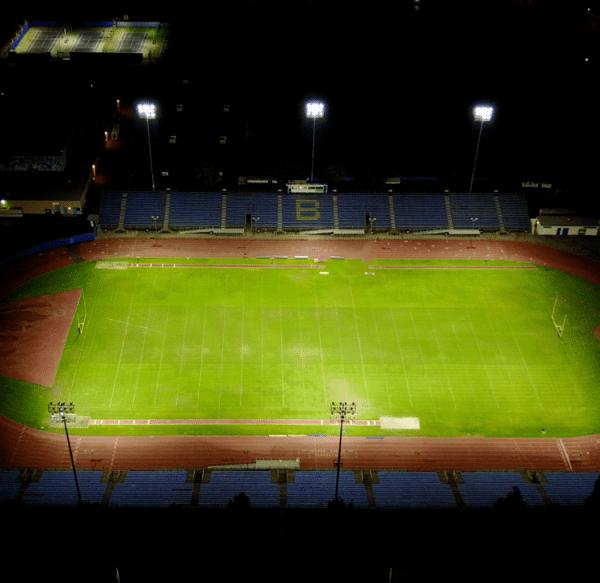
Light uniformity is where LED genuinely transforms sports lighting. Metal halide throws light in a roughly circular pattern. LED fixtures can be engineered for precise photometric distribution across a playing surface. For a FIFA-standard football pitch, uniformity requirements are strict: no hot spots, no dark zones. A well-designed LED sports lighting system achieves 0.7+ uniformity ratio across the entire field. Metal halide systems rarely get above 0.5 without significant over-lighting at the edges.
The Real Numbers: TCO Comparison That Actually Holds Up
Here’s where I get frustrated with supplier quotes that lead with “50,000 hour lifespan.”
LED lifespan claims are almost meaningless without context. L70 B50 ratings — the point at which a fixture’s output falls to 70% of original — are standard in the industry, but manufacturers test under ideal conditions. Real-world data from facilities in hot climates, coastal environments, or with inconsistent power quality will always differ.
What actually matters for procurement decisions: total cost of ownership over 10 years, with realistic maintenance assumptions.
Here’s the framework I use with clients evaluating sports lighting:
LED system (per pole, 4 fixtures at 600W each):
– Initial fixture cost: $3,200-5,500 (quality tier varies enormously — more on this below)
– Installation: $1,800-3,500 (same for both systems, typically)
– Energy cost over 10 years (8 hrs/day, $0.12/kWh): ~$4,200
– Maintenance: ~$400-800 per year (mostly driver replacements, not lamp changes)
– 10-year TCO: $13,500-20,000
Metal halide system (per pole, 4 fixtures at 1,500W each):
– Initial fixture cost: $1,600-2,800
– Installation: $2,200-4,000 (heavier poles, different mounting)
– Energy cost over 10 years: ~$10,500
– Maintenance: $800-1,500 per year (lamp replacements, re-aiming, re-lamping cycles)
– 10-year TCO: $23,000-33,000
LED wins in almost every scenario. The energy savings alone pay for the premium in 3-5 years at typical usage levels. The maintenance difference is the killer for metal halide: stadium-scale maintenance is expensive because of the height and equipment required, not just the lamp cost.
The Quality Tier Problem Nobody Talks About
Here’s where procurement teams get burned.
The $3,200 LED sports fixture and the $6,500 LED sports fixture might look identical in the spec sheet. Same wattage, same CRI, same IP rating. But the difference is in the photometrics, the driver quality, and the thermal management.
Sports lighting is unforgiving about photometric accuracy. A fixture that’s rated 90 CRI but has a 15-degree aiming error on a 40-meter pole creates a dead zone on your field. You can’t “adjust” a stadium pole — you re-aim it at significant cost.
Driver quality matters more in sports applications than almost anywhere else. Stadium power quality is notoriously rough: large motor loads, variable frequency drives, transformer switching. A cheap driver will fail in that environment within 3-5 years. Mean Well, Philips Xitanium, and Inventronics drivers are the ones I specify for projects where I can’t afford callbacks — which is every project.
Thermal management is the hidden differentiator. LED junction temperature directly determines lifespan. A fixture that looks well-ventilated in the catalog but runs hot in real summer conditions (40°C+ ambient) will depreciate faster than its rated lifespan. Ask your supplier for thermal test data at the ambient temperature of your specific installation site, not the 25°C lab standard.
The Specs That Actually Matter for Stadium Lighting Procurement
When I review a stadium lighting quote, I work through this checklist:
-
Photometric layout file (.ies format) — Any serious supplier will provide this. Run it through a free tool like Relux or DIALux to verify the uniformity claims.
-
TM-21 projected lifespan — Ask for the actual TM-21 report, not just the 50,000-hour marketing claim. This document shows the tested data and the mathematical projection.
-
Glare rating (UGRL) — For televised events, UGR < 19 is typically required. For amateur facilities, UGR < 28 is acceptable but < 22 is worth paying for.
-
Surge protection rating — Stadium environments see 10-20kV surge events from grid switching. I want to see at least 10kV surge protection on the fixtures, not just the distribution panel.
-
Color rendering for broadcast — If the venue hosts televised events, TLCI (Television Lighting Consistency Index) score matters as much or more than CRI. TLCI > 85 is the broadcast standard.
-
Mounting wind load calculation — This one gets skipped constantly. A 30-meter pole in a coastal area faces different wind loads than an inland stadium. Verify the fixture’s effective projected area (EPA) against your structural engineer’s calculations.
The Retrofit Trap: Why “Drop-In Replacement” Isn’t a Strategy
A growing number of projects fail because someone decided to “retrofit” existing metal halide poles with LED fixtures without redoing the electrical infrastructure.
LED and metal halide have different electrical requirements. Metal halide uses magnetic or electronic ballasts that regulate current. LED drivers need specific voltage and current characteristics. If your retrofit fixture is designed for a different driver topology than your existing wiring supports, you will have problems — typically driver failures, flickering, or premature depreciation.
The right approach for a retrofit: pull the existing fixture, replace the mounting bracket and wiring as needed, install the new LED fixture with its supplied driver. Budget 15-20% above the fixture cost for electrical modification work on older installations. That premium prevents callbacks.
What I’m Watching in 2026
Three developments worth tracking:
Li-Fi integration — A few manufacturers are piloting LED sports lighting with integrated Li-Fi (light-based data transmission). Still niche, but the convergence of illumination and connectivity is real.
Connected photometry systems — Wireless-controlled sports lighting systems that allow dynamic re-aiming and zoning for different sports on the same field are becoming more competitive in price. For multi-sport facilities, this changes the ROI calculation significantly.
Emerging Asian manufacturers — The quality gap between Tier 1 (Sylvania, Philips, GE, Acuity) and Tier 2 Asian manufacturers has narrowed considerably in sports-specific fixtures. You can now get 95 CRI, TM-21 certified, 50,000-hour LED sports fixtures from qualified manufacturers at 40-50% below European brand pricing. Due diligence is still required, but the value proposition for non-broadcast, non-FIFA-standard facilities is real.
The Bottom Line
For commercial sports lighting projects in 2026, LED isn’t the forward-thinking choice — it’s the obvious one. The economics are clear, the technology is mature, and the maintenance profile is transformative for facility operators.
The challenge is quality differentiation in a market full of spec sheet copywriters. Focus on photometric verification, real-world thermal performance data, and driver specifications. A fixture that’s $500 cheaper upfront but fails at year 4 in a hot climate is not a saving.
If you need help evaluating sports lighting specifications or want a TCO comparison framework for a specific project, our team has sourced and specified commercial LED systems across 30+ countries. Reach out — I don’t do the installation, but I make sure you’re buying the right thing.
Related Reading:
• How to Choose Commercial LED Downlights from China: Complete Wholesale Guide
• Commercial Lighting Wholesale Trends 2026
• LED Driver Types Explained: Constant Current vs Constant Voltage
About YoubeeLight: YoubeeLight is a professional LED lighting OEM/ODM manufacturer serving commercial, industrial, and institutional buyers worldwide. With 15 years of experience in the lighting industry, we supply wholesale buyers, distributors, and project contractors across North America, Europe, and Southeast Asia.
