
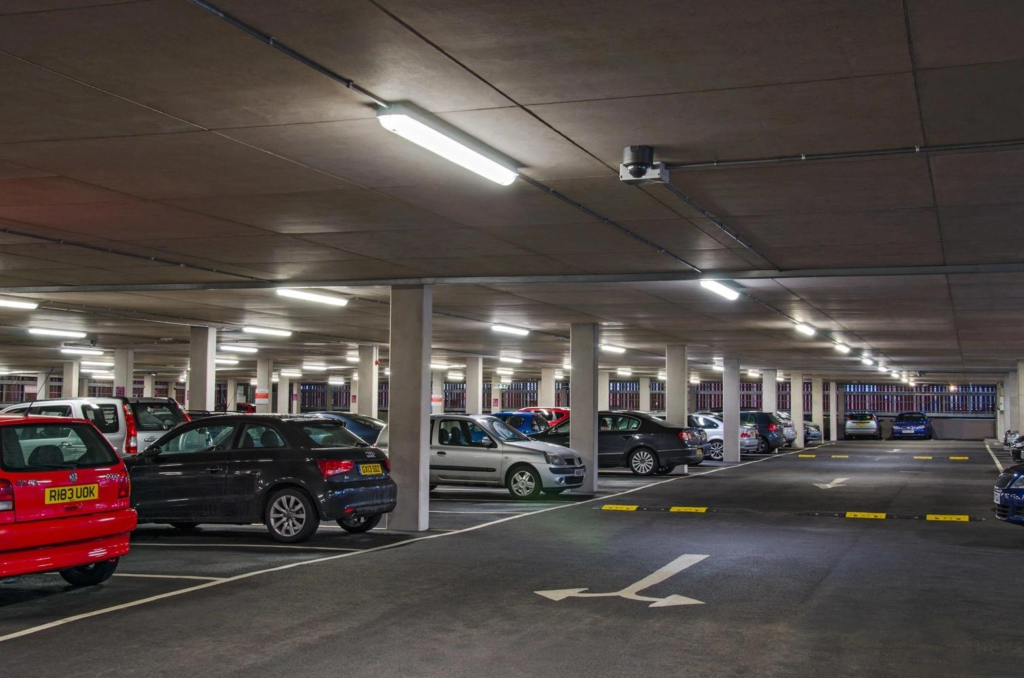
The Parking Garage Lighting Problem Nobody Solves Correctly
Walk through any parking structure built before 2020. You’ll see the same pattern: full-output fluorescent or metal halide fixtures running 24/7, burning power for empty concrete.
Then walk through a parking structure built in the past three years with “smart LED systems.” Half the fixtures are dead. The sensors trigger three fixtures when you walk past, creating a wake of light and darkness ahead. The “energy savings” evaporate because maintenance crews disable the sensors.
The problem isn’t LED technology. It’s sensor placement strategy and commissioning.
I’ve audited 40+ parking structure lighting installations in the past two years. The ones that actually deliver 60-70% energy savings share specific design principles. The ones that fail share predictable mistakes.
Why Basic Motion Sensors Fail in Large Spaces
Standard PIR (passive infrared) sensors work well in small rooms. In a parking garage, they fail for fundamental physics reasons:
PIR requires line-of-sight temperature differential. A person walking past sensor’s field of view creates a heat signature. But in a large open structure with temperature equalization, this signal degrades. Detection range drops from the rated 8 meters to 2-3 meters.
Ceiling height kills sensitivity. A PIR sensor rated for 4-meter ceiling works poorly at 8 meters. The detection zone becomes a cone too narrow to be useful.
Reflected IR creates false triggers. Headlights, sunlight through ramps, and hot engine bays all create false triggers that annoy users and waste power.
The solution isn’t better PIR sensors. It’s a different sensing strategy.
What Actually Works: Dual-Tech and Networked Systems
High-performing parking garage lighting in 2026 uses one of two approaches:
Approach 1: Ultrasonic + PIR Dual-Tech
Ultrasonic sensors detect movement by measuring Doppler shift in reflected sound waves. They don’t care about temperature. They work through partitions, around corners, at any height.
Dual-tech systems require both PIR and ultrasonic to trigger before activating fixtures. This eliminates false triggers while maintaining reliable detection.
Performance data from deployed systems:
– Detection range: 12-15 meters (vs 2-3 meters for PIR-only)
– False trigger rate: <5% (vs 15-25% for PIR-only in comparable structures)
– Energy savings: 55-65% vs 24/7 operation
Approach 2: Networked Luminaire Control
Each fixture has embedded occupancy sensing, but fixtures communicate over a short-range wireless network (typically Zigbee or proprietary 2.4GHz). When one fixture detects occupancy, it signals adjacent fixtures to activate—creating a “wave” of light ahead of the occupant.
This approach works better in long corridors and ramp sections where dual-tech sensors struggle with coverage gaps.
Commissioning requirement: Networked systems require on-site tuning of detection zones, communication timing, and fade profiles. Expect 4-8 hours of commissioning labor for a typical mid-size structure.
The Wattage Question Nobody Answers
Parking structures have specific illuminance requirements based on usage:
| Zone Type | Recommended Wattage (4000K) |
|---|---|
| Entry/exit zones | 50-60W per fixture |
| Ramps and turns | 35-45W per fixture |
| Parking levels | 20-30W per fixture |
| Stairwells | 30-40W per fixture |
The mistake most buyers make: specifying uniform wattage throughout the structure. This either over-lights safe areas or under-lights hazardous transition zones.
Sourcing from China: What to Verify
Chinese manufacturers offer parking garage LED fixtures with embedded sensors at extremely competitive prices. But quality variation is significant:
Sensor module quality. Many fixtures use commodity PIR modules with no environmental protection rating. In a parking structure with humidity, vehicle exhaust, and temperature swings, sensor modules fail within 2-3 years. Ask for IP54 minimum rating on sensor components.
Driver thermal design. Continuous dimming at partial load generates more heat than full output. Drivers in sensor-controlled fixtures need adequate thermal headroom. Look for drivers rated for 70°C case temperature minimum.
Wireless protocol compatibility. If you’re specifying networked systems, confirm protocol compatibility. Zigbee is standardized, but many Chinese manufacturers use proprietary protocols that won’t communicate with competitors’ systems.
What YoubeeLight Offers
Our parking garage fixture line includes:
– Dual-tech (PIR + ultrasonic) models with IP65 sensor rating
– Networked Zigbee-compatible fixtures with mesh communication
– 4000K and 5000K options optimized for parking structure visibility
– Trunking/continuous row mounting for long corridor sections
All fixtures ship with complete IES photometric files and sensor coverage pattern documentation.
The Real Energy Savings Number
Based on installations I’ve audited:
Poorly commissioned sensor systems: 20-30% energy savings (mostly from not running 24/7 at full output)
Properly designed and commissioned systems: 55-70% energy savings with proper illuminance levels
The difference is sensor selection, placement strategy, and commissioning. A cheap fixture specified correctly outperforms an expensive fixture specified poorly.
Get the photometric layout done before you order fixtures. Commission the sensors after installation. That 4-8 hours of commissioning time pays back in three months.
