
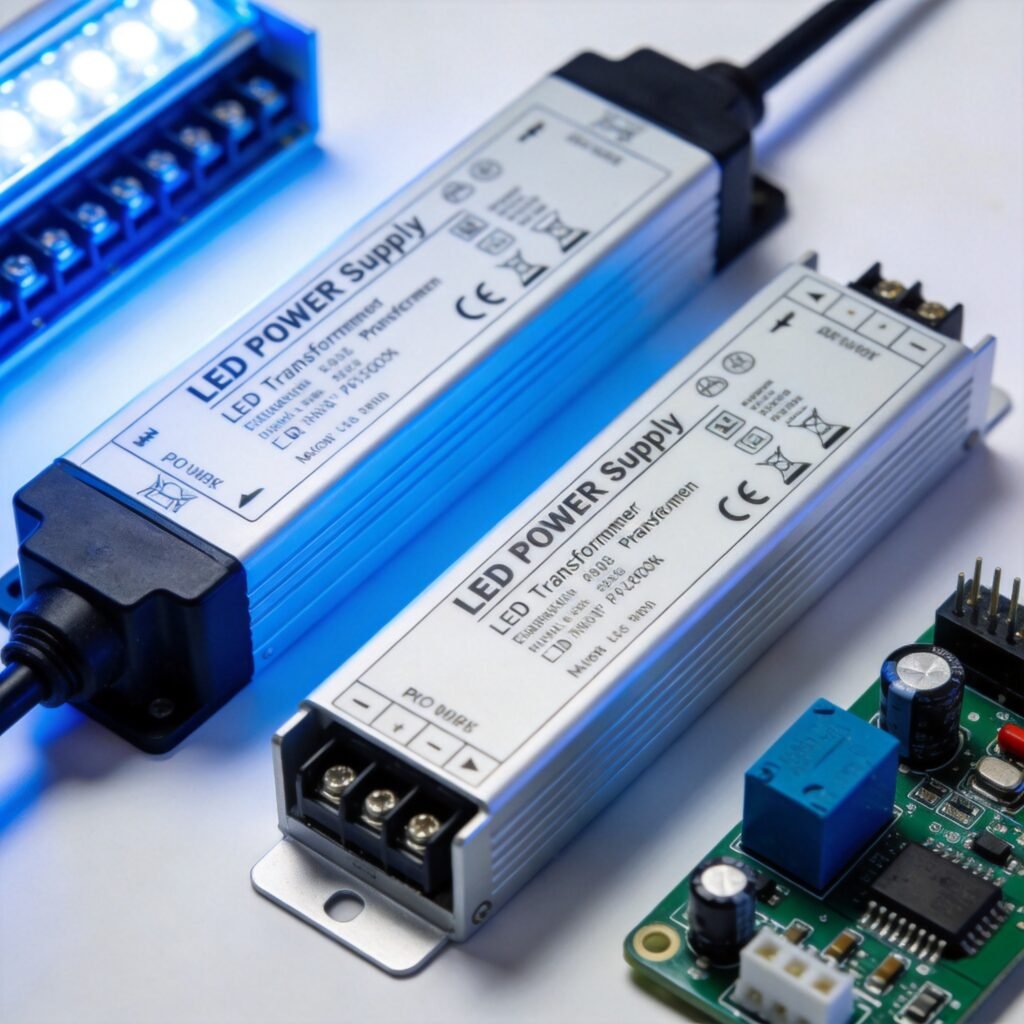
LED Driver Types Explained: Constant Current vs Constant Voltage for Commercial Lighting Systems
Understanding LED driver technology is crucial for lighting professionals, yet the constant current vs. constant voltage debate confuses even experienced specifiers. Choose wrong, and you’ll face flickering luminaires, premature failures, or costly callbacks. Choose right, and your commercial installations deliver years of reliable performance.
In this technical guide, we break down exactly how each driver type works, where each excels, and how to select the optimal driver for your specific commercial lighting application.
What Does an LED Driver Do?
An LED driver is the electronic power supply that converts incoming AC power to the low-voltage DC power that LEDs require. Unlike traditional incandescent bulbs that handle mains voltage directly, LEDs need precise current or voltage regulation to operate safely and efficiently.
Key Driver Functions:
– Converts AC (100-277V) to DC power (typically 12V, 24V, or 36V)
– Regulates electrical current to prevent LED damage
– Enables dimming capabilities
– Provides surge and over-temperature protection
– Maintains consistent light output despite input variations
Constant Current LED Drivers
How They Work
Constant current drivers deliver a fixed output current (measured in milliamps, mA) while allowing the output voltage to vary within a specified range. The driver monitors and adjusts voltage to maintain the precise current your LEDs need.
Example Specifications:
– Output: 350mA (constant)
– Voltage Range: 20-40V DC
– Power: Up to 14W
Advantages for Commercial Applications
Consistent Light Output: By maintaining exact current, constant current drivers ensure all LEDs in a circuit produce identical brightness—no hot spots or dim sections.
Optimal LED Performance: LEDs perform most efficiently at their designed current. Constant current drivers keep LEDs in their sweet spot.
Simplified Thermal Management: Predictable power dissipation makes thermal design more straightforward.
Better for High-Power Applications: Ideal for high-bay lights, flood lights, and other demanding commercial installations.
Common Constant Current Configurations
| Current Rating | Typical Applications | Voltage Range |
|—————|———————|—————|
| 350mA | Residential downlights, task lighting | 3-12V |
| 500mA | Commercial recessed lighting | 9-40V |
| 700mA | High-bay fixtures, track lighting | 20-48V |
| 1050mA | Industrial high-bay, sports lighting | 30-60V |
| 1500mA+ | Stadium lighting, flood lights | 40-100V |
Disadvantages
– Less Flexible: Each luminaire typically requires its own driver
– Series Wiring Complexity: One failed LED affects the entire string
– Higher Cost Per Fixture: Individual drivers add expense
Constant Voltage LED Drivers
How They Work
Constant voltage drivers maintain a fixed output voltage (typically 12V or 24V DC) while allowing the current to vary depending on the total LED load connected.
Example Specifications:
– Output: 24V DC (constant)
– Max Current: 5A
– Max Power: 120W
Advantages for Commercial Applications
Parallel Wiring Simplicity: Multiple LED modules connect to the same driver in parallel. One failed module doesn’t affect others.
Easy System Expansion: Add or remove LED fixtures within the driver’s capacity without recalculating circuits.
Cost-Effective for Distributed Lighting: One driver can power numerous small LED modules across a large area.
Ideal for LED Strip Systems: Perfect for linear accent lighting, cove lighting, and signage.
Common Constant Voltage Applications
| Application | Voltage | Why Constant Voltage? |
|————|———|———————-|
| LED Strip Lighting | 12V or 24V | Easy runs up to 10m+ |
| Recessed Modular Lights | 24V | Parallel wiring flexibility |
| Landscape Lighting | 12V | Low voltage safety |
| Signage & Channel Letters | 12V | Multiple connection points |
| Under-Cabinet Lighting | 24V | Longer runs without voltage drop |
Disadvantages
– Current Limiting Required: LED modules must include built-in current regulation
– Voltage Drop Issues: Longer wire runs cause brightness variation
– Power Waste: Series resistors convert excess power to heat
Key Comparison Factors
1. Application Type
Choose Constant Current When:
– Installing high-power individual fixtures (high-bay, flood lights)
– Maximum energy efficiency is critical
– Precise light output consistency is required
– Each fixture operates independently
Choose Constant Voltage When:
– Using LED strips or linear lighting
– System requires flexibility for future modifications
– Distributed lighting across large areas
– Budget constraints favor shared drivers
2. Dimming Compatibility
| Dimming Type | Constant Current | Constant Voltage |
|————-|—————–|—————–|
| 0-10V | Excellent support | Good support |
| DALI | Excellent support | Good support |
| PWM | Works well | Native compatibility |
| TRIAC (phase-cut) | Requires specific drivers | Widely supported |
3. System Efficiency
Constant Current Advantages:
– No series resistors needed
– Direct LED connection maximizes efficiency
– Lower total system power consumption
Constant Voltage Considerations:
– Voltage regulation causes ~5-10% efficiency loss
– Wire resistance creates voltage drop
– Proper wire gauge selection is critical
4. Maintenance and Troubleshooting
Constant Current Systems:
– Easier to identify failed fixtures
– Driver replacement is fixture-specific
– Parallel wiring simplifies troubleshooting
Constant Voltage Systems:
– Failed modules isolated to that section
– One driver powers entire zones
– Voltage testing across system is straightforward
Making the Right Choice
Decision Framework
Q1: What’s your fixture type?
– Individual fixtures >50W → Constant Current
– LED strips or distributed modules → Constant Voltage
Q2: Do you need flexibility?
– Fixed, permanent installations → Constant Current
– Potential future modifications → Constant Voltage
Q3: What’s your budget?
– Fewer, expensive fixtures → Constant Current
– Many small fixtures → Constant Voltage
Q4: What’s the installation environment?
– Industrial/high-bay → Constant Current
– Retail/architectural → Either, based on design
Installation Best Practices
For Constant Current Systems
1. Match Driver to LED: Verify driver current matches LED forward current
2. Calculate Voltage Drop: Ensure total LED voltage falls within driver range
3. Thermal Planning: Drivers need adequate ventilation
4. Dimming Wiring: Use dedicated dimming wires, separate from mains
For Constant Voltage Systems
1. Right Wire Gauge: Calculate voltage drop for wire run lengths
2. Fuse Protection: Add fuses at each branch circuit
3. Load Planning: Keep total load at 80% of driver capacity
4. Quality LED Modules: Ensure modules have proper current regulation
Quality Indicators for LED Drivers
Look for These Certifications:
– UL/CE/ETL safety listing
– Class 2 output (fire safety)
– Surge protection (2kV minimum)
– Operating temperature rating (-20°C to +50°C+)
– 5-year warranty from reputable manufacturer
Warning Signs:
– No safety certifications
– Extremely low pricing
– No datasheet or specifications
– Generic “compatible with all LEDs” claims
Professional Consultation Available
Need Help Selecting Drivers for Your Project?
Choosing the right LED driver impacts system reliability, efficiency, and maintenance costs for years to come. Our technical team at YoubeeLight has extensive experience specifying drivers for commercial installations worldwide.
Contact YoubeeLight for Technical Support
Whether you’re specifying for a new project or troubleshooting existing installations, YoubeeLight offers:
– Expert driver selection consultation
– Complete luminaire packages with matched drivers
– OEM solutions for custom requirements
– Global shipping with technical documentation
Get in Touch:
– Email: info@youbeelight.com
– WhatsApp: +85265063139
– Website: https://youbeelight.com/contact/
Explore Our Product Catalog
Browse our full range of commercial LED lighting solutions at YoubeeLight LED Catalog featuring UL/ETL certified fixtures with premium drivers.
—
Frequently Asked Questions
Can I use a constant voltage driver with constant current LEDs?
No—these are fundamentally different systems. Always match driver type to LED requirements.
What happens if I exceed the driver’s voltage range with constant current?
The driver will try to maintain current by increasing voltage. If voltage reaches maximum without achieving target current, the LEDs will be under-driven and dim.
Is constant voltage less efficient than constant current?
Constant voltage typically has 5-10% lower efficiency due to voltage regulation and any current limiting components in the LED modules.
What driver do I need for DALI dimming?
Both constant current and constant voltage drivers can support DALI. Ensure the driver is specifically DALI-certified and compatible with your DALI controller.
How do I calculate driver sizing?
For constant current: Match the LED’s forward current and ensure total forward voltage falls within driver’s output range. For constant voltage: Ensure total LED wattage is 20% less than driver maximum capacity.
