
Smart Lighting Control: Why Your Commercial Building Needs More Than Just WiFi Bulbs
A warehouse owner in Ohio called me last year. He’d spent $12,000 on a “smart lighting system” — WiFi-connected LED fixtures controlled from his phone. Six months later, he had two problems: half the fixtures had dropped off the network (because WiFi wasn’t designed for hundreds of IoT devices in a metal building), and his facilities team had stopped using the app entirely because the interface was slower than just using the light switches.
This is the most common failure mode I see in “smart lighting” projects: consumer-grade technology applied to commercial requirements.
The reality is that commercial lighting control is a genuinely complex problem, and the solution isn’t a single protocol or platform — it’s matching the right control architecture to the building’s actual use case, scale, and maintenance capability.
Let me break down where each technology actually belongs.
The Protocol Mess: DALI, Casambi, 0-10V, and Why They Solve Different Problems
The first decision point that kills smart lighting projects: choosing a protocol before defining the use case.
0-10V dimming is analog. It’s been around since the 1980s and it’s still perfectly fine for what it does: simple, single-room dimming. One controller, one or more drivers that accept a 0-10V signal, done. The limitation is that 0-10V doesn’t know anything about individual fixtures — you can dim everything together, but you can’t address specific fixtures, query their status, or change the system without physical rewiring.
Use 0-10V when: you have a single large space with uniform dimming needs, a modest budget, and no requirement for individual fixture control or integration with other building systems.
Don’t use 0-10V when: you need daylight harvesting (responsive dimming based on natural light levels), scene control, or integration with a building management system. The protocol just can’t support it.
DALI (Digital Addressable Lighting Interface) is the commercial standard for a reason. Every fixture gets a unique address. You can query individual fixture status, create groups and scenes, set fade times, and integrate with BMS systems through standard gateways. DALI is also fault-tolerant: if one driver fails, the rest of the system keeps working.
The downside is that DALI requires DALI-specific drivers in every fixture and a DALI bus (separate wiring from the power circuit). Retrofitting an existing building with DALI is expensive because you’re running new cable. New construction: DALI is worth the investment.
Use DALI when: the building is new or you’re doing a full renovation, you need individual fixture control, you want BMS integration, and the project has a professional commissioning process.
Don’t use DALI when: it’s a retrofit with budget constraints, the facilities team can’t support professional commissioning, or you only need simple on/off and basic dimming.
Casambi: The Retrofit Game-Changer That’s Not Magic
Here’s where I see the most confusion in the market.
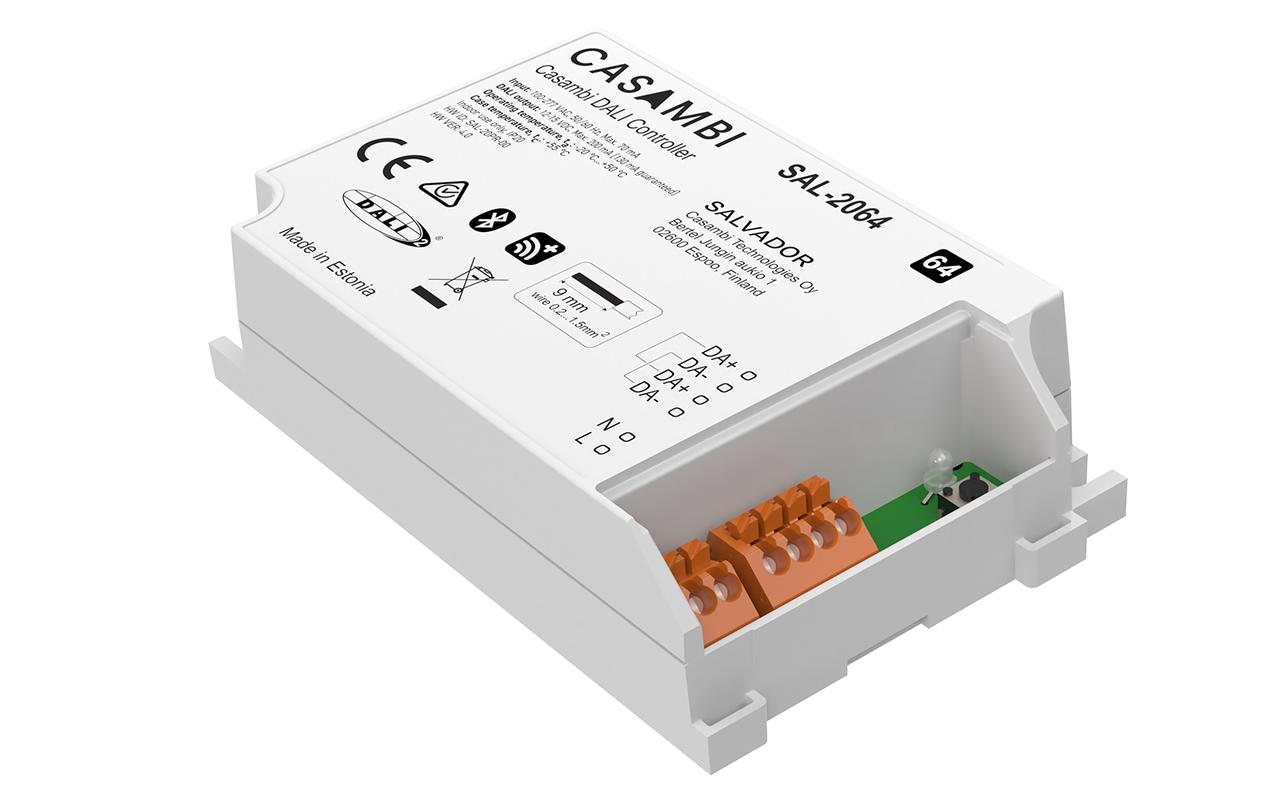
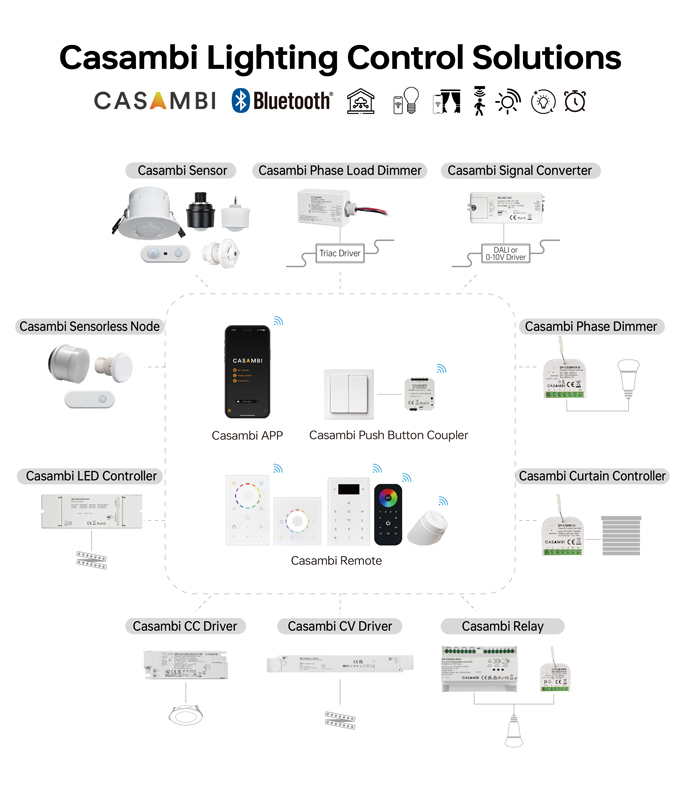
Casambi is a wireless lighting control platform built on Bluetooth Low Energy mesh. The core hardware is a small module (typically integrated into a driver or a junction box) that communicates with other Casambi nodes over Bluetooth mesh. No gateway required for basic operation — the app talks directly to the fixtures.
The Casambi pitch is compelling: retrofit an existing building with smart lighting control without running new wiring. That’s a real advantage. In buildings where running DALI bus cable would cost $80,000 in labor and conduit, Casambi can deliver wireless control for the cost of the modules and commissioning.
But the confusion comes from what people assume “wireless control” means versus what it actually delivers in practice.
What Casambi does well:
– Retrofit scenarios where running new cable is cost-prohibitive
– Simple on/off, dimming, and scene control via app
– Basic presence detection and daylight harvesting with wireless sensors
– No gateway or internet connection required for core functionality
– Scalable: start with one room, expand across a building
What Casambi doesn’t do well (or at all):
– Native BACnet or KNX integration without additional gateway hardware
– Enterprise-level audit logging and reporting without a paid Casambi ecosystem subscription
– Critical lighting applications (Casambi is not certified for emergency lighting control in most jurisdictions)
– Buildings with heavy RF interference (metal shelving, thick concrete, competing Bluetooth devices)
The BMS Integration Question That Gets Skipped
Here’s the conversation that saves clients from expensive mistakes: “Do you actually need this to talk to your building management system?”
In most cases, the answer is more nuanced than a yes or no.
Building management system integration makes sense when: HVAC, lighting, blinds, and fire safety are all controlled from a central operator station. When a facilities manager needs to see all building systems on one screen and respond to alarms holistically. When energy reporting requires combined data from multiple systems.
Building management system integration is overkill when: the building has simple HVAC and lighting, facilities management is decentralized, or the integration cost exceeds the operational benefit.
A 0-10V dimming system with photocell-based daylight harvesting doesn’t “talk to the BMS” — but it also doesn’t require commissioning, doesn’t have software to update, and doesn’t generate support tickets. For a warehouse or a retail space, that simplicity is a feature, not a limitation.
I had a client who spent $45,000 on a DALI system with full BACnet integration for a 5,000 sq ft retail showroom. The integration was specified by an architect who doesn’t operate the building. The facilities manager uses a wall panel and a $40 photocell. The BACnet integration has never been activated. That $45,000 bought complexity, not value.
Smart Home vs. Commercial: The Fundamental Architecture Difference
Consumer smart lighting (Phillips Hue, LIFX, WiZ) is designed for residential environments: small scale, transient connectivity, app-based control, short commissioning cycles.
Commercial building lighting has different requirements:
Scale: A commercial building might have 500+ fixtures. A consumer platform isn’t designed for that device count, and the network infrastructure (consumer routers, home WiFi) collapses under the load.
Reliability: Commercial lighting often covers egress paths, security-sensitive areas, and regulated environments. Consumer products are not tested to the standards required for these applications.
Maintenance: Consumer IoT products have a 2-3 year support lifecycle. Commercial lighting is expected to perform for 15-20 years. A platform that EOLs its cloud services in 3 years leaves building operators with expensive hardware that’s suddenly difficult to manage.
Commissioning: A residential smart home is set up by the homeowner in an afternoon. A commercial building requires lighting commissioning by trained technicians — and the control system’s commissioning software needs to support that workflow.
The Three Questions That Determine the Right Control Architecture
Before specifying any lighting control system, answer these:
1. What’s the maintenance capability?
If the facilities team can handle basic commissioning and occasional reconfiguration, a programmable system is viable. If lighting maintenance is handled by an electrical contractor who visits twice a year, the system needs to be dead simple — or the commissioning budget needs to cover ongoing support.
2. What’s the failure mode?
If a lighting control failure creates a safety issue (dark egress path, no emergency lighting), the system needs redundant control and local override capability. If it’s a retail showroom where dimming goes down for an afternoon, that’s a different risk profile.
3. What’s the integration requirement, really?
Get specific: “We want the lights to turn on when the building opens” — that’s a time schedule, solvable by any system. “We want lights to respond to CO2 levels in occupied zones” — that’s full BMS integration requiring DALI or another addressed protocol with a proper gateway.
What I’m Recommending in 2026
For new commercial construction with professional facilities management: DALI with BACnet/IP gateway. The architecture is proven, components are widely available from multiple manufacturers, and the commissioning ecosystem is mature. Budget 8-12% of fixture cost for control hardware and commissioning.
For retrofit projects with moderate requirements: Casambi-based wireless control with Tuneable White drivers for circadian or task-ambiance control. The app-based commissioning is accessible enough that building staff can manage it without specialized training. Budget 5-8% of fixture cost.
For simple commercial spaces (warehouses, parking structures, utility areas): 0-10V with photocell and occupancy sensors. Lowest cost, highest reliability, minimal complexity. Budget 2-3% of fixture cost for basic dimming and daylight harvesting.
For mixed-use or campus environments: Zigbee-based systems (like Philips Sysat) with a proper network infrastructure and professional commissioning. Zigbee mesh scales better than Bluetooth for large deployments and has better BMS integration pathways.
The biggest mistake in lighting control is treating it as a product selection rather than a system design problem. The protocol is just the language — the architecture is the strategy.
If your lighting control project is at the spec stage and you want a second opinion before committing to a particular approach, I’m available for consultation. 15 years of commercial lighting procurement across 30 countries means I’ve seen what works and what doesn’t — including the $45,000 BACnet integration nobody uses.
Related Reading:
• Smart Lighting Controls in Commercial Projects: Hidden Costs
• LED Dimming Protocols Compared: 0-10V vs DALI vs DMX
• Commercial LED Dimming Technologies Guide
About YoubeeLight: YoubeeLight is a professional LED lighting OEM/ODM manufacturer serving commercial, industrial, and institutional buyers worldwide. With 15 years of experience in the lighting industry, we supply wholesale buyers, distributors, and project contractors across North America, Europe, and Southeast Asia.
