
Dimming is no longer a luxury feature in commercial lighting—it’s an expectation. From office buildings seeking energy savings to hospitality venues creating ambiance, commercial LED dimming has become essential for meeting modern lighting requirements.
Yet choosing the right dimming protocol remains one of the most confusing decisions for lighting specifiers, contractors, and project managers. This technical deep-dive compares the four dominant commercial LED dimming technologies.
The Four Major Commercial Dimming Protocols
1. 0-10V Dimming: The Industry Workhorse
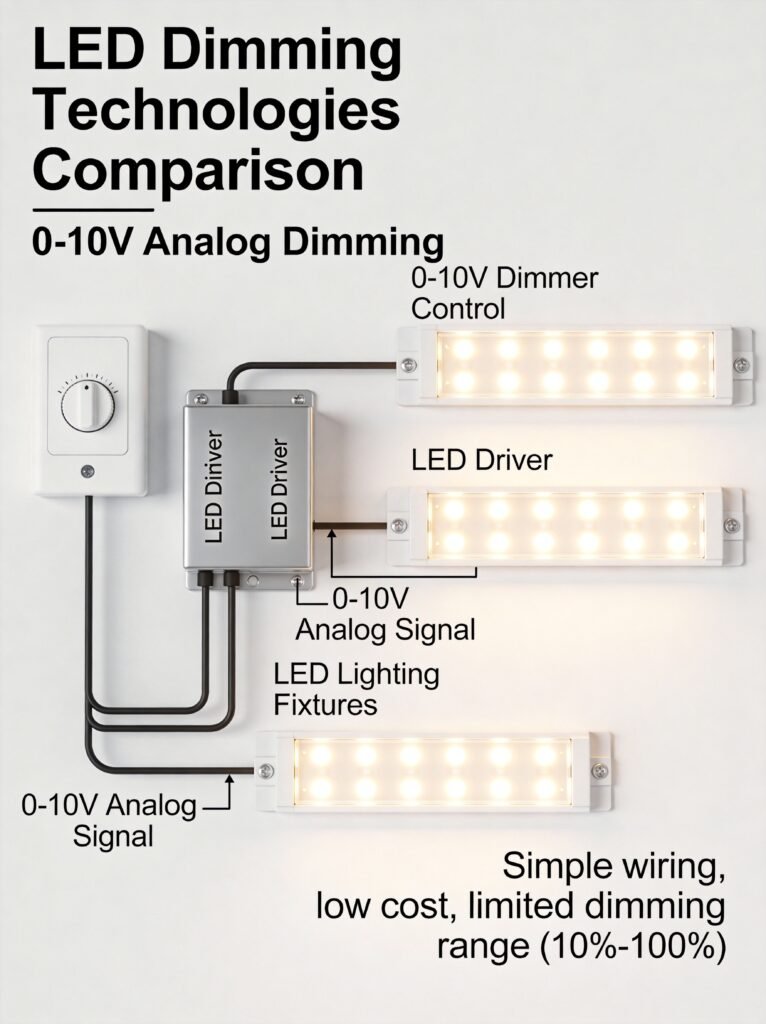
0-10V analog dimming is the oldest and most widely deployed dimming protocol. A control signal (1-10V DC) proportionally adjusts light output.
Advantages: Simplicity, compatibility, lowest system cost, proven reliability.
Limitations: Limited dimming range (typically 10-100%), no individual addressing, voltage drop issues on long runs.
Explore YoubeeLight’s 0-10V dimmable LED fixtures →
2. DALI (Digital Addressable Lighting Interface)
DALI is a digital lighting control protocol enabling individual fixture control, status feedback, and complex scene programming.
Advantages: Individual addressing, bidirectional communication, flexible grouping, scene control, DALI-2 standardization.
Limitations: Higher cost (20-40% more than 0-10V), design complexity, 64 devices per bus limit.
Learn about YoubeeLight’s DALI-compatible commercial lighting solutions →
3. DMX512: The Entertainment Industry Standard
DMX512 was developed for stage lighting but has found applications in architectural lighting and RGB color control.
Advantages: High speed (44 updates/second), 512 devices per universe, perfect for synchronized effects.
Limitations: Manual addressing, single-master architecture, overkill for basic dimming.
4. Bluetooth Mesh: The New Contender
Bluetooth Mesh enables many-to-many device communication without a central hub.
Advantages: No gateway required, scalability to thousands of nodes, self-healing networks, easy commissioning.
Limitations: Latency (50-200ms), range limitations, crowded 2.4GHz spectrum.
Application-Specific Recommendations
- Office Buildings: DALI-2 for flexibility and energy monitoring
- Hospitality: DALI-2 + Bluetooth Mesh hybrid
- Retail: 0-10V for track lighting, DALI-2 for ambient
- Entertainment: DMX512 for dynamic effects
- Industrial: 0-10V or basic smart controls
Making the Right Choice
Not sure which dimming technology fits your project? Contact YoubeeLight’s technical team for a free consultation. We’ll help you select the optimal dimming solution based on your specific requirements.
📧 Email: info@youbeelight.com
📱 WhatsApp: +852 6506 3139
Frequently Asked Questions
Q: Can I mix different dimming protocols in the same project?
While possible with protocol converters, it’s not recommended due to increased complexity and cost.
Q: What’s the minimum dimming level for LED fixtures?
Depends on driver quality. Standard drivers: 10% minimum. Premium drivers: 1% or lower.
Q: What certifications should dimmable fixtures have?
For US markets: UL listed drivers with dimmer compatibility listing. For EU: CE marking with EN/IEC 62386 compliance.
Ready to specify the right dimming technology for your project? Request a quote from YoubeeLight.
