Wattage is the wrong starting point for commercial LED flood lighting specification. Every supplier wants to sell you on watts because bigger numbers are easy to compare. But lumens per watt varies by manufacturer by 30-40%. A 200W fixture from one supplier might outperform a 300W fixture from another due to superior driver efficiency, thermal design, and optic precision. Yet procurement specs across the industry still read like light bulb shopping lists from a decade ago.
I’ve reviewed dozens of project specifications for commercial outdoor installations—sports fields, building facades, parking lots, loading docks, perimeter security—and the procurement mistakes are remarkably consistent. Here’s what actually matters when you’re sourcing fixtures for a project that needs to perform for 10+ years in hostile outdoor conditions.
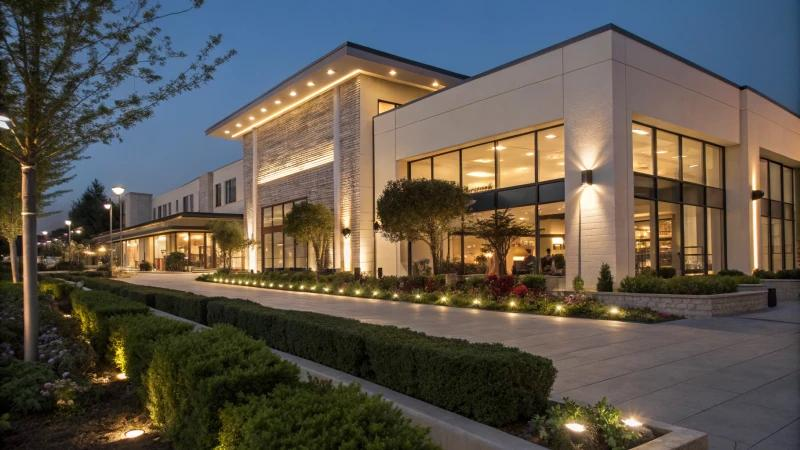
Commercial building facade LED architectural lighting at night
IP Ratings: The Difference Between 5 Years and 15 Years in the Field
Ingress Protection (IP) ratings are frequently misunderstood and routinely underspecified in outdoor flood lighting procurement. The two digits matter independently.
The first digit (0-6) indicates solid particle protection. For outdoor flood lights in commercial applications, you want minimum IP5X (dust-protected) and ideally IP6X (dust-tight). IP5X allows some dust ingress that will accumulate on optical surfaces over time, gradually reducing output. In industrial environments—loading docks, grain facilities, mining sites—you need IP6X.
The second digit (0-9K) indicates liquid ingress protection. Here’s where buyers consistently under-spec:
IP65: Protected against water jets from any direction. This is the minimum for outdoor flood lights in most commercial applications. IP65 fixtures handle rain, irrigation overspray, and pressure washing.
IP66: Protected against powerful water jets. Required near pressure wash zones, coastal fog exposure, or industrial environments with high-pressure cleaning cycles.
IP67: Protected against temporary immersion. Relevant if your flood light might be submerged during flooding events or pressure-tested.
IP68: Protected against continuous immersion. Typically overkill for standard mounting positions but necessary for below-grade installations or fountain lighting.
For coastal installations, IP66 minimum is non-negotiable. Salt air accelerates corrosion at fixture joints and compromises gasket integrity. IP65 fixtures in a beachfront parking lot typically fail within 3-4 years. IP66 buys you 8-10 years with proper maintenance.
YoubeeLight’s commercial flood light range starts at IP65 across the full product line, with IP66 and IK10-rated options for demanding environments. Check the LED catalog for specific IK impact ratings on each series.
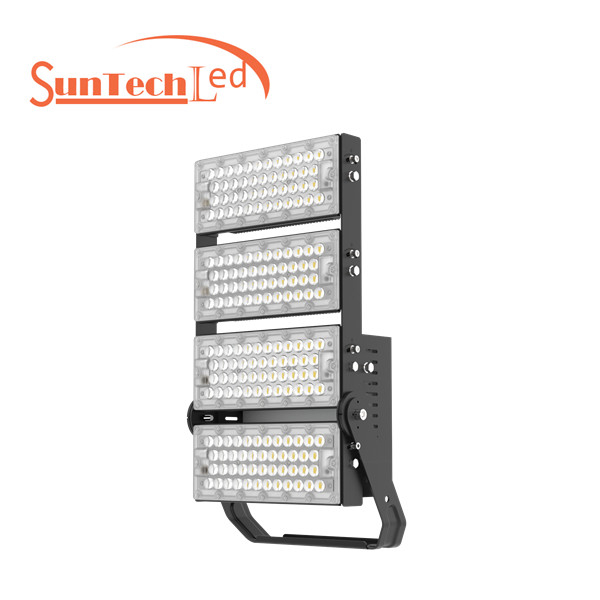
LED stadium flood lighting fixture – high mast sports illumination
Thermal Management: The Silent Killer of Outdoor Fixtures
Outdoor flood lights operate in thermal conditions that destroy poorly designed fixtures. Direct sun exposure on dark-housing fixtures can push internal temperatures 30-40°C above ambient. Add driver heat generation and you’re looking at 70-80°C junction temperatures in a Phoenix summer installation, where ambient hits 45°C.
LEDs degrade exponentially with temperature. The “L70 lifetime” of a fixture—that’s the point at which light output drops to 70% of initial—is typically rated at 25°C ambient. Run that same fixture at 50°C and L70 might collapse from 50,000 hours to 20,000 hours. At 70°C, you’re looking at 10,000-12,000 hours. That’s three years of 10-hour-per-night operation instead of fifteen.
What separates professional-grade flood light thermal design from cheap imports:
1. Die-cast aluminum housings with passive cooling fins vs. stamped sheet metal. Thermal conductivity differs by an order of magnitude.
2. Thermally isolated LED modules from driver compartment. The driver is the hottest component and proximity to LEDs accelerates both failures.
3. Thermal interface materials (TIM) between LED board and housing. Cheap thermal paste degrades within 2-3 years. Professional fixtures use phase-change thermal materials rated for 150°C continuous.
4. Driver operating temperature rating: Minimum Ta 50°C rating for commercial outdoor use. Many import fixtures are rated Ta 40°C only—which is fine for climate-controlled interiors, not Phoenix parking lots.
Ask your supplier for the TM-21 projected lumen maintenance data at the specific operating temperature your project will face. If they can’t provide TM-21 (or the older LM-80 data), they’re guessing about fixture lifespan.
Beam Angle Selection: Getting It Wrong Costs More Than You Think
Beam angle is where specifiers either over-engineer or under-engineer, often both simultaneously. The instinct is to use narrow beam angles for throw distance and wide angles for area coverage. But the actual selection depends on three variables: mounting height, coverage area, and uniformity requirement.
The practical rule: mounting height determines your maximum practical beam angle before uniformity becomes unacceptable. At 8 meters mounting height with a 60° flood, you get significantly better uniformity than at 15 meters with the same fixture. The light just travels farther before spreading enough to cause hot spots and dark zones at ground level.
For common commercial applications:
Application
Mount Height
Recommended Beam Angle
Notes
Building facade washing
6-12m
10°-30° narrow flood
Creates gradients, minimizes light spill
Sports field (recreational)
8-15m
40°-60° flood
Uniformity critical, ≥0.6 ratio
Sports field (competition)
15-25m
25°-45° narrow flood
Glare control per sport federation rules
Loading dock / yard
8-12m
60°-90° wide flood
Area coverage > uniformity
Parking lot (mid-size)
5-8m
60°-90° wide flood
ADA compliance affects uniformity
Perimeter security
4-8m
10°-30° narrow
Throw distance drives selection
A common mistake: mixing beam angles within the same installation without adjusting fixture spacing. If you combine 30° and 60° fixtures on the same pole layout, your uniformity will vary dramatically across the site. Stick to one beam angle family per zone or recalculate spacing for each type.
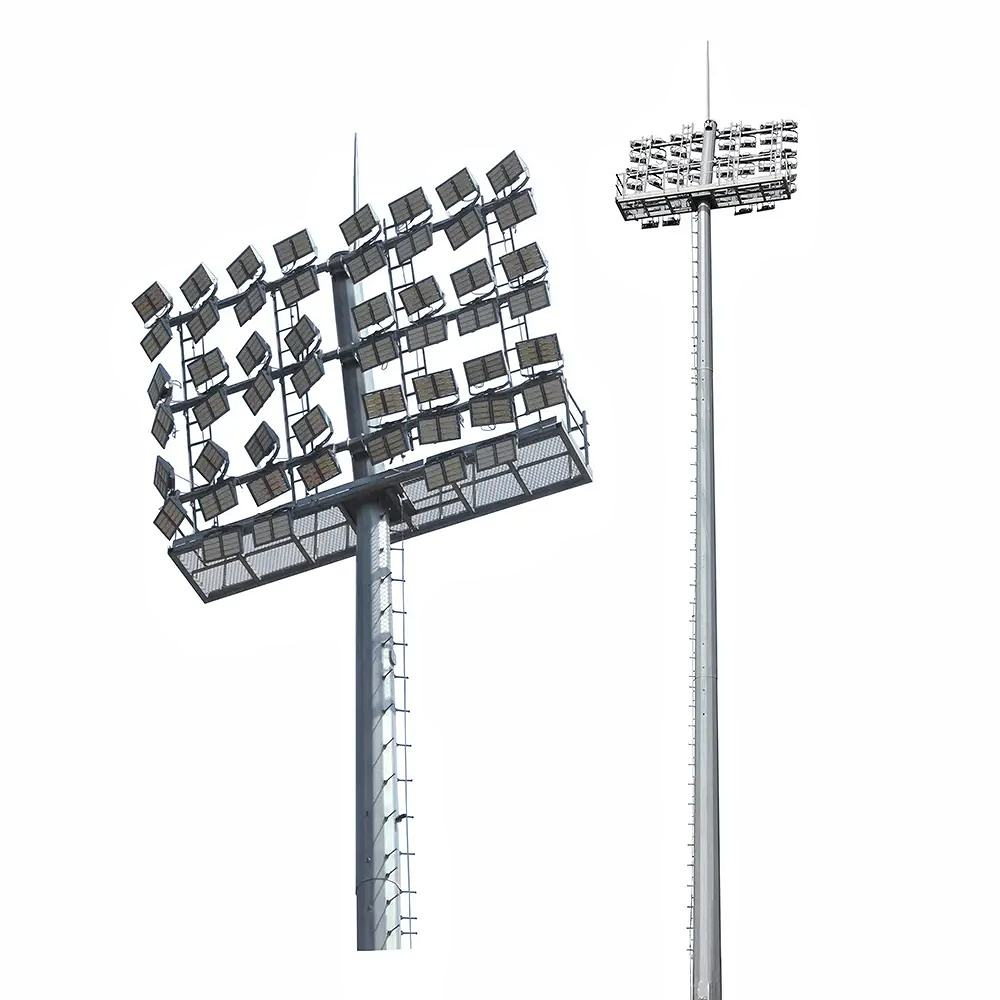
Outdoor stadium LED high mast lighting towers for professional sports facilities
Glare and Light Pollution: The Spec That’s Getting Harder to Ignore
Commercial flood lighting is increasingly scrutinized for light pollution—uplight that wastes energy, creates skyglow, and violates dark-sky ordinances now active in over 2,000 US municipalities. ASHRAE Standard 90.1 now includes backlight/uplight/glare (BUG) ratings for exterior lighting.
For most commercial outdoor installations, you need fixtures with UGR < 24 for general area lighting and < 19 for pedestrian-scale areas. Above that threshold, glare becomes a liability issue as much as a quality issue. A poorly shielded flood light in a parking structure entrance can create a genuine safety hazard at night.
Flood lights with precision optics and internal baffles reduce glare without sacrificing throw distance. The trade-off is always efficiency—you’re blocking some lumens to control light spill. Well-designed internal shielding might cost you 8-12% of total lumens but eliminates 95% of problematic uplight.
Cutoff classification matters:
Full cutoff: Zero uplight (0° above horizontal). Required in most dark-sky jurisdictions.
Cutoff: < 5% lumens above 90°. Acceptable for most commercial projects.
Semi-cutoff: < 5% above 80° and < 15% above 85°. Limited use cases.
Non-cutoff: No restriction. Only appropriate for flagpole and tower lighting where uplight is intentional.
If your project is in a dark-sky designated zone, near an airport, or subject to local ordinance, specify full-cutoff fixtures from the start. Retrofitting after installation is expensive and rarely achieves the same optical performance.
Sourcing Takeaway
Commercial outdoor flood lighting procurement starts with IP rating verification and thermal performance data, not wattage comparisons. Get TM-21 lumen maintenance projections at your actual site temperature. Calculate beam angle and mounting height together—never one without the other. Specify UGR and BUG ratings against your project lighting ordinance requirements. And always ask for fixture sample testing under actual conditions before committing to a large order.
For project lighting specifications or custom configurations for demanding outdoor environments, the YoubeeLight project team has delivered commercial flood lighting installations across North America, Europe, and the Middle East. Our full product range with detailed thermal and photometric data is available in the LED catalog.