
Retail Lighting Solutions for Shops & Stores 2026: A Wholesale Buyer’s Field Guide
When a UK fashion retailer called me up last month complaining their newly installed “premium” LED track lights made every garment look like a different color under the fitting room mirror, I knew exactly what went wrong. They bought on lumen output and wattage. Nobody asked about CRI at different CCTs. Nobody tested under actual store conditions.
That’s the retail lighting trap most buyers fall into. They spec lights in a warehouse, install them in a boutique, and wonder why sales don’t match their lighting consultant’s projections.
The Fundamental Problem With Retail Lighting Specs
Here’s what catalog specs won’t tell you:
Lux levels are meaningless without context. A lighting plan specifying 500 lux at counter height sounds reasonable until you realize it was calculated for a 3-meter ceiling. Your actual store has 4.2 meters and a grid ceiling that blocks 30% of downward light.
CCT numbers lie about ambiance. 4000K sounds neutral. But under 4000K LED in a north-facing London boutique, cashmere reads gray. In a sun-drenched Miami showroom, the same 4000K looks cold and clinical.
CRI tells half the story. A CRI 90 fixture can still make reds look muddy if the R9 (red) value drops below 50. Most spec sheets don’t even list R9.
The only spec that matters for retail: what does the merchandise look like at point of sale?
What Actually Works in Retail Lighting
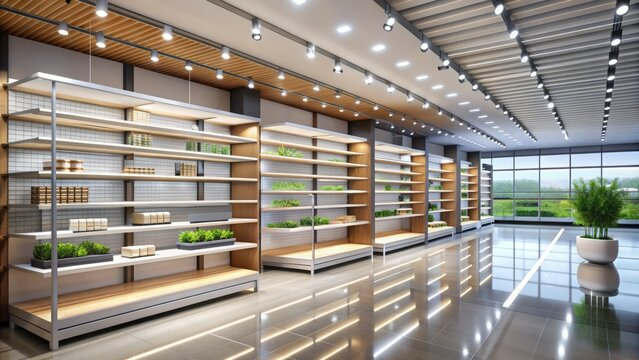
After 15 years of watching lighting projects succeed and fail, the patterns are clear:
Fashion & Apparel Stores
This is where lighting gets complicated. You’re not illuminating a space—you’re illuminating fabric, leather, and skin tones simultaneously.
The sweet spot is 3000K-3500K with CRI 95+ and R9 above 80. Anything cooler washes out complexions. Anything warmer flatters inventory but distorts color relationships between pieces.
Track lighting works best because you can aim individual fixtures. A 24-degree spot for display windows. A 15-degree accent for focal pieces. 60-degree floods for general ambient.
Don’t cheap out on dimming. Retail traffic patterns change. High noon in summer needs 60% output. Evening needs 100%. Dim-to-warm drivers (that shift CCT as you dim) are worth the premium in fitting rooms.
Electronics & High-Tech Retail
This is where you can go cooler—4000K to 5000K—because you’re lighting products, not people. The cool light makes screens and metallic finishes pop.
But watch the glare. High-gloss products reflect fixture hot spots. Use recessed downlights with 50-degree cut-off angles, or linear pendant systems with diffused panels.
Grocery & Specialty Food
Color rendering is non-negotiable here. Customers literally use lighting to judge freshness. A warm 2700K makes produce look appealing. The same tomatoes under 5000K look anemic.
Consider tunable white systems. Morning shift at 3500K. Evening at 2700K to make everything look “just brought in.”
The Retail Lighting Mistakes That Kill ROI
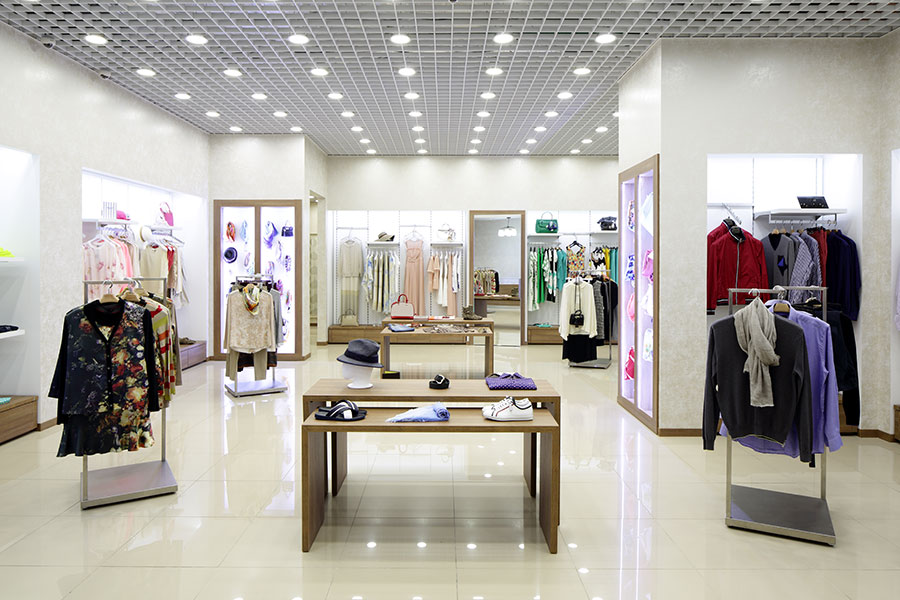
Mistake #1: Uniformity obsession. Some buyers spec lights so evenly spaced that the store looks flat. Professional retail lighting creates contrast. Brighter at entry. Focused on key merchandise. Subdued in service areas. That contrast guides customer movement.
Mistake #2: Ignoring maintenance factor. LED depreciation is real. A fixture rated L70 at 50,000 hours at 25°C ambient will depreciate faster in a poorly ventilated ceiling. Spec 80% of initial lumens as your working light level. Budget for re-lamping at 60% of rated life.
Mistake #3: Retrofit theater. Here’s a pet peeve. Customers swap halogen for “equivalent” LED and complain the store “doesn’t feel the same.” It’s because they bought on wattage equivalence, not photometry. A true 50W halogen replacement needs the same beam angle, CCT, and CRI—not just the same base.
Mistake #4: Control system under-spec. The best LED system with a cheap dimmer flickers at low levels.预算 for DMX or DALI controls with smooth 0-100% dimming. Budget 15% of control system cost for commissioning.
Sourcing Retail Lighting From China: What Actually Matters
Most buyers focus on the wrong things when sourcing from Chinese manufacturers. Here’s what to actually verify:
Verification Checklist
Factory visit or third-party inspection is non-negotiable. I’ve seen spec sheets from factories that can’t actually produce what’s printed. The CRI 95 fixtures? Off a different production line. The IP65 rating? Tested samples only.
Minimum order quantities exist for a reason. If a factory offers 1-unit MOQ on custom track fixtures, they’re dropshipping from a warehouse, not manufacturing. True custom work starts at 200-500 units minimum.
Lead time math: Standard track fixtures: 4-6 weeks. Custom colors or optics: 8-12 weeks. UL/ETL certification: Add 4-6 weeks and $5,000-15,000 per model.
Sample process: Order 3-5 samples before any production order. Test them in your actual store environment, not under showroom conditions. Pay the $200-500 sample premium. It’s cheaper than a $50,000 inventory mistake.
The Retail Lighting Layout That Actually Sells
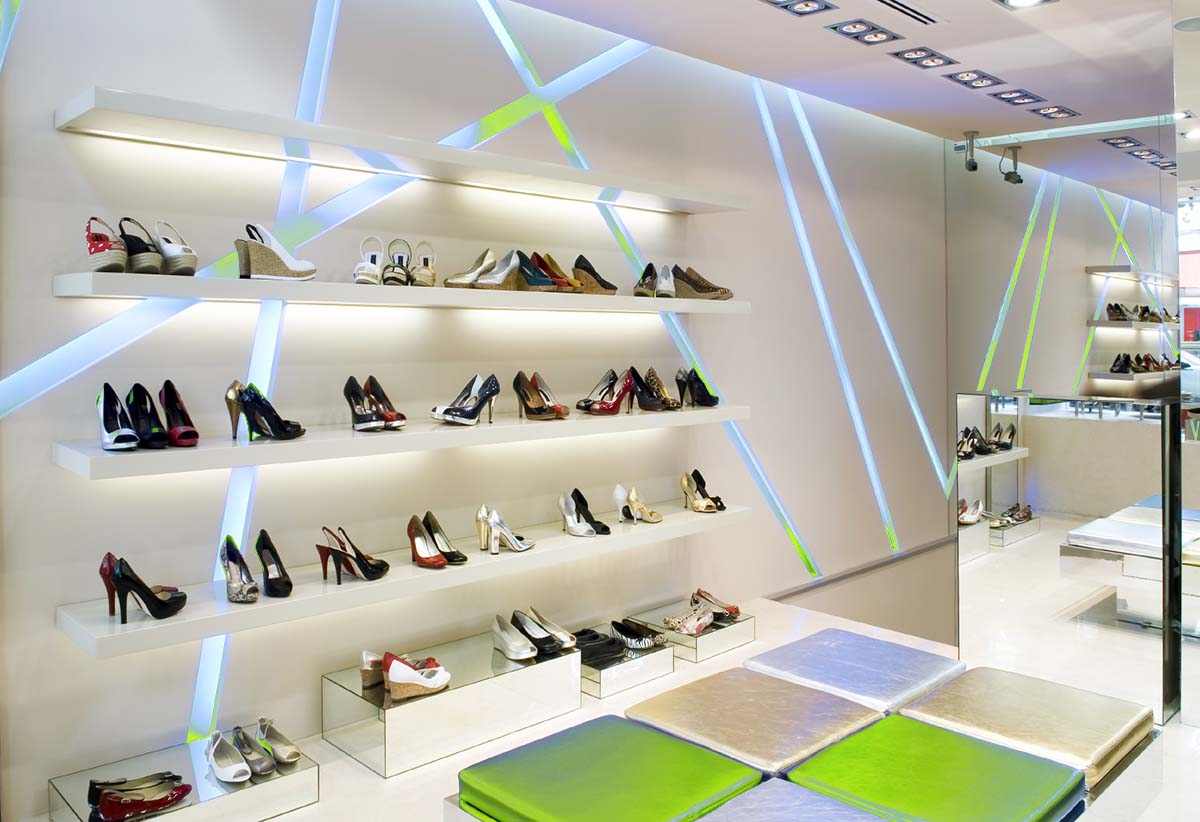
Forget the lighting plan your architect drew. Here’s what retail lighting should accomplish:
-
Draw the eye to entry. The first 3 meters of your store should be brightest. Customers make the “do I stay or go” decision within 6 seconds.
-
Create a path. Use lighting to guide customers past key merchandise zones. Not a straight path—a curated journey.
-
Create a destination. Key display areas should be 2-3x ambient light levels. This creates visual anchors.
-
Light the service areas. Fitting rooms, checkout counters, consultation areas—these need functional task lighting that customers won’t consciously notice but will feel as “easy to use.”
-
Leave shadows in non-selling zones. Storage, staff areas, utility zones—under-lighting these areas is fine. It actually makes the selling floor feel more premium by contrast.
What’s Changing in 2026
Human-centric lighting is moving from concept to spec. Tunable white systems that shift CCT throughout the day are now cost-competitive with fixed-CCT systems. In regions with strong wellness positioning (Nordic markets, premium fitness retail), this is becoming a differentiator.
Connected lighting is table stakes for new projects. Not for the energy savings—for the data. Occupancy sensors reveal customer flow patterns. Daylight harvesting optimizes energy spend. But connected doesn’t mean complicated. Casambi and Samsung SmartThings have simplified commissioning significantly.
The sustainability story is evolving. It’s no longer enough to specify “LED.” European and North American retailers are asking for Environmental Product Declarations (EPDs), repairability scores, and take-back programs. Chinese manufacturers with genuine sustainability credentials are getting preference over pure price competitors.
The Bottom Line
Retail lighting is not a commodity purchase. The fixtures you spec determine how merchandise looks. How merchandise looks determines purchase decisions. Purchase decisions determine revenue.
The ROI calculation isn’t “what did we save on fixtures.” It’s “what did we gain in sell-through, reduced returns, and customer dwell time.”
Work with manufacturers who understand retail, not just lighting. Ask for reference projects. Test samples in your actual store. And for God’s sake, check the R9 value before signing any purchase order.
Need help specifying retail lighting for your next project? Browse our commercial lighting catalog or contact our specification team for project-based consultation.
At YoubeeLight, we supply LED track systems, downlights, and linear fixtures to retailers and lighting designers across Europe and North America. MOQ starts at 200 units with custom optics and controls available.
