
LED Flicker and Stroboscopic Effect: The Hidden Quality Problem Killing Your Commercial Space
I got a call last year from a warehouse manager in Rotterdam. His workers were complaining of headaches, eye strain, and difficulty focusing. Productivity was down 12% in the picking zone. They’d replaced the old HID fixtures with LED high bays six months prior.
The problem wasn’t the LED quality. It was flicker.
Not the obvious, visible flicker you’d see from a dying fluorescent tube. This was invisible stroboscopic effect—the kind your eyes can’t consciously detect but your brain absolutely notices after hours of exposure.
This is the quality spec nobody talks about until someone gets sick.
What Is Flicker (And Why Most People Get It Wrong)
Flicker has two components:
Visible flicker is what you see—a light pulsing on and off. This happens with poor quality drivers at low dimming levels or when LEDs are powered by incompatible AC/DC conversions.
Stroboscopic effect is invisible to most people but still detected by your visual system. It’s the perception that a moving object has multiple positions or appears frozen. Think of a conveyor belt under strobe lighting. Same principle applies with high-frequency LED systems.
Both are caused by the same root issue: AC power modulation.
Mains electricity runs at 50Hz (Europe) or 60Hz (North America). This means the voltage sine wave crosses zero 100 or 120 times per second respectively. If your LED driver doesn’t smooth this completely, the light output modulates at that frequency.
The IEEE PAR 1789 Standard
In 2015, IEEE published PAR 1789, a risk assessment for flicker in LED lighting. It categorizes risk levels based on:
- Flicker frequency (how many modulations per second)
- Flicker percentage (how much the light output varies)
| Risk Level | Frequency Range | Percentage |
|---|---|---|
| No concern | > 3kHz | Any |
| Low risk | 100-3kHz | < 3% |
| Low risk | 50-100Hz | < 1% |
| High risk | < 50Hz | Any |
Here’s the problem: most budget LED drivers modulate at 100-120Hz. This is in the “low risk” category by IEEE standards. But “low risk” doesn’t mean “no risk”—especially for environments where people work 8-hour shifts.
Why Commercial Spaces Are Most Vulnerable
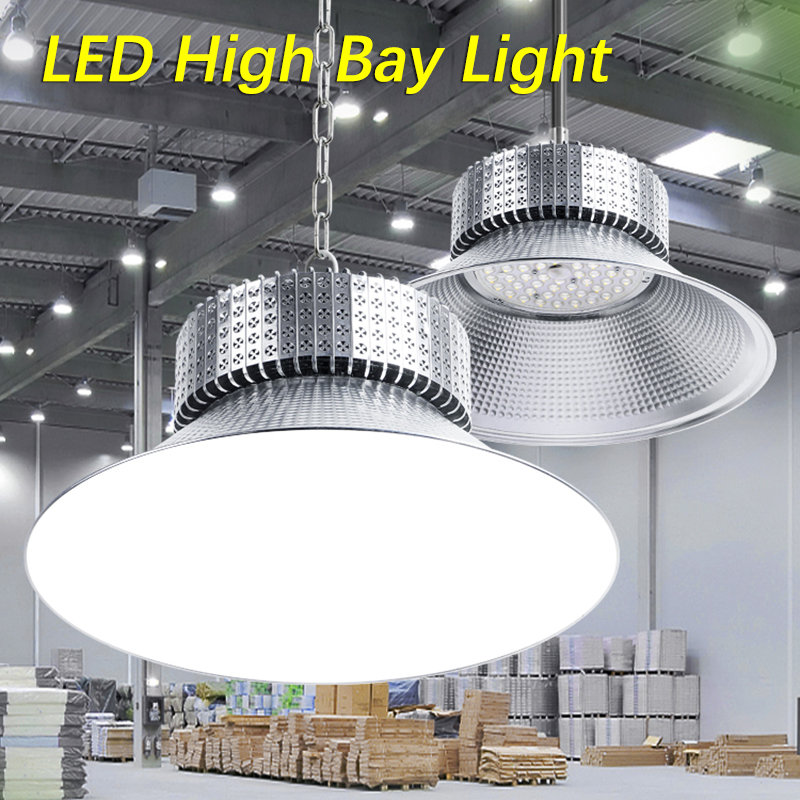
Industrial facilities are ground zero for flicker problems:
High-bay installations typically use cheaper constant-voltage drivers driving multiple fixtures. The wiring length introduces impedance variations that make flicker worse at the end of runs.
Motion-heavy environments (warehouses, manufacturing floors, gymnasiums) are where stroboscopic effect becomes dangerous. A forklift moving at 10km/h under 100Hz flicker can appear to have multiple positions. Operators making split-second decisions are working with corrupted visual data.
Long exposure time matters. A consumer walking through a retail store for 20 minutes gets minimal exposure. A warehouse worker operating equipment for 8 hours accumulates significant neurological load.
But it’s not just industrial:
Offices with poor-spec LED cause the afternoon productivity slump nobody blames on lighting. The eye strain and difficulty focusing that everyone attributes to “screen time” is often actually low-level flicker exposure.
Healthcare settings are particularly concerning. Stroboscopic effect can interfere with visual perception in medication preparation areas, surgical support zones, and anywhere fine motor control under time pressure matters.
Schools and universities are starting to face flicker complaints as LED retrofits age and driver quality degrades. Teenagers already dealing with circadian disruption from screens are doubly compromised by flickering classroom lights.
The Technical Root Causes
Driver Quality
The driver is where flicker happens. A quality driver:
- Uses active power factor correction (PFC) to smooth input power
- Maintains output current within 5% across the dimming range
- Uses high-frequency switching (> 1MHz) to eliminate perceptible modulation
Budget drivers use passive PFC and cheap switching components. They meet minimum efficiency standards but don’t eliminate flicker—they just push it above the threshold of obvious visibility.
Dimmer Compatibility
This is where specifiers consistently drop the ball. They specify “dimmable LED fixtures” without checking dimmer compatibility.
Leading-edge (TRIAC) dimmers designed for halogen are the worst offenders. They chop the leading edge of the AC sine wave to reduce power. The resulting waveform has massive harmonic distortion that cheap LED drivers can’t filter.
Proper dimming requires:
– Trailing-edge dimmers for low-power applications
– 0-10V signaling for commercial systems
– DALI or DMX for addressable dimming with smooth response
Supply Voltage Variation
In industrial zones, supply voltage can vary 10-15% based on load. A fixture spec’d at 230V might actually see 207V during peak demand. Cheap drivers will modulate output with this variation, creating flicker.
How to Test for Flicker (Without Expensive Equipment)
You can’t see flicker with your naked eye in most cases. But here’s a practical test:
The smartphone test: Open your camera app, point it at the fixture, and slowly pan across the lit area. If you see banding or pulsing patterns, you have flicker. This isn’t scientifically accurate but it works for quick field assessment.
The pen test: Wave a pen rapidly in front of a light. If you see multiple pen images or the motion appears stuttery, you have stroboscopic effect.
The professional tool: A PAR 1789-compliant meter or a smartphone app like “Flicker Tester” (iOS) will give you percentage readings. Aim for < 3% flicker at your dimming levels.
What Good Spec Looks Like
When you’re specifying flicker-free LED for commercial applications:
Driver Requirements
- Driver type: Constant current, isolated output

- Flicker frequency: > 1kHz at all dimming levels

- Flicker percentage: < 3% at full output

- Flicker percentage: < 5% at 10% dimming

- THD (Total Harmonic Distortion): < 10%

- Power factor: > 0.95
Verification Process
- Request driver datasheets with flicker specifications
- Test production samples with a flicker meter
- Conduct extended exposure testing in actual application
- Survey workers after 30/60/90 days of operation
The Cost Reality
Flicker-free drivers cost 30-50% more than budget drivers. For a warehouse with 200 high bays, that’s $10,000-20,000 additional cost.
But compare that to:
– A 12% productivity reduction = $60,000+ annual loss in a picking operation
– Workers’ compensation claims for eye strain or headaches
– Retraining costs if turnover increases due to discomfort complaints
The ROI calculation isn’t difficult.
The Certification Landscape
Some regions are starting to mandate flicker requirements:
CEC (California Energy Commission) Title 24 now includes flicker requirements for certain commercial applications.
EN 12464-1 (Europe) provides guidance on flicker for workplace lighting, though it’s not yet mandatory.
DLC (DesignLights Consortium) 5.1 includes flicker requirements for listed products—the qualification that opens utility rebate programs in North America.
If you’re procuring for a regulated market, check current flicker requirements. They’re tightening annually.
Sourcing Flicker-Free Fixtures From China
Most Chinese manufacturers can produce flicker-free fixtures. The issue is verification.
Questions to Ask
- “What driver do you use?” (Look for brand names: Mean Well, Tridonic, Osram)
- “Can you provide flicker test reports from an accredited lab?”
- “What is your flicker percentage at 10% dimming?”
- “Do your dimmable fixtures work with [specific dimmer brand]?”
Red Flags
- “All our LEDs are flicker-free” without specification
- Refusal to provide third-party test reports
- Driver components listed as “or equivalent”
- MOQ too low for proper quality control (under 100 units for custom work)
Sample Testing Protocol
Order 5-10 samples minimum. Test them:
– At full output
– At 50% dimming
– At 10% dimming
– After 4 hours continuous operation (driver temperature affects flicker)
If any sample fails flicker criteria, reject the batch. It’s not a calibration issue—it’s a quality control issue.
The Future: Flicker-Free as Standard
Here’s my prediction: Within 5 years, flicker-free will be as standard as RoHS compliance. Not because of regulation, but because the liability exposure is becoming too high.
Workers’ compensation claims for lighting-related health issues are increasing.law firms are starting to specialize in these cases. The documentation requirements for defense are substantial—and having specified known-flicker products is not a good starting point.
The good news: flicker-free technology is becoming cheaper as demand increases. The premium that existed 5 years ago is narrowing. For most applications, you can now specify flicker-free without significant cost penalty.
Stop accepting “LED flicker is normal” from suppliers. It’s a quality control issue, not an inherent LED characteristic.
Need flicker-free fixtures for your commercial project? Browse our industrial LED catalog for high-bay and linear fixtures with verified flicker specs. Our team can provide third-party test reports on request.
YoubeeLight supplies commercial LED fixtures meeting DLC 5.1 and EN 12464-1 requirements. Custom specifications available for projects with strict flicker requirements.
