
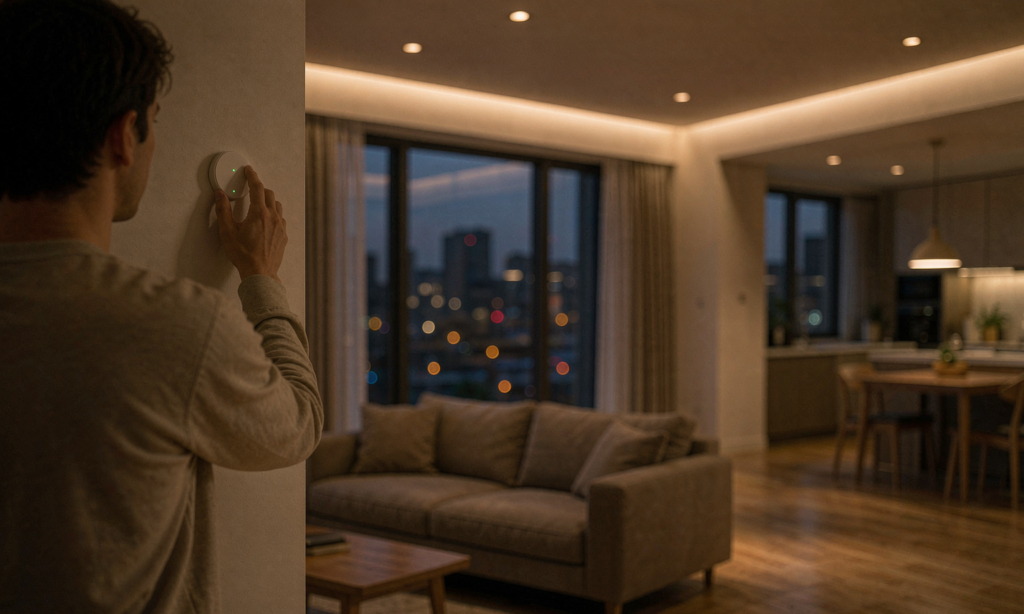
Direct answer: In 2026, Matter lighting is real — for residential and light-commercial rooms. On/off, dimming, color control, multi-ecosystem pairing and true local control now work across Apple Home, Google Home, Alexa and SmartThings, and Thread 1.4, released in September 2024, finally stopped border routers from splitting into competing meshes. What has not changed: there is no luminaire-level energy and diagnostics path comparable to D4i, no emergency-lighting device type, and no sign that commercial projects are switching. Specify Matter where the user is a person with a phone; keep DALI-2/D4i and Zigbee where the user is a facility manager.
What Matter actually is — an app layer, not a radio
Matter is an application-layer standard from the Connectivity Standards Alliance: one common language for smart home devices, running over IP on top of Wi-Fi, Ethernet or Thread. It defines device types and the data clusters each one supports. Lighting was in the first release — Matter 1.0 shipped in October 2022 covering on/off lights, dimmable lights, color-temperature lights and extended-color lights, alongside switches, plugs, sensors and locks.
Since then, the lighting part of the specification has barely moved, which is a sign of maturity rather than neglect. Matter 1.3 (May 2024) added scenes and command batching. Matter 1.4 (November 2024) delivered Enhanced Multi-Admin and the HRAP device type that combines a Wi-Fi access point with a Thread border router. Matter 1.5 (November 2025) brought cameras, closures and TCP transport. Matter 1.6 (June 2026) added NFC-based commissioning and Joint Fabric without new device categories. For a luminaire buyer the practical takeaway is simple: a Matter lighting device certified in 2023 speaks the same core language as one certified today.
One caution on vocabulary: only devices that pass CSA certification may carry the Matter logo. Marketing phrases like “Matter-ready,” “Matter-compatible” or “works with Matter via bridge” describe the vendor’s intention, not a certification status — and they are applied to everything from certified fixtures to cloud connectors that never went through the program. When a datasheet matters to a project, ask which device type the product is certified against, and check it against the CSA’s certified products listing.
What Thread actually is — and why the border router decides everything
Thread is the transport underneath much of Matter: an IEEE 802.15.4 mesh on 2.4 GHz, IPv6-native, self-healing, with end devices that can sleep for years on a battery. A Thread network supports up to 32 active routers, with end-device capacity in the hundreds per router in theory — practical designs stay in the low hundreds of nodes per network.
Every Thread network needs at least one border router to reach the rest of the world; that box routes traffic between the mesh and your LAN. Before 2024 this was the weak point: each vendor’s border router tended to build its own mesh, and devices from different ecosystems refused to share it. Thread 1.4, released in September 2024, changed the model — new border routers join the existing mesh and share credentials instead of partitioning it, the mesh can extend over the building’s Wi-Fi and Ethernet backbone through Thread over Infrastructure, large installations can commission devices with certificate-based credentials, and networks expose standardized diagnostics. In plain terms: the mesh your lights and sensors sit on stops being a vendor island.
The fork that matters: Matter over Thread or Matter over Wi-Fi
| Matter over Thread | Matter over Wi-Fi | |
|---|---|---|
| Power draw | Battery-friendly | Mains-powered devices |
| Network behavior | Self-healing mesh that hops around interference | Depends on your Wi-Fi; 2.4 GHz congestion is real |
| Extra hardware | Border router required | None — the router you already own |
| Without internet | Local control works fully | Local control works; vendor clouds and voice may not |
| Typical fit | Sensors, switches, battery devices, larger device counts | Plugs and bulbs in small homes, retrofit simplicity |
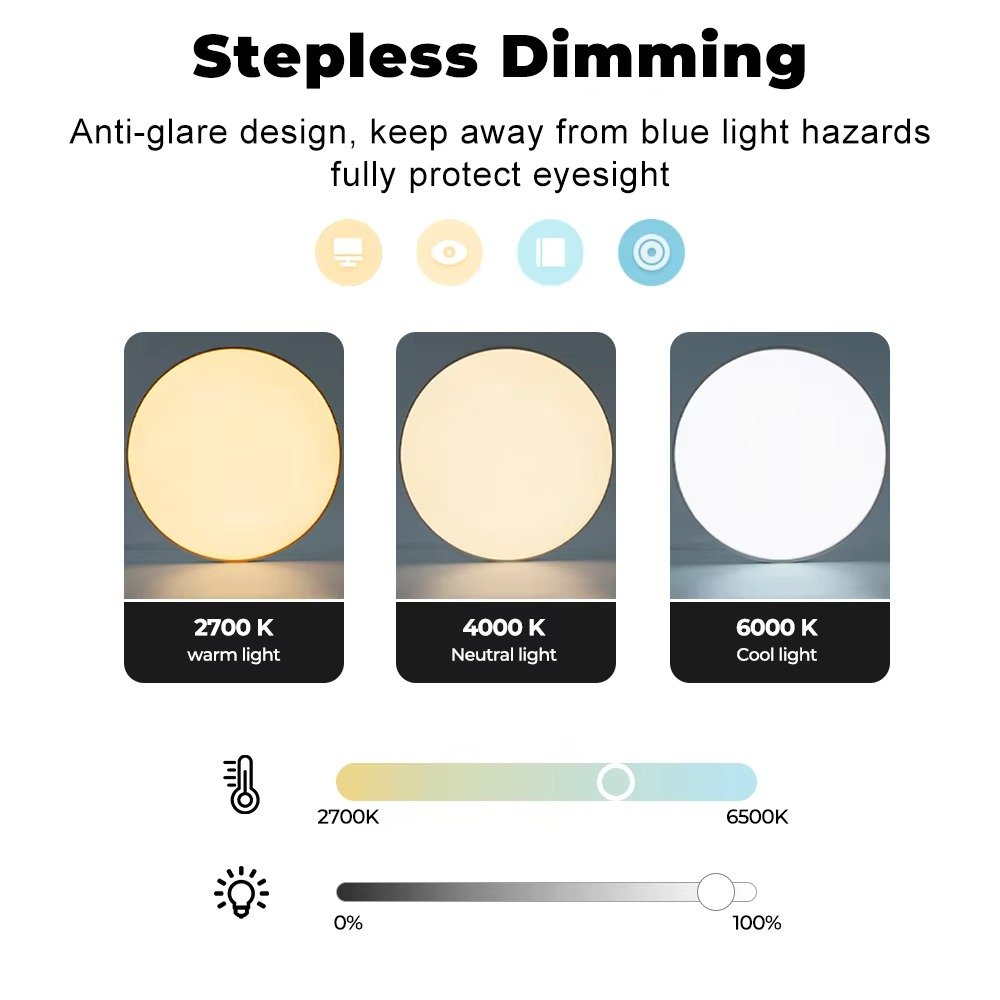
For a lighting specification this fork matters less than vendor marketing implies: the luminaire side is identical either way, and what changes is the infrastructure around it. The questions that actually matter are whether a Thread border router exists in the building and whether the controller ecosystem has adopted Thread 1.4 behavior.
What “Matter certified” tells you — and what it leaves out
The Matter logo on a datasheet means the CSA has certified that device against specific device types and clusters, and that it will commission into the major ecosystems. It does not tell you:
- Dimming quality. Minimum dimming level, dimming curve and flicker are datasheet items, not certification items. Two Matter-certified downlights can feel completely different at 10 percent output.
- Energy and diagnostics. Device-level energy measurement has been in the spec since Matter 1.3, but implementation is optional and rare on luminaires. D4i, by contrast, makes luminaire-level energy reporting (Part 252) and diagnostics (Part 253) part of the certification itself — see how D4i certification works for commercial lighting.
- Emergency operation. There is no Matter device type for emergency lighting or the self-test records an inspector will ask about. A Matter retrofit cannot replace the emergency circuits in a commercial fit-out.
- Feature availability. A 1.6 device may support NFC commissioning, but only when the controller app supports it — ecosystem adoption of new spec versions is staggered, and that is where most real-world friction lives.
Where Matter is genuinely the right call in 2026
Residential is solved: certified bulbs, fixtures and controllers interoperate across the four major ecosystems, multi-admin lets one fixture live in two apps simultaneously, and local control survives the ISP outage. Hospitality guest rooms are a strong fit — a fixture can be commissioned over NFC before it is even powered, a real use case the 1.6 specification was written for, since ceiling fixtures are awkward to commission after installation. Small retail, clinics and offices up to a few hundred control points work well, provided nobody needs luminaire-level energy dashboards. Joint Fabric in 1.6 points directly at the multi-tenant, shared-management case those buildings create.
A worked example makes the boundary concrete. A 40-room boutique hotel can run Matter end to end: pre-commission downlights and lamps in the warehouse, hand each room’s controller to the guest through the property app, and let housekeeping scenes live locally so a network outage never darkens a corridor. The same hotel’s back-of-house is a different answer — corridors on emergency circuits, energy dashboards by floor, and maintenance records the engineering team audits quarterly. That split, guest experience versus managed infrastructure, is the cleanest way to decide which rooms get which protocol.
Why commercial projects still standardize on DALI-2/D4i and Zigbee
Open a commercial lighting specification and the controls line still reads DALI-2, D4i or Zigbee — not because specifiers are conservative, but because the requirements have a different shape. DALI provides 64 addressed devices, 16 groups and 16 scenes per line over wired, deterministic wiring; there is no RF site survey and no mesh-throughput question to answer. D4i builds luminaire-level data on top of that: integrated power-supply data (Part 250), luminaire inventory data (Part 251), energy reporting (Part 252) and diagnostics (Part 253), all certified through the DALI Alliance’s D4i program. That is the dataset facility-management software, BMS integrations and maintenance contracts actually consume.
Matter has no native DALI support — bridges translate, and every translation layer loses group and scene fidelity. Matter’s commissioning model also assumes a phone and an app, not an installer with a handheld configurator addressing 400 drivers across three floors.
There is also a dimension nobody markets: interference engineering. A DALI line is a wired bus — it does not compete with the Wi-Fi network for spectrum, does not degrade when the steel racking in a distribution center blocks 2.4 GHz, and does not need a re-survey when the tenant rearranges the floor plan. Wireless retrofit controls have earned their place in existing buildings precisely because pulling wire is expensive; in new construction, where conduit is being installed anyway, the wired option is usually the cheaper one over the life of the building.
| Project requirement | Matter’s answer | DALI-2/D4i answer | Verdict |
|---|---|---|---|
| Per-luminaire addressing | Endpoint per device, app-based | 64 addresses per line, wired | DALI at scale |
| Energy reporting | Optional since 1.3, rare on luminaires | Mandatory Part 252 for D4i | DALI/D4i |
| Diagnostics and maintenance data | Not in the spec | Part 253, certified | DALI/D4i |
| Emergency lighting | No device type | DALI emergency devices with test records | DALI only |
| Multi-ecosystem app control | Native since 1.0 | Not DALI’s job | Matter |
| Room-level smart control, 50 rooms | Strong, improving with 1.6 | Works but heavier to commission | Matter |
| Facility software integration | Via bridges and clouds | Native BMS/BAS integrations | DALI/D4i |

The dead-end controller problem — five checks before you buy
The protocol risk in 2026 is not Matter itself; it is the controller you hang it on. Ecosystems rise and fall, but a luminaire installed in a ceiling for the next decade needs a control path that survives its vendor. Before specifying any controller, hub or luminaire with “Matter” on the box, run this checklist:
| Check | What to ask | Pass criteria |
|---|---|---|
| Spec version | Which Matter version is certified — not “Matter-compatible”? | Certified device, logo present, version stated |
| Border router | Is Thread 1.4 built in, or do I buy another box? | Thread 1.4 support stated; joins an existing mesh |
| Offline behavior | What still works when the internet is down? | Local control documented, not promised |
| Multi-admin | Can the fixture live in two ecosystems at once? | Multi-admin or fabric sync supported |
| Longevity | Who ships firmware updates, for how many years? | Stated update policy from a vendor with a lighting track record |
A practical hedge for mixed projects: choose controllers that speak both worlds — a Matter bridge sitting on a DALI-2/D4i backbone, or a bridge that exposes legacy Zigbee bulbs as Matter endpoints. You get app-level interoperability where it earns its keep, without betting maintenance data on a smartphone protocol.
Frequently asked questions
Do I need a bridge for my existing Zigbee lights?
Yes, typically. A bridge exposes the Zigbee network as Matter endpoints to your app of choice. Basic on/off and dimming control translates well; advanced vendor features usually stay inside the vendor’s own app.
Does Matter work without the internet?
Local control does — that is a core design property of the standard. What drops offline is remote access, cloud services and most voice-assistant features. Both Thread and Wi-Fi transports support this; the controller app is the variable.
Is Thread the same as Matter?
No. Thread is the mesh transport; Matter is the application language running over it. A Matter device can run over Thread, Wi-Fi or Ethernet, and Thread networks can carry application protocols other than Matter.
Will Matter replace DALI in commercial buildings?
Not on the current trajectory. Matter has no emergency-lighting device type, optional energy reporting and no certified diagnostics dataset — the three things commercial maintenance workflows are built on. Expect coexistence, with Matter at the room level and DALI-2/D4i at the system level.
How many devices can one Thread network hold?
The architecture supports up to 32 active routers per network, with end-device capacity in the hundreds per router in theory. In practice, plan networks in the low hundreds of nodes and add border routers — Thread 1.4 makes them share one mesh — as the building grows.
