Port and marine terminal lighting gets specified as if it’s just outdoor industrial lighting with slightly more rain exposure. That framing gets people killed and equipment damaged. Marine environments are chemically aggressive, mechanically stressed, and operationally critical in ways that make standard industrial specifications dangerously inadequate.
I’ve worked on lighting installations at container terminals, marina facilities, and commercial port operations across the Gulf Coast and Pacific Northwest. The failure modes I see most often aren’t product quality issues—they’re specification errors that doomed the project before anyone ordered fixtures.
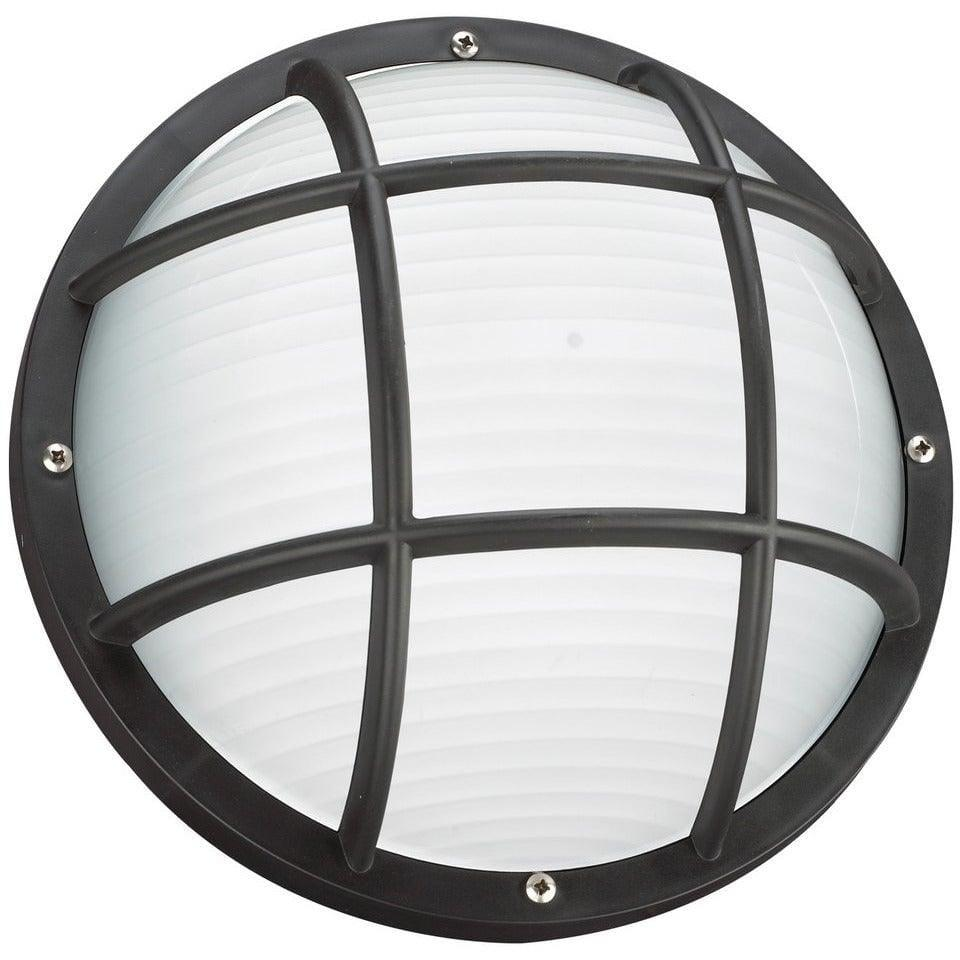
Outdoor marine wall pack fixture with protective grille for salt air environments
Salt Air Is a Different Beast
The standard assumption for outdoor lighting IP ratings assumes fresh water exposure. Rain, irrigation overspray, condensation—these are the reference conditions for IP65 and IP66 ratings.
Marine salt air is not fresh water.
Sodium chloride in suspension acts as an electrolyte on metal surfaces. It settles into gasket interfaces, migrates through microscopic seal imperfections, and accelerates corrosion at rates 5-10x faster than equivalent fresh water exposure. An IP66 fixture rated for industrial outdoor use might give you 8 years in a Phoenix parking structure. In a Gulf Coast marina, you’ll be replacing it in 18-24 months if it’s not explicitly rated for marine environments.
The specification you need: fixtures rated for ASTM B117 salt spray exposure (typically 1000+ hours without white corrosion products on base metal). This isn’t a standard industrial rating—it’s an add-on designation that adds cost but dramatically extends service life in marine exposures.
Marine-grade finishes matter as much as IP ratings. Powder coating over aluminum works in mild outdoor environments. In marine service, you need either:
316 stainless steel construction (expensive but inert to salt exposure)
Marine-grade powder coating over aluminum with proper surface preparation and conversion coating
Hot-dip galvanized components where accessible
YoubeeLight’s marine-rated fixture line uses 316 stainless hardware and marine-grade powder coating on aluminum housings, rated for ASTM B117 2000-hour exposure. The cost premium over standard industrial fixtures runs 40-60%, but when you’re calculating total installed cost including lift equipment and labor for replacement, the math favors marine-grade specification.
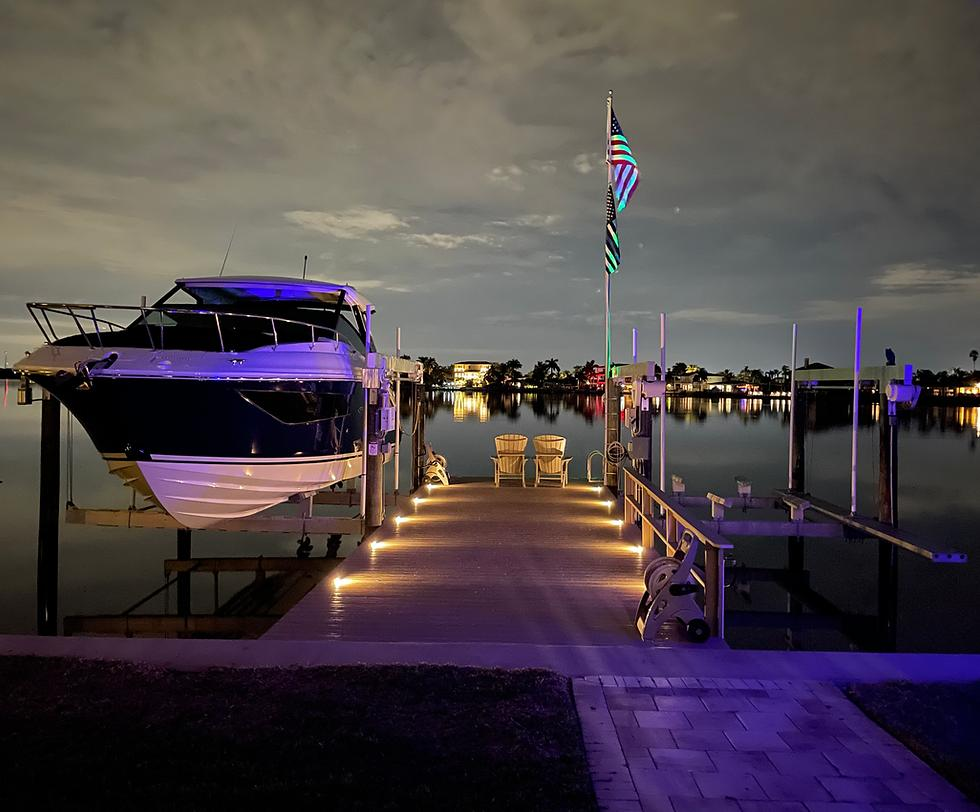
Marina dock at night with warm walkway lighting reflecting on water
Vibration Tolerance Changes Everything
Container cranes, ship unloaders, marine vessel mooring operations, and heavy equipment movement create vibration environments that indoor or sheltered industrial facilities never experience.
Standard LED fixtures use driver electronics and mounting systems designed for static installation. Vibration at frequencies common in port operations (3-15 Hz, amplitude varying with equipment and load) causes three failure modes:
1. Driver component fatigue—capacitors and solder joints fail prematurely under cyclic stress
2. Optical alignment shift—LED array position shifts relative to secondary optics, changing beam distribution
3. Mounting hardware loosening—fasteners vibrate loose even with lock washers
The spec requirement: fixtures designed for vibration isolation. Look for:
Driver mounting on vibration-isolated bases (rubber grommets or silicone mounts)
Locking hardware with prevailing torque specifications
Optical assemblies with positive retention (not just press-fit)
Mechanical testing documentation (IEC 60068-2-6 or equivalent)
Most marine fixture manufacturers test to Class 3M4 vibration levels per MIL-STD-167-1. Verify this certification if vibration is a concern in your application.
Task Zone Lighting Is Where Projects Fail
Marine terminals have distinct functional zones with radically different lighting requirements. Treating the entire facility as a single lighting specification is where budgets get blown and safety requirements get compromised.
Container Yard Stacking Areas
These need high-mast lighting with precise photometric control. The challenge isn’t achieving required foot-candle levels—it’s uniformity and spill control. Light falling outside the stacking area creates glare for crane operators and security camera washout. Light dropping below uniformity thresholds creates dangerous shadow zones where personnel and equipment interact.
High-mast installations require detailed photometric modeling with actual pole placement, mounting heights, and equipment shadow projections. Generic layouts based on “10,000 square feet per fixture” rules don’t work in container yards.
Mounting height typically runs 80-120 feet. This creates a secondary challenge: luminaire weight affects wind loading calculations on structures older than 15 years. Older port facilities often have structural constraints that limit fixture selection.
Access Roads and Vehicle Circulation
These zones get spec’d like standard highway lighting, which is wrong for two reasons: vehicle types vary from personal vehicles to heavy container trucks, and pedestrian activity occurs in designated zones but unpredictably across the full circulation network.
The lighting spec needs to balance:
Minimum maintained foot-candles for vehicle circulation (typically 5-10 fc for circulation lanes)
Enhanced lighting at pedestrian crossing points (20-30 fc minimum)
Glare control for approaching drivers
Uniformity requirements that avoid “tunnel vision” from single-source high intensity
Cutoff fixtures are mandatory in port road lighting. Light spill into container stacks creates the security camera washout mentioned above. Light spill into adjacent properties creates compliance issues and neighbor relations problems.
Loading Platform Zones
Container loading platforms require task lighting that handles the worst environmental conditions: salt spray from waterborne cargo, diesel exhaust, and thermal extremes from direct sun exposure on dark-housing fixtures.
Fixture spec here needs:
IP66 minimum, IP67 preferred
IK10 impact rating (forklift traffic and cargo handling damage potential)
Vibration tolerance for gantry equipment vibration
Wide temperature operating range (-30°C to +55°C) for coastal climate variation
Maintenance Access Determines Success
Here’s where port lighting projects consistently exceed budgets: maintenance access.
High-mast fixtures at 80-100 feet require specialized lifting equipment for maintenance. On operating container terminals, this equipment interferes with cargo operations. Maintenance windows are narrow and schedule-dependent.
The specification decisions that control long-term maintenance cost:
1. Fixtures with extended driver life (100,000+ hours) reduce maintenance frequency but require higher initial specification investment
2. Modular fixture design allows component replacement without full fixture changeout—verify this explicitly with manufacturers
For lower mounting height installations (under 40 feet), specify fixtures with tool-free maintenance access. Hand-hinged doors, tool-free lamp replacement, and quick-connect drivers reduce maintenance time by 60-70% compared to standard industrial fixtures.
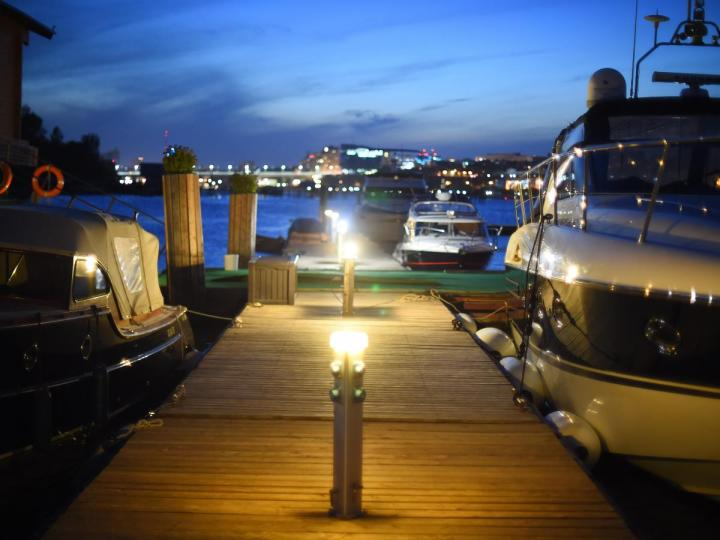
Commercial dock with security lighting illuminating vessel mooring area
The Electrical Reality for Marine Terminals
Marine environments create electrical challenges beyond standard industrial specifications:
Transient Voltage Surge (TVS) from lightning and electrical equipment switching is amplified by the conductive salt environment. All fixtures should have integrated TVS protection rated to IEEE C62.41.1/C62.41.2 Category C standards.
Ground Fault Sensitivity in wet environments causes nuisance tripping on standard circuit breakers. Fixtures with ground fault circuit interrupter (GFCI) compatible drivers avoid this issue.
Galvanic Isolation between fixture housing and electrical ground prevents electrolytic corrosion from dissimilar metal contact in salt environments.
YoubeeLight’s marine series includes all three electrical protections as standard specification, not add-on options. Verify this with other manufacturers—many include TVS protection only as a premium option.
Sourcing Takeaway
Marine and port lighting isn’t outdoor industrial lighting with a marine label. The specification requirements are categorically different: salt spray exposure ratings, vibration tolerance, task zone optimization, and maintenance access planning.
Start with a zone-by-zone requirements analysis before looking at fixture catalogs. Each zone has distinct operational and environmental requirements that drive different fixture specifications.
When evaluating marine fixture options, verify:
ASTM B117 salt spray test hours (1000 minimum, 2000 preferred)
Vibration testing documentation (IEC 60068-2-6 or MIL-STD-167-1)
IP rating + IK impact rating + thermal range specifications
Driver THD performance for harmonic-rich electrical environments
Maintenance access design and projected service life
The total installed cost calculation for marine lighting must include maintenance access equipment, operational disruption costs, and replacement labor—not just initial fixture cost. Marine-grade specification typically reduces total lifecycle cost by 30-40% compared to standard industrial fixtures in equivalent environments.