
Gas Station & Canopy LED Lighting: What Commercial Buyers Get Wrong in 2026
The canopy at a gas station isn’t just overhead cover. It’s the first impression, the safety zone, the branding real estate that runs 24/7 in all weather. Yet most buyers approach canopy lighting the same way they’d spec a warehouse—pick some wattage, maybe check the IP rating, done.
That’s how you end up with $40,000 in lighting that looks cheap, fails early, and makes your site manager call you every three months.
The Canopy Lighting Equation Nobody Talks About
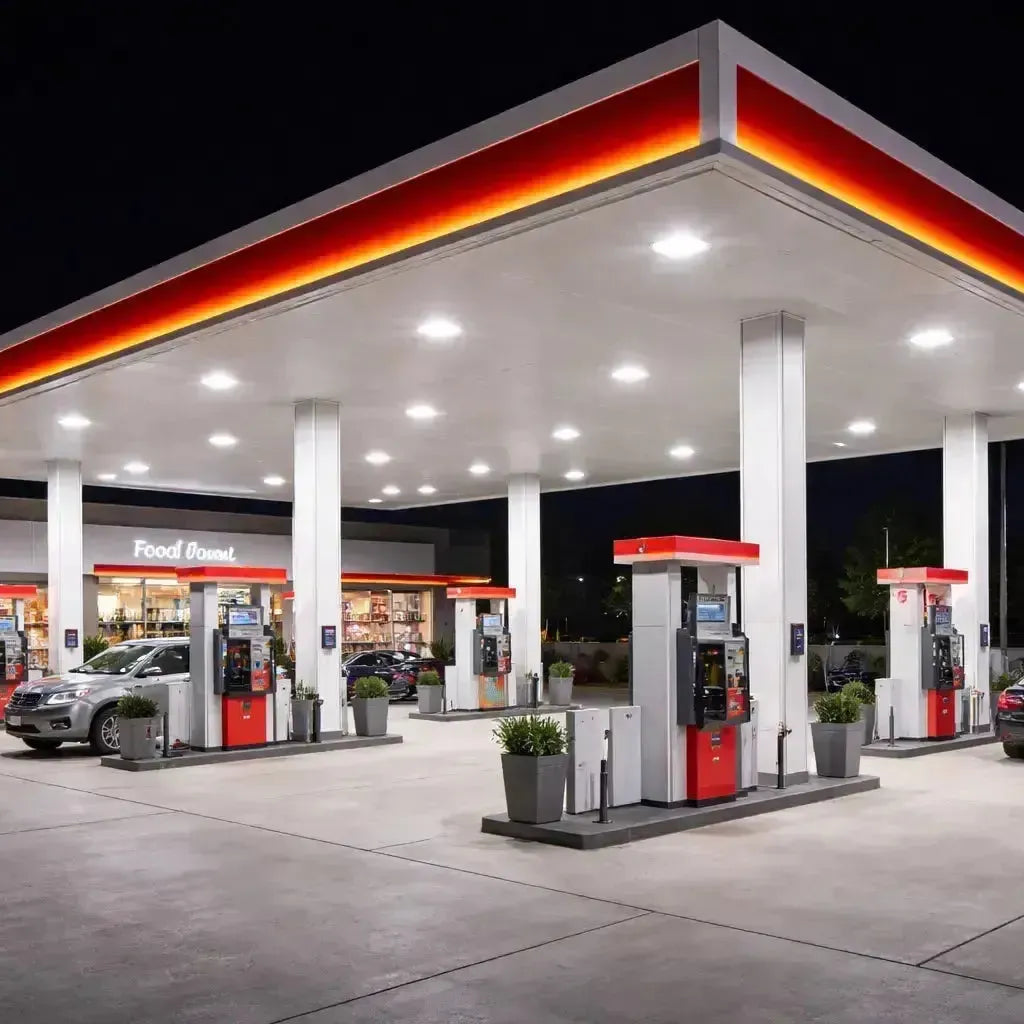
Here’s what separates a gas station canopy that looks professional at 2 AM from one that looks abandoned:
Vertical foot-candles matter more than horizontal ones.
Most photometric specs focus on the ground. But a canopy light is doing double duty: illuminating the fueling area AND making the pumps, signs, and canopies visible from the road. If your light distribution throws everything straight down, you’re blinding customers at the pump while your signage disappears into darkness.
I’ve walked into too many sites where the canopy is technically “bright enough” by meter reading, but the whole place feels sketchy because of how that light falls.
Uniformity ratio is your real quality metric. Aim for 3:1 max variance across the canopy deck. Hot spots near fixtures, dark zones between them—that’s what makes a site look under-maintained, even when everything’s working.
The Weather Sealing Reality Check
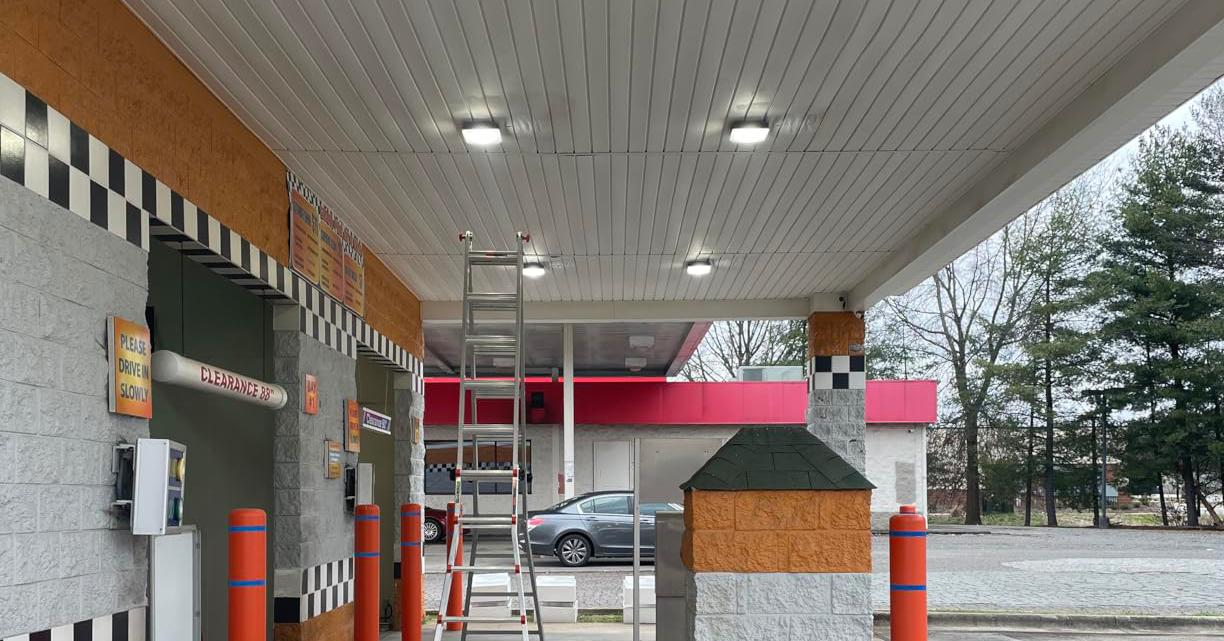
IP65 is the minimum. But IP65 on a spec sheet and IP65 under real-world conditions are two different things.
Canopy fixtures face thermal cycling constantly— afternoon sun heating the deck to 70°C, then cooling rapidly when clouds roll in or night falls. Condensation forms inside fixtures that haven’t been properly pressure-equalized. I see corrosion failures within 3-4 years on sites where the spec looked solid.
What actually matters for canopy longevity:
- Pressure-equalized venting (not just “breather holes”)
- Stainless steel or coated hardware—regular steel fasteners fail fast in coastal areas
- Silicone gaskets, not rubber (rubber hardens and cracks)
- Thermal cycling test proof, not just IP certification
One buyer I worked with switched suppliers specifically because the new option offered 10-year warranty with no-prorate. The price was 15% higher. After two years, his previous supplier had already replaced 8 of 24 fixtures under “out of warranty” claims. The math worked out.
The LED Driver Question That Saves You Headaches
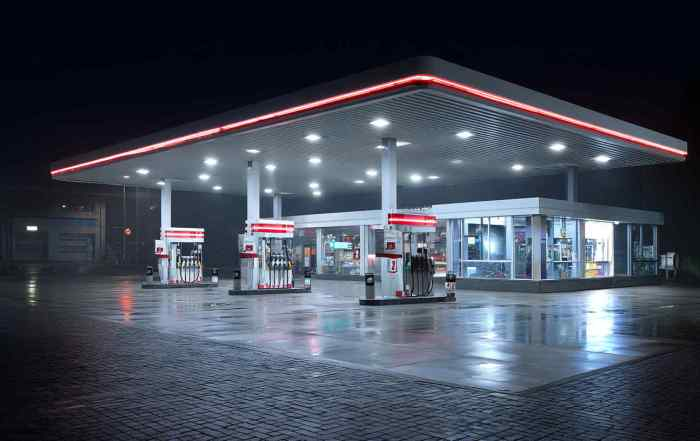
Most canopy fixture failures aren’t the LEDs—they’re the drivers.
In enclosed, thermally stressed environments, driver failure is the primary cause of early mortality. Your $30 driver that costs $8 to replace becomes a $400 service call when you factor in bucket truck, labor, and site management.
Spec for driver quality explicitly:
- Minimum 50,000 hour rated life at max case temperature
- Operating temperature range that exceeds your site conditions (not just “meets” them)
- Surge protection minimum 10kV
- Thermal shutoff protection
The driver compartment should be accessible without full fixture removal. That’s a detail that sounds minor until you’re paying for a crane truck to change a $30 component.
Color Temperature and the Night Sky Problem
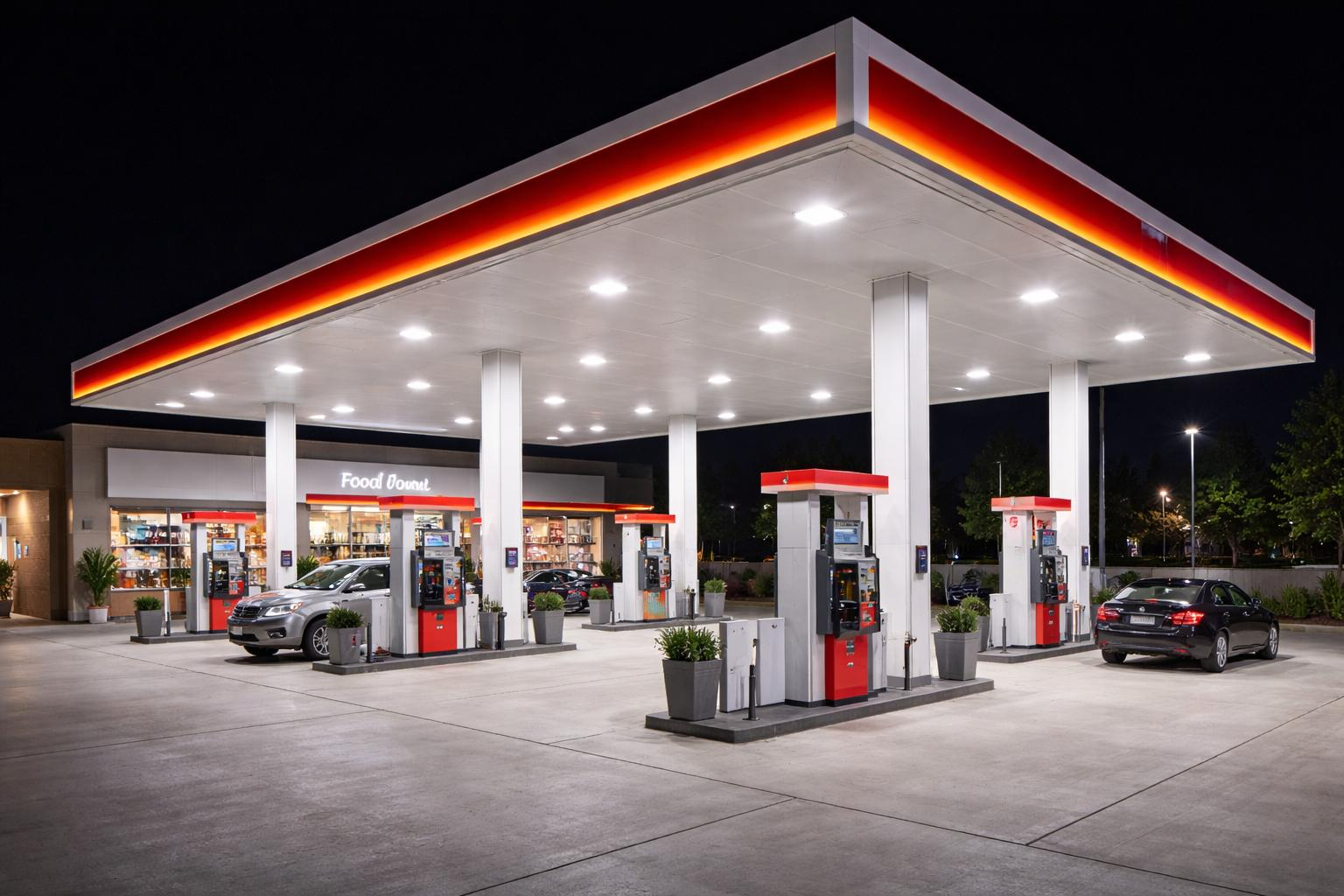
Canopy lighting faces an increasing regulatory environment around light pollution. Many jurisdictions now require shielded fixtures or specific cutoff ratings for sites near residential areas.
But here’s the practical implication for buyers: warm color temperatures (3000K and below) create less sky glow and less light trespass to neighboring properties. They’re also often perceived as “cheaper” or “less bright” by site owners because they put out fewer lumens per watt visually to the human eye.
The reality: 3000K at 100 lumens per watt looks different than 5000K at 100 lumens per watt. The human eye perceives warm white as slightly dimmer at equivalent photopic measurements. If you’re switching to lower CCT for compliance reasons, you may need to increase fixture count or wattage slightly to maintain perceived brightness.
This is where working with a supplier who can provide photometric modeling pays off. A $500 lighting layout with real site conditions will tell you whether your compliance solution actually works.
The Retrofit Trap
Many sites are still running metal halide or high-pressure sodium under the canopy. The retrofit market is flooded with cheap LED corn lamps and drop-in replacements that “work” but create problems.
The issues with retrofits in canopy applications:
- Thermal mismatch—the existing fixture wasn’t designed for LED thermal loads
- Unbalanced light distribution from the retrofit geometry
- Driver reliability in enclosed spaces
- Warranty coverage gaps
If you’re retrofitting, the right answer is usually a full fixture replacement, not a lamp swap. Yes, it’s more expensive upfront. But I’ve seen retrofits fail within 18 months while the same application with dedicated LED fixtures runs 8-10 years without intervention.
Making the Sourcing Decision
When you’re evaluating gas station canopy lighting suppliers, here’s what actually separates the serious players from the catalog pushers:
1. Canopy-specific product lines, not repurposed industrial fixtures. A fixture that works in a warehouse is not a canopy light. Look for products with documented canopy/mid-height mount testing.
2. PHOTOMETRIC FILES, not just lumen specs. Anyone can claim lumens. Only suppliers serious about commercial applications provide IES files for lighting layout software.
3. LOCAL SUPPORT, not just email support. When your fixture fails at 3 AM on a holiday weekend, who picks up the phone?
4. REFERENCE SITES IN YOUR REGION. Climate and regulatory environments vary. A fixture that performs in Arizona may not be right for coastal Florida or Canadian winters.
The buyers who get canopy lighting right aren’t the ones who spec the most lumens or the lowest price. They’re the ones who understand that a gas station canopy is infrastructure—it needs to work reliably for a decade with minimal intervention, in conditions that would challenge most electronic equipment.
Get the spec right once. Then let it run.
At YoubeeLight, we supply commercial LED fixtures for fuel retail, convenience stores, and canopy applications with full photometric documentation and global logistics support. View our commercial lighting catalog →
