
LED Lighting for Gyms and Fitness Centers: A Wholesale Buyer’s Guide to What Actually Works in 2026
I’ve spec’d lighting for around 40 commercial gyms in the last decade — from 800 m² boutique studios in London to 4,500 m² big-box fitness centers in Texas. And I’ll tell you right now: gym lighting is one of the most abused categories in commercial LED. Not because gym owners are careless, but because nobody told them that a fitness floor has five different lighting problems under one roof, and most LED suppliers are only solving one of them.
The result: a German chain I worked with last year ripped out €180,000 worth of 18-month-old downlights because the cardio zone had visible flicker on the gym’s own Instagram reels. The fixtures were technically fine. They were also worthless for the actual use case.
This is the guide I wish someone had handed me 10 years ago. It’s opinionated, it’s specific, and it’s going to save you from being the next project that gets called back for a complete re-fit.
The 4-Zone Problem (And Why Most Suppliers Quote You Wrong)
Walk into a commercial gym and you’ll see what looks like one big open space. As a lighting specifier, you need to see four — sometimes five — completely different zones that share a roof:
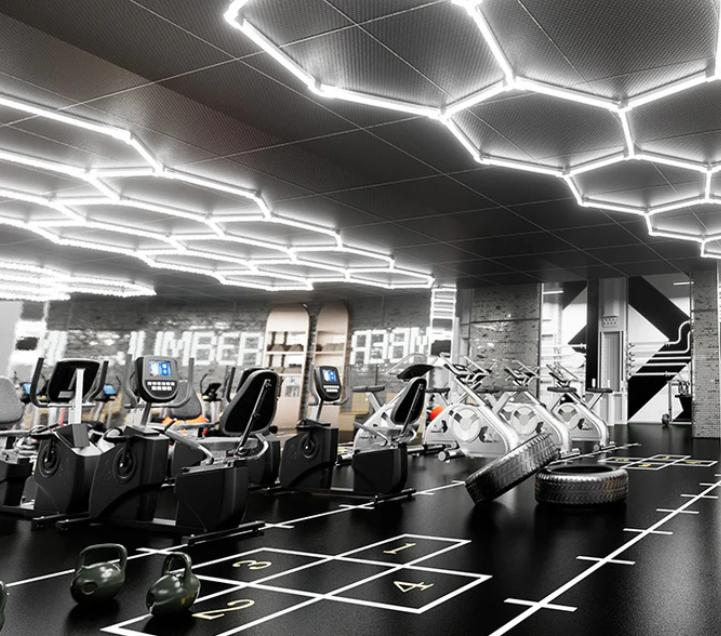
Zone 1: Cardio Floor (Treadmills, Bikes, Rowers)
This is where people stare straight ahead at a screen or a wall for 30–60 minutes. The lighting problem here is flicker. Not the kind of flicker you’d notice in a 2-second glance. The kind that shows up on slow-motion video, on CCTV footage, and on the face of anyone filming a 30-second reel for the gym’s social media. Which, in 2026, is happening every day.
Most “flicker-free” LED drivers on the market aren’t actually flicker-free. They drive the LED at 100–400 Hz PWM, which is invisible to the naked eye but creates banding on iPhone cameras and pulsing on most mirrorless cameras. To pass the test, you need a driver operating at 1,000 Hz minimum, and ideally 3,000–10,000 Hz for high-frame-rate video. I had a project in Frankfurt where we specified Osram drivers at 3,500 Hz — that was the only driver the gym chain would approve after the 2024 social media disaster.
Lux level on the cardio floor should be 300–500 lux horizontal at floor level, with the vertical plane (treadmill console) at 200–300 lux. People read phones, watch screens, and check heart rate monitors in this zone. You want comfortable, not bright.
Zone 2: Free Weights and Strength Area
This is the industrial zone. Heavy metal gets dropped. Slam balls hit the floor. People stack 25 kg plates from waist height. Your fixtures are getting hit, vibrated, and abused. The lighting problem here is impact and vibration resistance.
The spec is IK08 minimum on the lens, IK10 if you can get it. The housing needs to be die-cast aluminum, not plastic. The mounting must be anti-vibration — most gym failures I’ve seen are not from the impact itself, but from vibration loosening the mounting over 12–18 months until the fixture drops. I had a CrossFit box in Manchester where a 12 kg kettlebell hit a 36W downlight dead center; the fixture survived but the ceiling tile didn’t. The spec should have been a different fixture type altogether.
Lux level: 500–750 lux horizontal. CCT: 4,000–5,000K. CRI 80+ is fine. This is not the place to spend money on high CRI — your members are looking at dumbbells, not each other.
Zone 3: Group Fitness Studios (Spin, Yoga, HIIT, Pilates)
This is where the boutique fitness explosion has changed the spec. Pre-2020, a group studio was a multipurpose room with a sprung floor and a PA system. In 2026, the studio is a brand asset. It’s a content-creation environment. Members film classes. Instructors are influencers. The lighting is part of the Instagram aesthetic.
The spec here is the most variable. Different boutique studios want different things:
- SoulCycle-style spin studios: 0% ambient, 100% theatrical. RGBW or RGBA moving heads, programmed lighting cues that sync to BPM, blackout capability for “moments.” DMX or sACN control, not 0-10V. This is entertainment lighting, not commercial lighting.
- Barry’s-style HIIT studios: 4,000K white light for the work intervals, dimmed to 10% for the rest intervals, often with a red/orange gel on the back wall. Round recessed fixtures with high-output reflectors. Smooth dimming down to 1%.
- Yoga and pilates: 3,000K, 200–300 lux, high CRI 95+ for skin tones and apparel color. No flicker, no buzz, no color shift at low dim levels. Indirect lighting preferred — bounced off the ceiling for an even, shadowless wash.
Trying to solve all three studio types with one fixture strategy is the most expensive mistake in boutique gym design. The lighting should be a different sub-project with its own budget line.
Zone 4: Locker Rooms and Showers
This is the most common failure point. Locker rooms are wet, humid, hot (from the showers), and chemical-laden (chlorine, sweat, body products, cleaning agents). A standard IP44 downlight will fail in 12–18 months — the lens will yellow, the gasket will fail, and the LED chamber will corrode. Then you’ll get flickering and dead zones.
The spec is IP65 minimum for shower-adjacent fixtures, IP54 for general locker room ceiling, IK07 minimum. Stainless steel or anodized aluminum housings, not painted steel. Silicone gaskets, not foam. The fixture is going to live in a hostile environment, so the spec needs to reflect that.
CCT: 4,000K works for the main locker area; 3,000K for the “spa-style” wet zones where members are transitioning from shower to rest. A common mistake is putting 3,000K throughout the whole locker room — it makes the space feel like a hotel spa, but it also makes it harder to see the floor clearly when wet, which is a slip hazard. The transition zone is your friend.
Zone 5: Reception and Front-of-House
This is your brand zone. 3,000K, CRI 90+, accent lighting on the front desk, decorative pendants, maybe a wall-washer on the brand logo. Budget accordingly. The lighting here is doing the same job as a hotel lobby: setting a tone before members even touch a piece of equipment.
Three Project Files (And What They Cost)
Let me walk you through three specific projects from the last 24 months. I’m not using these to scare you — I’m using them because these are the patterns that repeat across every region I work in.
Case 1: The “Flicker-Free” Driver That Wasn’t
A UK boutique chain was opening their 12th location. The fit-out contractor sourced LED downlights from a Dutch supplier at a competitive price. The driver datasheet said “flicker-free” and showed a 200 Hz PWM frequency. The fixtures passed the spec review and went into 11 studios across the country. Then the chain’s marketing team started filming Reels for the launch campaign.
Every single video showed banding on the faces of the instructors. The lighting was technically compliant with the EU flicker standard (IEEE 1789 at “no effect” level), but it failed the social media test. The chain had to replace 1,200 downlights across all 11 locations with new drivers running at 1,500 Hz minimum.
Total cost: £76,000 in re-fit, plus six weeks of studio downtime during the launch window.
The lesson: “flicker-free” is a marketing term with no industry standard. If you care about video (and in 2026, every brand cares about video), you need a driver that operates above 1,000 Hz and ideally supports 0-10V or DALI dimming with smooth low-end performance. Ask the supplier for the actual PWM frequency, not the marketing claim.
Case 2: The Strength Floor That Killed Itself in 14 Months
A Texas-based big-box gym chain was rolling out a new prototype. The architect specified 200W UFO high bay lights for the strength area at 6-meter mounting height. The fixtures were IP65, IK08, and looked the part. Six months in, the chain started seeing failures — fixtures flickering, drivers failing, and lens cracking.
The root cause was the mounting. UFO high bays are designed for warehouse mounting with vibration-dampened hooks. The gym’s contractor had rigid-mounted them to the structural steel with no shock absorption. Every time a member dropped a barbell, the vibration traveled up through the steel and into the fixture. 14 months in, 18% of the high bays had driver failures.
Cost to replace: $112,000 in fixtures plus 240 hours of labor to install vibration dampers.
The lesson: a high bay in a warehouse sees floor vibration. A high bay in a gym sees impact vibration. The mounting system needs to be different. If you’re specifying UFO high bays for a gym, the install spec must include vibration dampers and the supplier must confirm the fixture has been impact-tested at the actual use environment, not just a static test rig.
Case 3: The Locker Room That Cost $28 Per Square Meter to Fix
A 600 m² locker room in a Norwegian fitness club was specified with IP44 LED panels. They were flat panels, recessed, 4,000K, CRI 80. After 22 months, the panels were visibly yellowing at the edges, and the chain’s maintenance team was replacing two panels per month on average. The cause: the silicone gaskets had failed and humidity had gotten into the LED chamber. The panels weren’t actually IP44 — they were IP44 on day one, and the production batch had a gasket defect that nobody caught at install.
The replacement cost was $17,000 for the panels, plus $4,000 in access equipment to reach the 4-meter ceiling. Total: $35 per square meter just for the locker room.
The lesson: IP ratings are batch-dependent. For wet environments, you need IP65 minimum, and you need to verify the gasket integrity at delivery. Some European gym chains now specify 316 stainless steel housings for the shower zone — over-spec, but they have zero failures.
The Spec You Should Walk Into the Project With
After all the projects, here’s the framework I’d use if I were quoting a commercial gym today. Save it. Send it to your architect. Argue with me in the comments.
| Zone | Lux Range | CCT | CRI | IP/IK | Driver / Control |
|---|---|---|---|---|---|
| Cardio floor | 300–500 | 4,000K | 80+ | IP54 / IK07 | 0-10V dim, 1,000Hz+ driver |
| Strength area | 500–750 | 4,000–5,000K | 80+ | IP54 / IK08 | Anti-vibration mount, on/off |
| Group studio (HIIT) | 300 dim to 50 | 4,000K | 90+ | IP54 / IK07 | DALI-2 or DMX, smooth 1% dim |
| Group studio (yoga) | 200–300 | 3,000K | 95+ | IP54 / IK07 | DALI-2, smooth 1% dim, no color shift |
| Locker room (general) | 200–300 | 4,000K | 80+ | IP54 / IK07 | On/off, motion sensor optional |
| Locker room (wet zone) | 200 | 3,000K | 80+ | IP65 / IK07 | On/off, 316 SS housing |
| Reception | 300–500 | 3,000K | 90+ | IP20 / IK05 | DALI dim, accent layers |
This isn’t a generic spec sheet. This is what I’d actually quote, with the brand and model called out per line.
Where Most Wholesalers Get It Wrong
If you’re a lighting distributor or a project buyer sourcing for a gym chain, here are the five traps I see every single week:
-
Quoting one fixture type across the whole gym. The single most common mistake. A 36W recessed downlight does not work in the cardio zone and the strength area. The two zones have different lux requirements, different impact profiles, and different dimming needs. If your supplier is offering you a “whole gym package” at a single price per fixture, they’re not engineering the project.
-
Specifying CRI 80 across the board to save money. Fine for the strength area. A disaster in the group studio. Boutique fitness members notice skin tones. Instructors with personal brands notice even more. The 1–2% premium on CRI 95+ in the studio zone is a rounding error compared to the cost of a brand-fit failure.
-
Ignoring the driver. The LED chip and the heatsink are 40% of the fixture. The driver is the other 60%. Cheap drivers fail. Cheap drivers flicker. Cheap drivers don’t dim smoothly. If your supplier can’t name the driver manufacturer, walk away.
-
Treating the locker room as “wet area, problem solved.” IP65 is the floor, not the ceiling. The wet zone also needs the right CCT (3,000K for the spa feel), the right CRI (80+ is fine), the right housing material (stainless preferred), and the right mounting height (4 meters needs a different optical distribution than 2.5 meters). A locker room is a designed space, not a checklist.
-
Skipping the maintenance plan. Every fixture has a lifespan. Every driver has a failure curve. The chain operator needs to know which fixtures are field-replaceable (driver accessible without removing the whole fixture from the ceiling) and which require ceiling access. This is the difference between a 15-minute repair and a 3-hour repair, and the difference compounds across a 30-location chain.
A Note on the Boutique Fitness Explosion
The boutique fitness category grew from $24 billion in 2019 to over $42 billion globally in 2025. Studios that were once the exception (SoulCycle, Barry’s, Orangetheory) are now the rule — every independent gym in a major city has at least one studio sub-format. And the lighting spec is what differentiates a premium boutique from a budget chain.
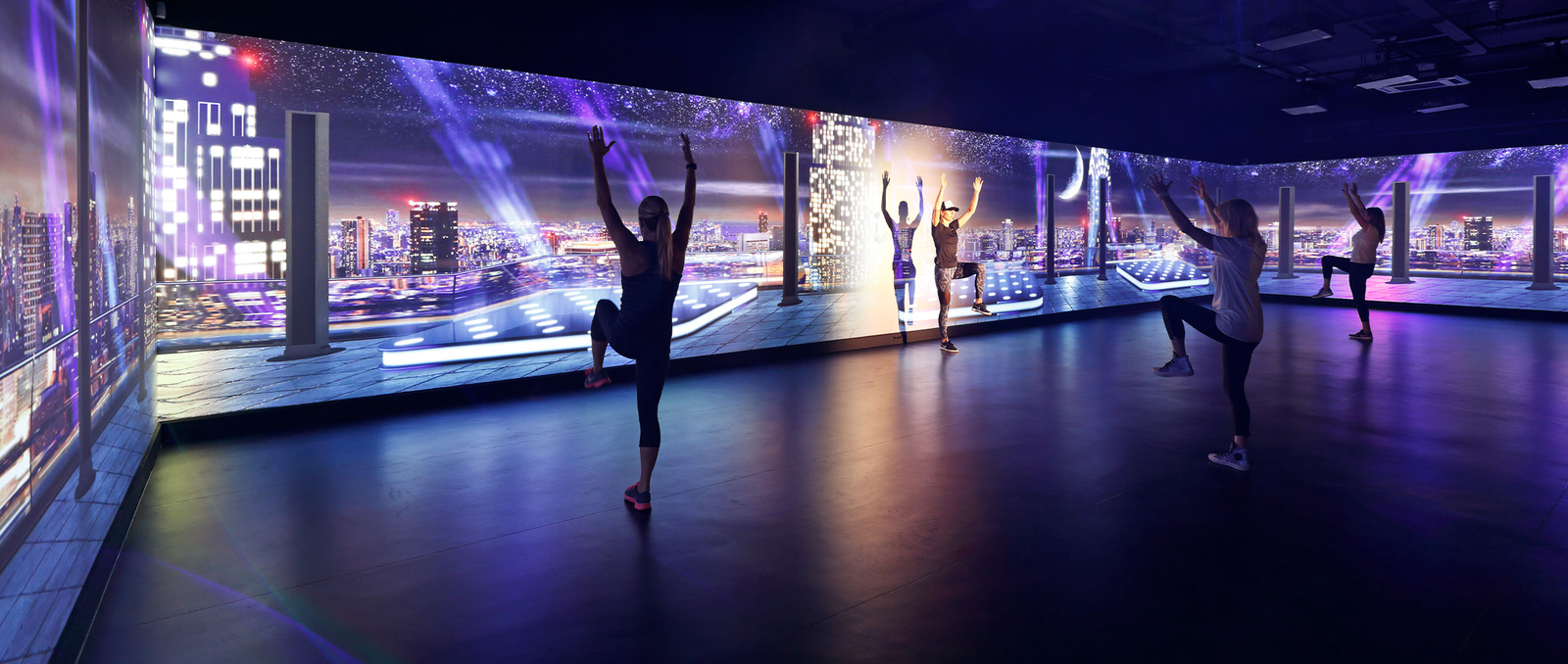
The brands that get this right — Equinox, Barry’s, SoulCycle, 1Rebel, Blok — are doing it with lighting designers and electrical engineers on staff, not with a wholesale catalog. If you’re a wholesaler trying to break into boutique fitness, you need to understand that the spec conversation is about atmosphere, not just lux levels. The studio is a content-creation environment, a community space, and a workout room simultaneously. The lighting has to do all three.
That’s not a catalog sale. That’s a project. Quote accordingly.
Sourcing Notes for Wholesale Buyers
If you’re buying for a gym chain or a fitness center developer, here are the three things to ask your supplier before you place the order:
- Driver frequency above 1,000 Hz. If they can’t tell you the PWM frequency, they don’t know the spec.
- IP65 certification from a third-party lab (TÜV, SGS, BV), not a self-declared report. Wet environments fail at the batch level, not the spec level.
- Field-replaceable drivers. Confirm the driver can be swapped without removing the fixture from the ceiling. If not, the maintenance cost will eat your margin.
You can see the full commercial-grade downlight and high bay range on our LED catalog page, and our About Us page has the manufacturing and certification details. For projects above 2,000 fixtures, we run dedicated driver and color binning programs so you don’t end up with the same 2,950K / 3,080K mismatch issue I’ve seen on too many gym projects.
