
LED Lighting for Auto Dealership Showrooms: The Spec That Sells Cars (And the One That Kills the Project)
A Spanish dealer in Madrid called me last October with a problem he’d been living with for nine months. He’d spent €2.1 million renovating a 4,200 m² showroom for a premium German brand. The architect specified 4,000K downlights at CRI 80+ across the entire sales floor. The installation was clean, the fixtures looked good in the catalog, and the dealer was proud of the result. Then the brand’s regional visual merchandising inspector walked through and wrote up a 47-point report.
The biggest complaint wasn’t about the lights themselves. It was that the cars looked wrong. The black metallic paint on the SUVs was reading as flat gray. The red cars looked dull. The white cars had a slight green tint that nobody could quite put their finger on. The inspector’s exact words were: “Your lighting is technically compliant, but it makes our cars look cheap. We cannot continue the dealership agreement unless this is fixed within 90 days.”
The dealer needed to rip out roughly 60% of the downlights in the showroom area, replace them with CRI 95+ fixtures at 3,000K, and add accent track lighting to bring up the contour on each car. Final cost of the fix: €380,000. The original savings from going with the cheaper fixtures: about €45,000.
This is the kind of mistake that happens every week in auto dealership projects around the world. And it’s almost always avoidable.
The Spec Sheet Doesn’t Match How Cars Actually Look
Let me explain why auto dealership lighting is its own discipline, because most lighting designers who haven’t worked on car projects don’t understand what’s actually being asked of them.
A car is the most complex object most people will ever stare at under artificial light. It has:
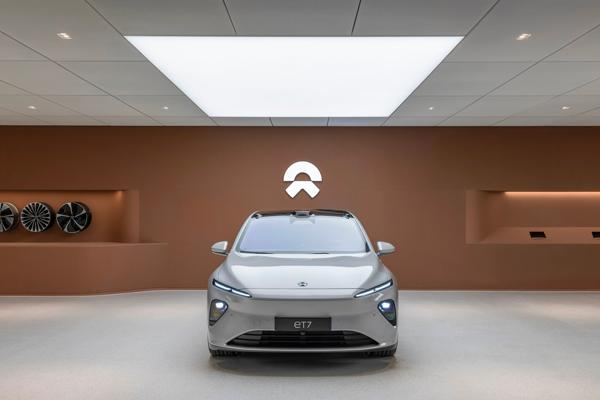
- Multiple high-gloss surfaces reflecting the ceiling and the light sources themselves
- Metallic paint flakes that depend on viewing angle for their visual effect
- Color-shifting pigments that read differently under different spectrums
- Deep shadows in the wheel wells, grille, and interior that need to “breathe” without going black
- Chrome and stainless trim that creates hot spots if lit carelessly
A spec sheet that lists “4,000K, CRI 80+, 1,500 lux at floor level” tells you almost nothing about whether the cars on display will look right. What matters is:
Color rendering for paint display. You need CRI 95+ minimum, and specifically strong R9 (saturated red), R10 (saturated yellow), and R12 (saturated blue) values. These are the three channels that determine whether red cars look red, gold cars look gold, and blue cars look blue. A standard CRI 80 fixture will measure acceptable on the general CRI scale but fail badly on R9 — usually single-digit R9, which is why red paint looks brown and orange under cheap LEDs.
Spectral continuity across the fixture range. Most dealership lighting is a mix of downlights, track lights, accent spotlights, and wall washers. If they all have different phosphor formulations (which happens when you buy from two different factories), the same car will look slightly different depending on which light hits it. The dealer’s eye picks this up as “something is off” but can’t articulate it.
Color temperature consistency across zones. Customer-facing showroom areas, brand-approved visual merchandising standards, and the OEM’s regional lighting manual will all specify a tight color tolerance. Mercedes’ 2024 retail lighting spec, for example, requires 3,000K ±50K with a Duv (distance from the black body locus) of less than 0.001. That’s tighter than most factories can hold without binning LEDs at the chip level.
I had a project in Belgium last year where two batches of the “same” track light from the same supplier showed up at 2,950K and 3,080K. Visually identical on a piece of paper, but when you put them side-by-side on a car hood, the difference is obvious. We had to scrap 30% of the shipment. The supplier had no idea why.
Showroom vs Service Bay: Two Completely Different Projects
Most dealers treat the whole building as one lighting problem. It’s not. The showroom and the service bay have opposing requirements, and if you try to solve them with the same fixture strategy, you’ll fail at both.
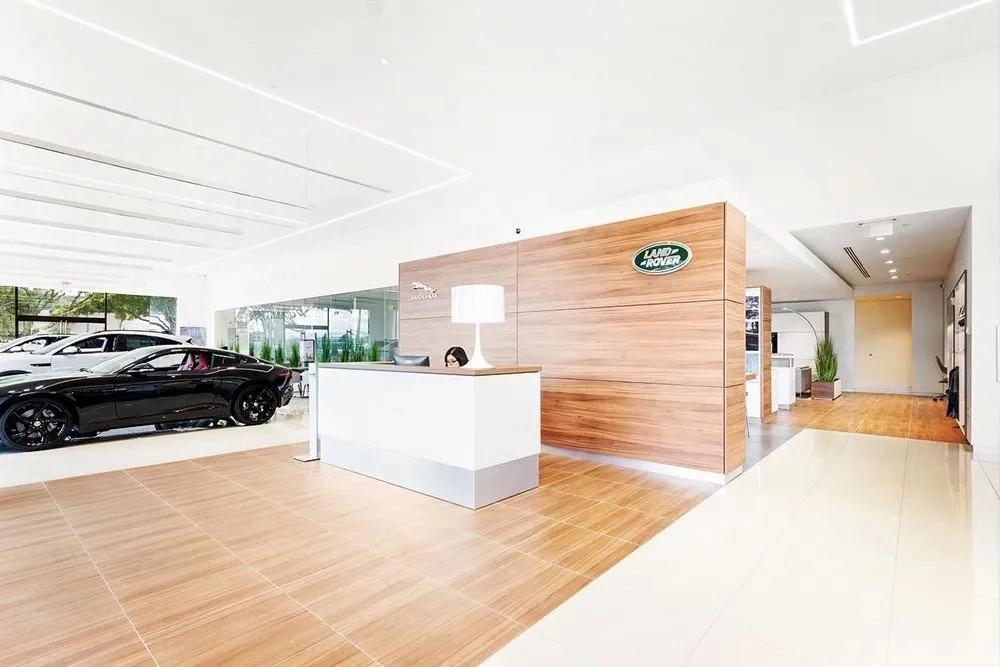
Showroom Requirements
The showroom is a selling environment. Its job is to make cars look desirable. The technical requirements are:
-
Vertical illuminance on car bodies, not just horizontal illuminance on the floor. IES standards for premium auto retail call for 1,500–2,500 lux on the vertical plane of the car, with the showroom floor running 30–50% lower. Most architects and electrical engineers light to floor-level lux, which gives you a bright floor and dim car bodies. The cars should be the brightest thing in the room.
-
Accent lighting for car contours. A 30W track light with a 24° beam aimed at the wheel of each car does more for showroom impact than 200W of ambient downlight. The fixture is working as a sculpting tool, not a room filler.
-
Glare control on chrome trim. Chrome reflects light sources directly. If you have a track light in the wrong position, every chrome bumper on the floor becomes a mirror reflecting that fixture back at the customer. The fix is careful aiming and matte-black anti-glare snoots on the track heads.
-
CRI 95+ and tight CCT tolerance (3,000K for premium, 4,000K for volume brands). Some Asian brands accept 4,000K; European premium almost universally wants 3,000K. Check the brand manual before you quote.
-
Flicker-free dimming. Many premium dealerships have circadian or scene-set lighting programs (day/evening/event modes). The dimming has to be smooth down to 5% with no visible flicker, no buzz, and no color shift. Cheap 0-10V drivers fail this test. DALI-2 or Casambi with proper LED drivers is the safe play.
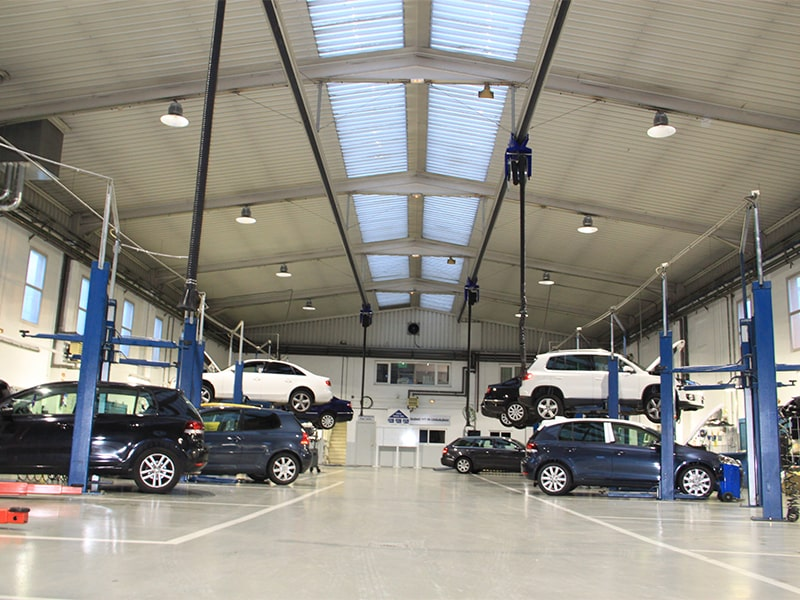
Service Bay Requirements
The service bay is a working environment. The technicians need to see what they’re doing. The requirements are totally different:
-
High horizontal illuminance, 500–750 lux at the work plane. This is not the place for CRI 95+ accent lighting. CRI 80+ is fine.
-
High IP rating, minimum IP54. Cars come in wet. Floor cleaning happens with pressure washers. A standard indoor downlight will fail within 18 months. You need sealed fixtures with gasketed optical chambers.
-
Impact resistance, IK08 minimum. Tools get dropped. Lifts come up and down. A fixture that can be smashed by a dropped wrench is a recurring maintenance problem.
-
High color temperature (5,000K–6,500K). Technicians need clarity, not warmth. The slight blue tint helps with detail work on engines and undercarriages.
-
No accent lighting, no dimming. The service bay is a 24/7 working environment. Dimmable fixtures are wasted cost.
Trying to combine these two zones with one lighting strategy is a classic mistake. The showroom needs theatrical lighting, the service bay needs industrial lighting. Different fixtures, different drivers, different mounting, different price points.
Three Cases from My Files (And the Money Lost)
Let me walk you through three specific projects from the last 24 months. These aren’t theoretical scenarios — they cost real money and damaged real relationships.
Case 1: The “Compatible” Track Light Disaster
A Greek dealer group was renovating six showrooms for a Japanese volume brand. The brand manual specified 4,000K track lights with CRI 90+. The dealer sourced a Chinese-made track light that the supplier claimed was “fully compliant.” The fixtures arrived, the installation was completed, and the brand inspector came through. Three of the six showrooms failed inspection because the R9 value was 18 — well below the 60 minimum the brand required.
The dealer had to replace 1,400 track heads across three showrooms. Cost: $94,000, plus six weeks of showroom downtime.
The lesson: CRI 90+ is not the same as “R9 60+.” The Chinese factory was using a phosphor recipe that scored well on the standard CRI test but failed on the saturated red channel. Always ask for the full TM-30 report, not just CRI. TM-30 gives you Rf (fidelity) and Rg (gamut) values, plus the 99 individual color evaluations. If your supplier can’t provide a TM-30-18 report, walk away.
Case 2: The Wrong Beam Angle for the Car Size
An Italian dealer was lighting a new Porsche showroom. The electrical contractor installed 38° track lights across the whole floor. From the ceiling height of 4.2 meters, the beam spread at floor level was about 2.8 meters in diameter. The cars were positioned 2.4 meters apart, and the beams were overlapping heavily. The result: every car was getting lit by 3-4 fixtures, and the “accent” effect was completely lost. The showroom looked like a parking garage with extra fixtures.
The fix was to swap to 24° track heads and re-aim every fixture individually. Cost: $32,000 plus three weeks of work.
The lesson: beam angle depends on ceiling height, car size, and car spacing. For 3-meter ceiling height with 2.4-meter car spacing and standard sedans, you want 24° or narrower. For 4.5-meter ceilings with SUVs and trucks, 30-36° works better. Most lighting designers oversimplify this and default to a “medium” beam, which usually means the wrong beam.
Case 3: The Service Bay That Killed the Showroom
A French dealer group built a new combined facility. The architect, trying to save money, specified the same LED panel light for both the showroom and the service bay above the work area. The panels were 4,000K, CRI 80, IP40 — perfectly fine for the showroom (though not ideal). They were a disaster in the service bay: 18 months in, 40% of the panels had visible yellowing on the diffuser, the IP40 rating meant dust and moisture had gotten into the LED chamber, and the technicians were complaining about headaches and eye strain from the flat 4,000K at 1,000 lux for 8 hours a day.
The dealer group had to replace all 220 service bay panels with proper IP65 tri-proof fixtures. Cost: $76,000. The showroom panels are still running fine four years later.
The lesson: a service bay fixture needs to be specified for the service bay, not the showroom. They’re different environments with different stresses. This is the kind of mistake that happens when an architect or electrical engineer tries to standardize across the whole project to simplify procurement.
The EV Showroom Problem (And Why It’s a Spec Reset)
If you’re lighting a dealership in 2026, you need to know that the EV showroom is a fundamentally different spec problem from the combustion showroom. I’ve worked on six EV-only dealership projects in the last 18 months, and the pattern is consistent.
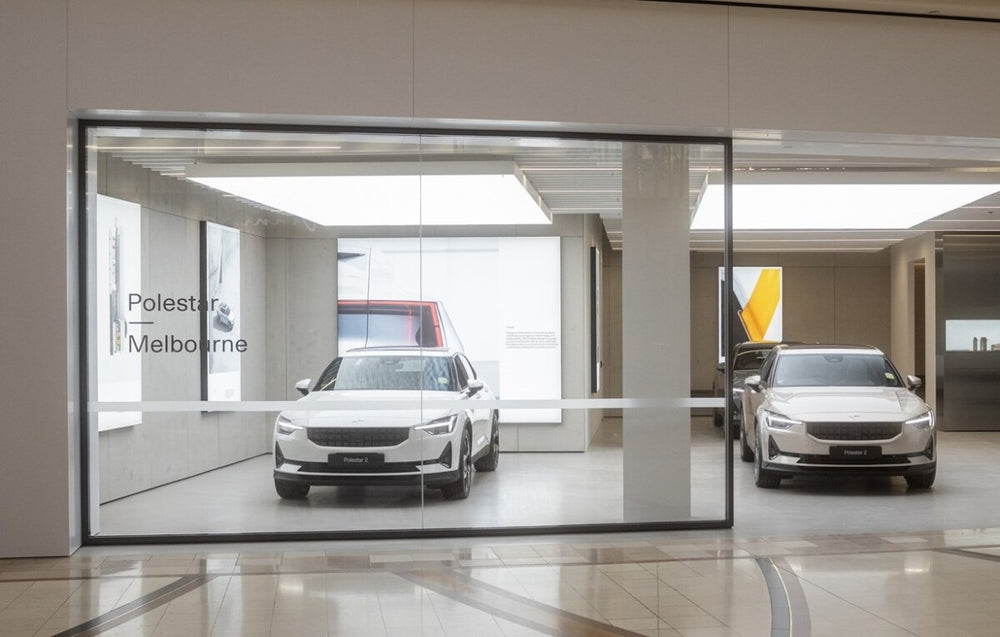
EVs have less “stuff” to look at under the hood. The traditional sales conversation used to happen around the engine bay, with the customer leaning in to look at the motor while the salesperson explained specs. EVs don’t have that moment. The selling happens around the battery, the interior tech, the software interface, and the design language. Which means the lighting has to work harder on:
-
The interior cabin, not just the exterior. Customers want to see the dashboard, the screen, the materials. Interior accent lighting is now a critical part of the spec, not an afterthought.
-
The wheel design, which on EVs is often more prominent (because there’s no engine to look at). Wheel detailing is a major selling point on EVs from Tesla, BYD, and the European premium brands.
-
The charging port and badge details, which are designed to be visually distinctive and need to be lit without creating glare.
-
The software interface on the central screen, which is harder to read under aggressive accent lighting. Some EV brands are now specifying lighting that doesn’t put direct light on the dashboard area, to keep the screens readable.
Chinese EV brands like NIO, BYD, and Zeekr are setting new standards for showroom lighting that the European and American OEMs are now copying. If you’re a lighting supplier working with dealers in 2026, you should be paying attention to what the Chinese EV brands are doing in their flagship stores. The lighting specs on those projects are often two to three years ahead of the European premium standards.
How to Quote a Showroom Lighting Project (The Right Way)
If you’re a wholesaler or contractor quoting a dealership project, here’s the workflow that actually works. This is the same checklist I use when I review a project’s specifications before sending a quote.
Step 1: Get the brand manual, not the architect’s spec
Every major OEM has a brand-specific retail lighting manual. Mercedes, BMW, Audi, Porsche, Volvo, Toyota, Honda, Hyundai — they all have them. The architect’s spec is a starting point, not the source of truth. The brand manual will specify exact CCT, CRI, R9, beam angles, fixture types, mounting heights, and lux targets. If you don’t have the brand manual, ask the dealer. They have it. If they say “we don’t have one,” they’re either hiding something or they haven’t been through the approval process yet.
Step 2: Walk the space with the brand visual merchandising lead
The brand’s visual merchandising team has final say on whether the showroom passes inspection. Walk the space with them before you quote. They’ll tell you things the architect won’t, like “we want accent lighting on the wheels but not on the badge,” or “we need higher vertical illuminance on the SUVs than the sedans.” These details save you from reworking the project after installation.
Step 3: Specify track heads, not just downlights
Showroom lighting is 60% accent lighting, 40% ambient. If your quote is mostly downlights, you haven’t understood the project. A typical 2,000 m² premium showroom will have 200-300 downlights and 400-600 track heads. The track heads are doing the heavy lifting on car presentation. Specify them carefully: CRI 95+, tight CCT binning, multiple beam angle options, dimmable drivers, and anti-glare snoots.
Step 4: Separate the showroom and service bay quotes
Don’t mix the two in the same quote. The fixtures, drivers, and price points are too different. The dealer needs to see the showroom and service bay as separate budget lines, both because the financing often works differently and because the spec approval processes are different.
Step 5: Specify spare fixtures, not just spares
On a premium showroom project, specify 5-10% spare fixtures and 2-3% spare drivers. LEDs fail, drivers fail, and the brand visual merchandising team will not accept a single dead fixture on a car display. Having spares on site means the dealer can fix the problem in 10 minutes instead of waiting three weeks for a replacement shipment from China.
If you want to see the kind of track lighting we typically recommend for premium auto showrooms, the commercial track light catalog has the spec sheets and beam angle options. Most of our auto dealer projects use a combination of 24W and 38W track heads from our premium range, with 0-10V or DALI-2 drivers.
The Five Mistakes That Kill Dealership Projects
I see the same five mistakes over and over. If you avoid these, you’ll outperform 80% of the suppliers competing for dealership projects.
Mistake 1: Quoting CRI 80+ when the brand spec says CRI 95+
The price difference is real — CRI 95+ fixtures cost 30-50% more. But quoting the cheaper option to win the bid almost always costs you the project in the end, because the brand inspector will reject the installation. Or worse, the dealer accepts the cheaper fixtures, gets rejected, and you eat the replacement cost. Either way, you lose.
Mistake 2: Skipping the TM-30 report
CRI is a legacy metric from the 1960s. It’s not designed for LEDs. TM-30-18 is the modern equivalent and gives you much more useful data. If your supplier can’t provide a TM-30 report for their “CRI 95+” fixtures, the fixtures probably aren’t actually CRI 95+ across the full color spectrum. They might score 95 on CRI but 70 on Rf (the TM-30 fidelity score). Always ask for the full TM-30 data.
Mistake 3: Treating the showroom and service bay as one project
The fixtures, drivers, IP ratings, and price points are completely different. Specifying them together leads to compromises that hurt both zones. The showroom ends up with fixtures that aren’t theatrical enough, and the service bay ends up with fixtures that won’t survive the environment.
Mistake 4: Ignoring color temperature tolerance
A 100K tolerance sounds tight, but across 200 fixtures, even small variations become visible. A 300K spread across the showroom will make some cars look warmer than others under different lights. The fix is either factory binning (which most Chinese suppliers don’t offer by default) or careful incoming inspection on site. The YoubeeLight team has been binning fixtures for premium European dealers for years, and it’s the single biggest reason our showrooms pass brand inspection on the first try.
Mistake 5: Not specifying spare drivers separately
LEDs last 50,000+ hours. Drivers fail in 15,000-25,000 hours. If your spec includes 5% spare fixtures but no spare drivers, you’ll be replacing fixtures when only the driver has failed. Specify spare drivers: usually 10% of fixture count. They’re cheap and they’ll save the dealer thousands in service calls.
What I Actually Recommend for New Dealership Projects in 2026
If you asked me, “Daniel, what should I be quoting on a premium auto showroom project in 2026?”, here’s the short version:
- 3,000K, CRI 95+ with R9 ≥ 90 for European premium brands
- 4,000K, CRI 90+ with R9 ≥ 60 for volume brands and most Asian brands
- 24° or 30° track heads for car accent lighting, with anti-glare snoots
- 60° downlights for ambient, 1,500-2,500 lux on vertical car surfaces
- DALI-2 or Casambi drivers for dimming (no 0-10V on premium projects)
- CRI 80+, 5,000K-6,500K, IP65 tri-proof for the service bay
- 5-10% spare fixtures and 10% spare drivers
- Full TM-30-18 report on every fixture type
- Single-batch procurement for tight color binning across the whole project
The dealers who do this right win the brand approval, get the volume contracts, and build long-term relationships across multiple locations. The dealers who try to save 10% on the fixtures end up spending 30-40% more on the rework.
If you’re specifying a dealership project right now, the YoubeeLight catalog has the track lights and downlights we typically recommend for these jobs. We can also provide full TM-30 reports and single-batch color binning for premium projects where the brand tolerance is tighter than what most factories offer as standard.
About the Author
Daniel has been sourcing commercial lighting for European and American dealers for over 15 years. He works with independent wholesalers, regional dealer groups, and OEM-approved contractors on premium auto retail projects. He’s based in Shenzhen and travels to dealer projects in Europe, the Middle East, and Southeast Asia about 80 days a year.
