
Jewelry Display LED Lighting: What Wholesale Buyers Actually Pay For
Most jewelry store lighting is tragic. I mean it. Walk into 20 jewelry shops and count how many actually make their product look good. Maybe 3. The rest are either blasting harsh white overheads that flatten every sparkle, or they’ve gone so warm that the gold looks like brass and the diamonds look like glass.
As a commercial lighting buyer who’s spec’d out dozens of retail projects, I can tell you: jewelry lighting is its own beast. The rules that work for general retail will destroy your jewelry display.
The Physics Nobody Talks About
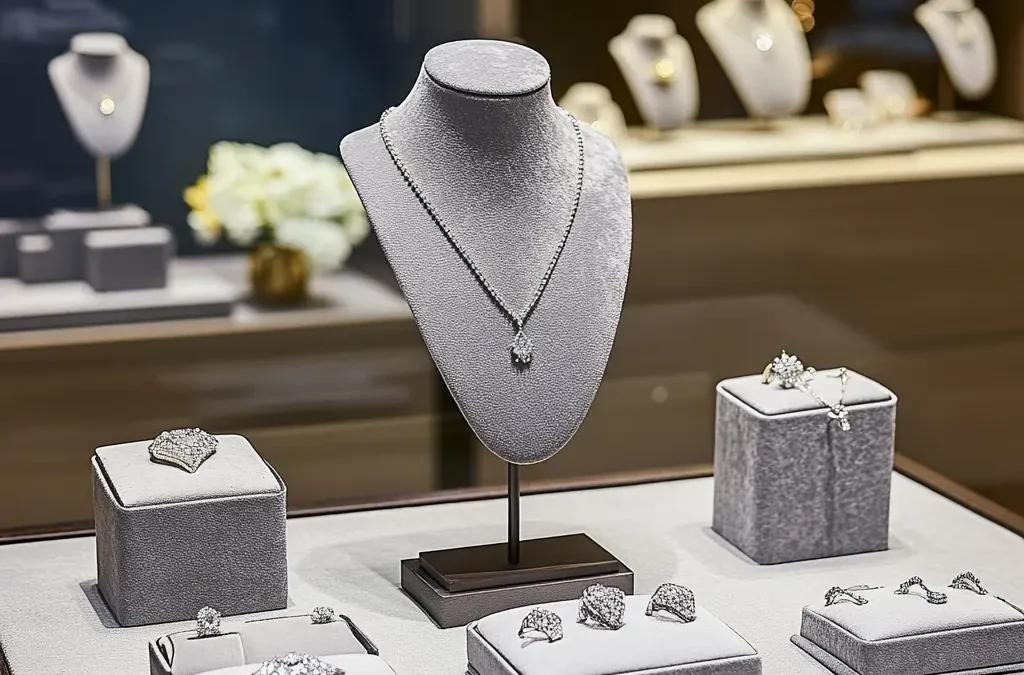
Here’s what actually happens with light and precious metals/stones:
Diamonds need directionality, not brightness. A 5000K panel overhead will technically “light” a diamond. But it’ll look flat and lifeless. You need sharp, angled highlights that create that characteristic “fire” – the dispersion of light into spectral colors. This requires precise beam angles, typically 15-30 degrees, positioned to create multiple facet reflections.
Gold and warm metals are the opposite. They absorb blue light and reflect yellow/red. Put them under cool white LEDs and you get a muddy, flat appearance. You want 2700K-3000K, warm and rich, with high CRI in the red-yellow spectrum.
Silver and platinum are mid-tone nightmares. Too warm and they look yellow. Too cool and they look blue. You need a neutral 3500K-4000K to keep them looking like themselves.
The practical implication: a single uniform overhead lighting scheme will never work for mixed jewelry displays. You need zoning.
The Display Case Problem
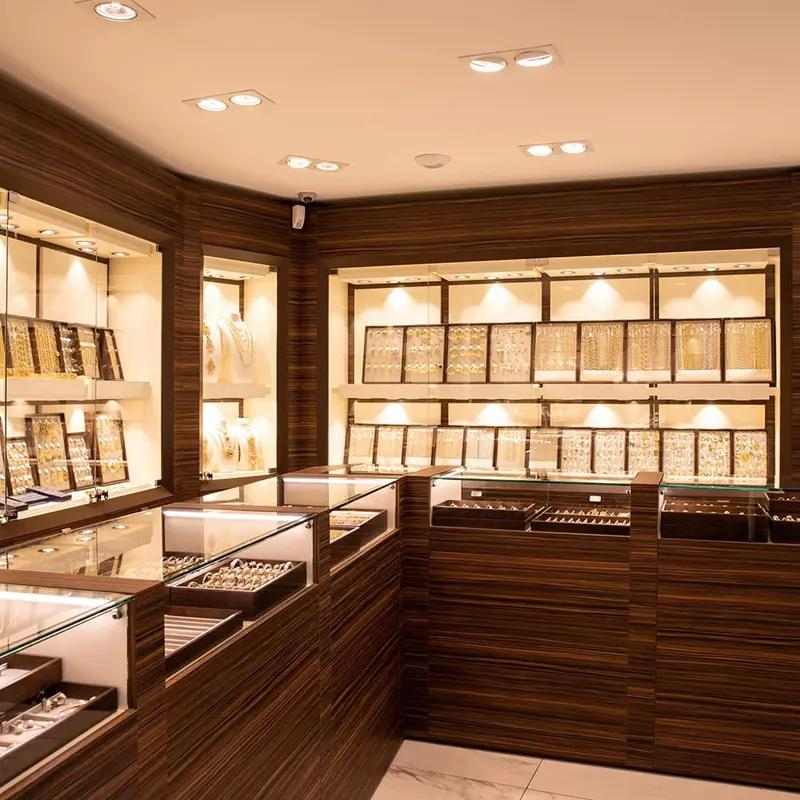
This is where most buyers screw up. They spec a nice general retail track system, install it, and then wonder why their $50,000 diamond necklace looks like a costume piece.
The issue: general retail lighting assumes the light source is above and the viewer is below. But jewelry display cases have glass tops, which means:
- You get reflections from the overhead lights
- The viewer’s face and clothing reflect in the glass
- The actual jewelry sits 2-3 inches below the glass, in a different light zone entirely
What actually works for display cases:
- LED strips inside the case at 3000K for warm metals, 4000K for silver/platinum
- Directional puck lights mounted at the case ceiling, angled 15-20 degrees toward the back wall
- Backlit gradient panels for necklace displays – creates a halo effect that photographs beautifully
- Adjustable arms for showcase spots so you can re-aim when merchandise changes
I’ve seen cases where the internal LED strips alone, properly diffused, did more for product appearance than a complete overhead redesign.
Color Temperature Zoning That Actually Works
Let me give you the breakdown I’ve used on real projects:
| Zone | Product Type | Recommended Temp | Beam Angle |
|---|---|---|---|
| Diamond showcase | Diamonds, white gold | 5000K-6000K | 15-25° |
| Gold display | Yellow gold, rose gold | 2700K-3000K | 20-30° |
| Silver/platinum | Silver, platinum, white gold | 3500K-4000K | 25-35° |
| Mixed display | Multiple types | 4000K tunable | Adjustable |
| General ambient | Background, browsing | 3500K-4000K | Wide flood |
The “tunable white” category is where things are heading. Yes, it’s more expensive. But for high-end jewelry retailers who change merchandise frequently, the ability to dial in the perfect temperature for each display is worth the investment.
The CRI Reality Check
Every supplier will tell you their LEDs have “high CRI.” Ask them specifically about R9 (red) and R12 (blue) values. For jewelry, R9 is critical because it affects how reds and warm tones render. Standard “high CRI” might be CRI 90+ but R9 of 50. For precious metals and colored stones, you want R9 above 80.
This is where Chinese manufacturers have gotten impressively good. The factory I work with can deliver CRI 95+ with R9 above 90 at competitive prices. That’s not marketing – that’s spec sheet reality.
Dimming Is Non-Negotiable
Jewelry stores have multiple lighting scenarios: bright for browsing, softer for evening events, accent-only for after-hours display lighting. Your LED system needs to handle this without color shift.
The dimming protocol matters:
- 0-10V is reliable but analog – you’ll get slight color temperature shift as you dim
- DALI gives you true dim-to-warm where the temperature shifts naturally with brightness (warmer as dimmer)
- DMX offers precise control but is overkill for most jewelry applications
For jewelry specifically, I’d recommend DALI with tunable white drivers if budget allows. The ability to have the light automatically shift warmer as it dims creates a premium atmosphere that customers associate with luxury.
Practical Spec List for Jewelry Retail
When I’m writing a spec for a jewelry store lighting project, here’s my checklist:
- [ ] Dedicated circuits for different lighting zones
- [ ] Showcase internal lighting with individual dimming
- [ ] Accent track or recessed fixtures with 15-30° adjustable optics
- [ ] General ambient at 3500K-4000K, separate from accent
- [ ] No direct overhead on glass display cases
- [ ] CRI >90, R9 >80 minimum
- [ ] DALI or 0-10V dimming on all accent circuits
- [ ] Emergency lighting that doesn’t kill the ambiance
The Photography Problem
Here’s something most buyers don’t consider: if the jewelry is being photographed for e-commerce or social media, your lighting setup needs to work for cameras too. Ring lights, phone cameras, and professional cameras all have different spectral sensitivity.
The practical solution: aim for consistency across 3000K-5000K range with smooth spectrum LEDs. Avoid LEDs with strong spike peaks in the spectrum – they’ll cause color fringing in photography.
Where Budget Goes
Let me be honest about cost distribution:
- Premium brands (Erco,-iGuzzini, WAC): $200-500 per display fixture – justified for flagship stores
- **Mid-tier commercial (ukan, AI-MAT): $50-150 per fixture – right for most independent jewelers
- Budget commercial: $20-50 per fixture – acceptable for larger chains with frequent refresh cycles
For a typical independent jewelry store (2000-3000 sq ft with 15-20 display cases), you’re looking at:
– Full system design and spec: $3,000-5,000
– Hardware (fixtures, drivers, wiring): $8,000-20,000 depending on brand tier
– Installation: $5,000-15,000 depending on existing infrastructure
That’s a wide range, I know. But jewelry lighting done right pays back in reduced merchandise returns (customers see what they’re buying), better photography, and the intangible “this place feels expensive” factor that justifies premium pricing.
The Supplier Conversation
When you approach a supplier, come with:
1. Store floor plan with display case locations
2. Product mix breakdown (what percentage is gold vs. silver vs. diamonds)
3. Photography requirements
4. Budget range
5. Whether you need to light window displays separately
A good supplier will push back on your spec if it’s wrong for your product mix. The ones who just confirm everything are either lying or don’t know better.
Bottom line: Jewelry lighting isn’t a lighting problem – it’s a retail strategy problem that happens to use light as the tool. Get the physics right, zone appropriately, and your merchandise will sell itself.
For commercial lighting solutions and custom specifications, browse our LED catalog or contact our project team.
