
Why Your LED Catalog Says “CRI > 80” But Colors Still Look Off
Here’s what fifteen years of sourcing taught me: the CRI number on your supplier’s spec sheet is often theater, not truth.
I learned this the hard way in 2015 when a German retailer returned an entire container of track lights. The lights had CRI 85+. But their store’s food displays looked washed out under the warm-white setting. The reds were dead. Their customers complained.
The problem wasn’t the CRI score. The problem was that CRI, as a metric, was designed in the 1960s and hasn’t kept up with LED technology.
What CRI Actually Measures (And What It Misses)
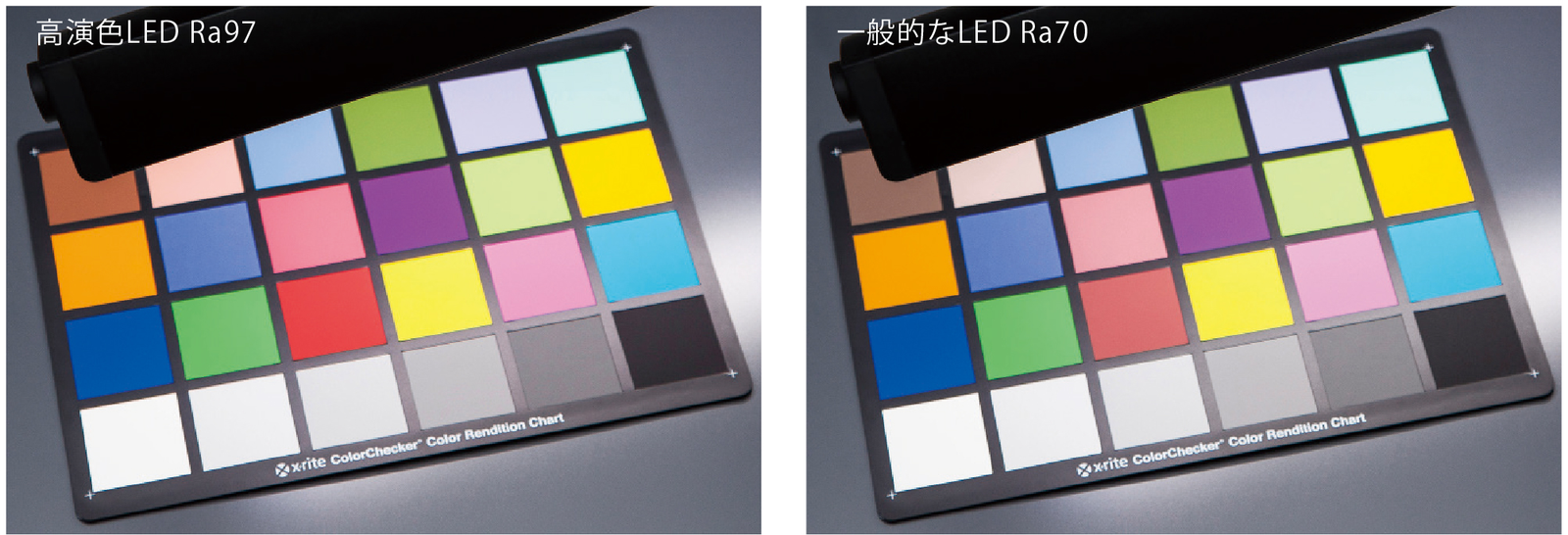
CRI—the Color Rendering Index—tests how a light source renders eight standardized pastel colors. The score is an average.
The critical flaw: CRI doesn’t test saturated colors. LEDs often score well on pale pastels but fail spectacularly on deep reds, blues, and greens—the colors that make retail displays pop.
In commercial lighting, this is exactly backwards. You need great rendering on the colors that sell: the red of fresh meat, the green of produce, the gold of baked goods.
TM-30: The More Honest Standard
IES TM-30, introduced in 2015, is a fundamentally different approach:
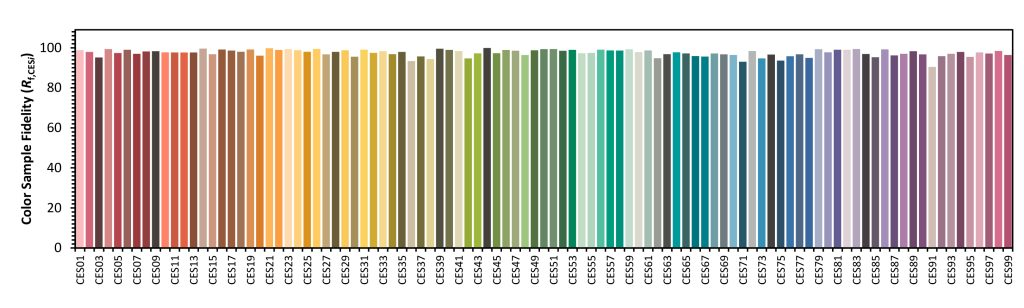
- Tests 99 color samples (vs CRI’s 8)
- Includes 16 saturated colors that CRI ignores
- Provides two scores: Fidelity Index (Rf) and Gamut Index (Rg)
- Rf ranges 0-100 (similar to CRI)
- Rg indicates saturation: above 100 = oversaturated, below 100 = undersaturated
What to demand from your supplier: Ask for TM-30 report with Rf and Rg values. A quality LED manufacturer should provide this without hesitation.
At YoubeeLight, we provide TM-30 reports for all our professional-grade track lights and downlights. Our CRI 90+ products typically score Rf 88-92 with Rg 100-105.
CQS: NIST’s Attempt to Fix CRI
The National Institute of Standards and Technology developed CQS (Color Quality Scale) as another improvement. It uses 15 saturated colors and a different calculation method.
Practical comparison
| Metric | Colors Tested | Saturated Colors | Industry Adoption |
|---|---|---|---|
| CRI | 8 | 0 | Universal (but flawed) |
| TM-30 | 99 | 16 | Growing (2015+) |
| CQS | 15 | 15 | Limited |
How to Use This When Sourcing
Step 1: Define your application
- Retail food/goods: TM-30 Rg 100-108 preferred
- Museum/gallery: TM-30 Rf 90+ with natural saturation
- Office general: CRI 80+ may suffice
- Photography/videography: TM-30 Rf 95+ essential
Step 2: Request documentation
- Ask for TM-30 reports, not just CRI claims
- Compare Rf values across suppliers (higher = more accurate)
- Check Rg to understand saturation behavior
Step 3: Test before container orders
- Always request samples for color-critical applications
- Compare under your actual working conditions
- Budget for this—it saves expensive returns
The Bottom Line
CRI tells you part of the story. TM-30 tells you more. For professional lighting applications, don’t source on CRI alone.
For buyers evaluating Chinese manufacturers: A supplier who provides TM-30 data is demonstrating technical competence and transparency. Refuse to provide TM-30? Question their quality control elsewhere.
YoubeeLight’s LED catalog includes TM-30 test reports for professional-grade products.
Quick Reference: What to Ask Your Supplier
| Your Question | What Good Answer Looks Like |
|---|---|
| “What’s your CRI?” | “CRI 90+, here’s the test report” |
| “Can you provide TM-30?” | “Yes, Rf 89, Rg 102, here’s the file” |
| “Why does CRI 85 look different?” | “Different binning, TM-30 shows the real difference” |
For commercial lighting solutions that include complete photometric data, browse our professional-grade range or contact our sourcing team.
