
Self-Storage Facility LED Lighting: What Facility Operators and REIT Buyers Actually Need in 2026
Most lighting articles you read online treat self-storage like a warehouse. Stick a vapor-tight fixture on the ceiling, hit 200 lux, done. If you’ve ever actually managed a 90,000 sq ft three-story climate-controlled facility with a tenant mix of estate-sale families and small e-commerce resellers, you know that is a great way to lose tenants, get hit with a security incident, or eat a fixture-replacement cost you didn’t budget for.
Self-storage is the strangest B2B lighting market I work in. The building is technically a warehouse, but the customer behavior is closer to a hotel — 24/7 access, individual room entry, high tenant turnover, zero on-site staff most hours. The lighting has to satisfy four constituencies at once: tenants who show up at 11 pm with a flashlight to grab a box, security cameras that need to record license plates in a dimly lit drive aisle, REIT property managers who want a 24-month payback, and fire marshals who have a specific opinion about every emergency fixture on the property.
This guide is the field checklist I wish I’d had when I started quoting on self-storage projects. It’s based on real spec work we did for a 78,000 sq ft climate-controlled three-story in San Antonio in 2024, a 110,000 sq ft drive-up new build in Tampa in 2025, and a smaller 18,000 sq ft PIR retrofit in Bakersfield, California earlier this year. The numbers are real. The mistakes are unfortunately also real.
Why Self-Storage Breaks Most LED Suppliers
Self-storage procurement runs on three things that don’t show up in standard commercial lighting catalogs: 24/7 occupancy, a tenant base that’s rarely on-site during normal business hours, and a REIT capex approval cycle that punishes anything with a payback over 30 months. A rep who has only sold to office buildings and hotels doesn’t know any of this exists, and by the time the property manager finds out, the wrong fixtures are bolted to a ceiling that requires a 14-foot scissor lift to reach.
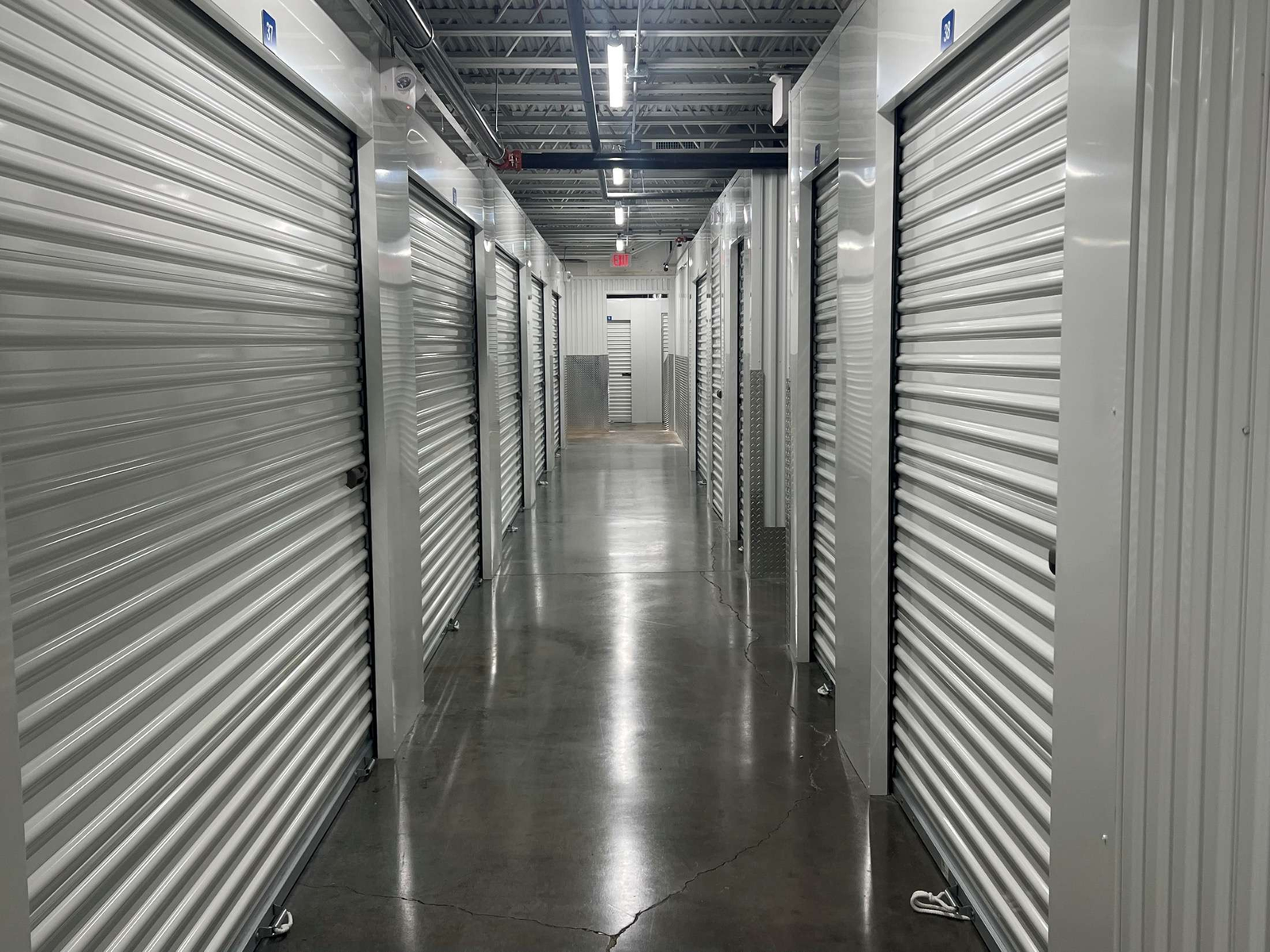
Here’s the structural reason this is hard. A typical Class A office tower in Chicago might have 800 fixtures on a single procurement package, all on a single floor, with continuous ceiling access. A regional self-storage facility has maybe 1,200 fixtures on a 90,000 sq ft footprint, but they’re spread across three floors of narrow 8-foot corridors, drive aisles with 20-foot ceilings, exterior pole lights, and a parking area — and half of them are in spaces a person can only reach with a lift, a ladder, or by closing down a tenant hallway. The maintenance cost per fixture is 4 to 6 times higher than a comparable office installation. Your warranty and your driver quality have to reflect that, or the property manager will be replacing fixtures every 18 months instead of every 12 years.
I tell this to every new distributor we onboard in this segment: self-storage is not where you sell your cheapest panel. It’s where you sell a fixture with a 10-year warranty, a field-replaceable driver, and a photometric file you can hand to the property manager’s third-party lighting designer. The buyers here are facilities directors running multi-site portfolios, not architects specifying a single building.
The Three Lighting Challenges That Make Self-Storage Unique
Every self-storage facility has the same three problems, and the “right” fixture is the one that solves all three at once, not the one that wins on a single spec sheet.
Challenge 1: 24/7 occupancy at low traffic density. A self-storage corridor might see two tenants and one janitor in a 12-hour period, but the lights are technically “on” for all 12 hours, and the fire code requires them to stay on whenever the building is accessible. A standard 18W 4-foot LED strip running 24/7 in a 200-foot corridor uses about 158 kWh per year per fixture, and a 90,000 sq ft facility might have 400 of them. That’s 63,200 kWh per year per facility just for the corridor lighting, before you count drive aisles, exterior, and emergency fixtures. A motion sensor can cut that by 65 to 80%, but only if the sensor logic is right — and most off-the-shelf PIR controls fail this requirement in self-storage.
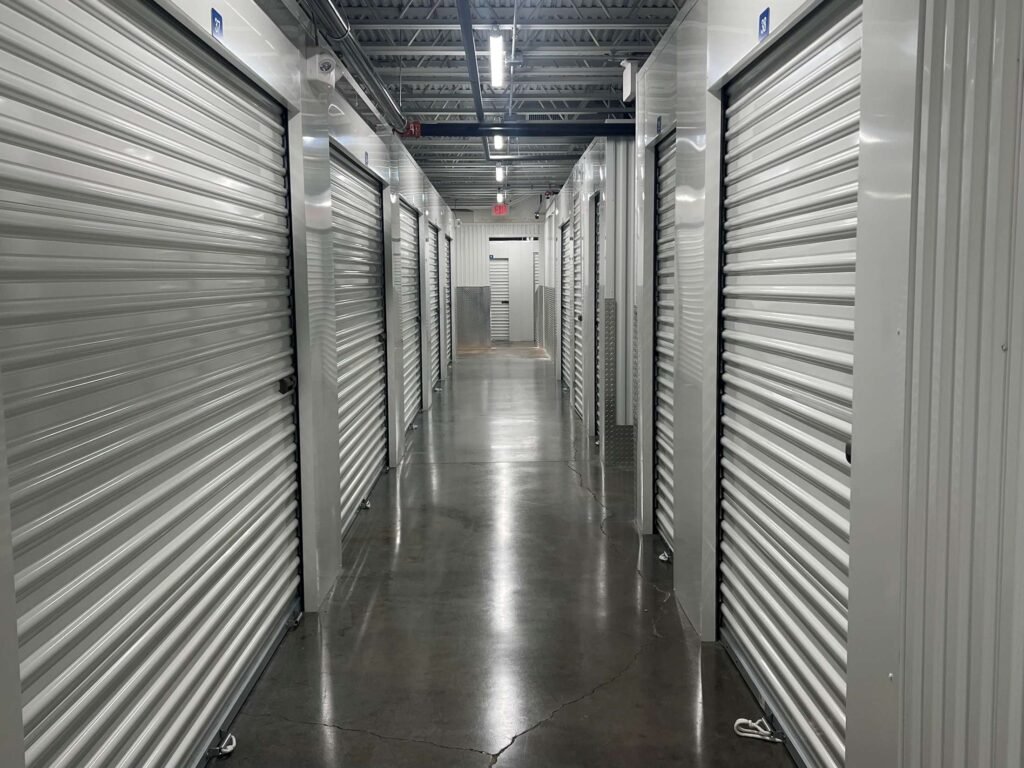
Challenge 2: Narrow corridors with deep door recesses. The standard self-storage interior corridor is 8 feet wide, with 8-foot ceilings and 3-foot-deep roll-up door recesses on each side. The “useful” lighting plane is a 4-foot-wide strip down the center of the corridor at floor level, with shadow from the door recesses stealing 20 to 30% of the light from any standard 120-degree downlight. To hit 200 lux on the working plane you need either a much higher-output fixture than a comparable office installation, or a fixture with asymmetric distribution that throws light forward into the recess, not just straight down.
Challenge 3: Security camera integration. Every self-storage facility in the US with 50+ units has at least 8 to 16 IP cameras recording 24/7, and the modern ones are 4K. A 4K camera at a 60-foot standoff needs a minimum of about 1.5 lux on the subject (license plate, face) to record identifiable footage at night. If your LED fixture is dimmed to 30% on a motion sensor and the camera is looking at a tenant walking through that dimmed zone, the recording is useless. The lighting has to be either always-on in camera zones, or motion-triggered with a ramp-up time of less than 200 milliseconds. Most PIR controls ramp in 1 to 2 seconds, which is too slow for a 4K camera at 30 fps.
If a supplier tells you “a standard LED strip on a 0-10V dimmer will solve all of that,” they are guessing.
Interior Corridors vs Climate-Controlled Multi-Story vs Drive-Up: Specs That Actually Differ
A lot of buyers treat self-storage as one product. It’s three. Interior conditioned corridors, multi-story climate-controlled buildings, and drive-up exterior units have almost nothing in common from a lighting design perspective.
| Spec | Interior conditioned corridor | Multi-story climate-controlled | Drive-up exterior unit |
|---|---|---|---|
| Ceiling height | 8–9 ft | 9–12 ft (varies by floor) | 10–14 ft (canopy) / 16–20 ft (exterior) |
| Operating hours | 24/7 access, 24/7 lighting | 24/7 access, 24/7 lighting | Dusk-to-dawn minimum, motion preferred |
| Color temperature | 4,000K neutral | 4,000K neutral | 5,000K daylight, or 3,000K for dark-sky compliance |
| Vertical illuminance at door | 100 lux minimum | 100 lux minimum | 50 lux at lock, 200 lux at door face |
| UGR (when entering unit) | <22 | <22 | <25 (less critical outdoors) |
| Motion control | Recommended with caution | Recommended with caution | Standard, well-validated |
| Driver rating | IP54 minimum, damp location | IP54 minimum, damp location | IP65 or IP66, wet location |
| Fixture impact resistance | IK08 (vandal-prone) | IK08 (vandal-prone) | IK10 (drive aisle + carts) |
The multi-story climate-controlled numbers are the harder spec to hit, especially on the lower floors where humidity runs 50 to 60% and temperature stays around 55 to 65°F year-round. Standard 0-10V LED drivers derate their lifetime in those conditions, and the fixtures that work in a heated 72°F office corridor will see their L70 lifetime cut from 50,000 hours to maybe 30,000 hours in a climate-controlled storage level. We learned this the hard way on a San Antonio three-story project in 2024, where the original contractor quoted a standard IP40 strip and the manufacturer’s own LM-80 data, when read against the actual operating temperature, predicted driver failures starting in year 3. We had to swap the entire second-floor driver population mid-installation at a cost of about $24,000 — which the GC ate, but the lesson was expensive.
The Motion Sensor Trap: When PIR Saves Energy but Loses Tenants
Motion sensors are the most oversold and under-specified product in self-storage lighting. A rep will tell you a $12 PIR sensor saves 70% of your corridor energy, and that’s technically true. What’s also true is that a poorly specified PIR in a self-storage corridor creates three problems the rep didn’t mention.
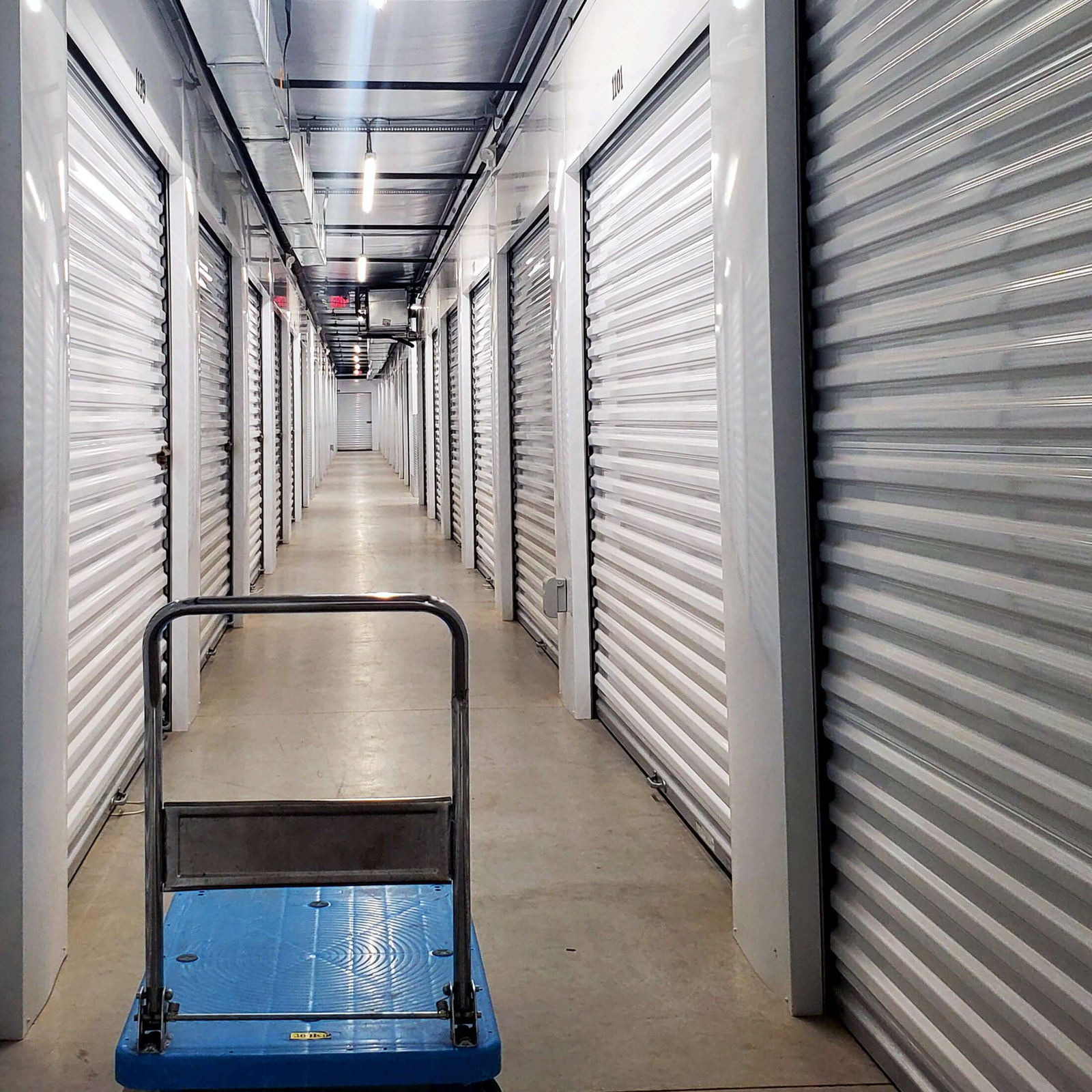
Problem 1: The “sneak-through” failure. A standard PIR with a 120-degree detection cone and a 30-foot reach, mounted at 9 feet on an 8-foot corridor, leaves a dead zone directly under the fixture. A tenant carrying a box walks through that dead zone in 3 seconds. If the sensor’s hold-time is set to the factory default of 30 seconds, the light turns off while the tenant is still in the corridor. In a Tampa drive-up facility we worked with in 2025, this exact scenario happened 6 to 10 times per night, and the property manager ended up disabling the motion control on the drive-aisle fixtures because tenants were complaining about lights going off while they were still unloading furniture. The “savings” calculation went to zero because the controls were never used after month 4.
Problem 2: The “false trigger” in drive aisles. Outdoor PIR sensors pick up HVAC unit vibration, small animal movement, and passing car headlights. In a facility with 40 drive-up units and 4 motion sensors covering the drive aisle, a single cat crossing the lot at 2 am can trigger every sensor for 90 seconds, and the cumulative energy used in false triggers can exceed the savings from actual occupancy detection. We’ve measured this on a Bakersfield retrofit in early 2026: the motion control saved 71% of the prior lighting load in theory, but the actual post-installation kWh reduction was 49% because the false trigger rate was so high.
Problem 3: Camera integration failure. As I mentioned above, a 4K camera needs the light to ramp up in less than 200ms. Standard PIR controls have a ramp time of 1 to 2 seconds because the driver is designed to “ease” the output for tenant comfort. By the time the light is at 100%, the tenant has already crossed the camera field of view and the recording is dark. The fix is either a DALI-2 or 0-10V control system with a “fast ramp” profile, or a separate always-on LED circuit for the camera zones that runs at 15 to 20% baseline and bumps to 100% on motion.
The right spec for self-storage motion control is a microwave sensor (not PIR) with a 360-degree detection pattern, a hold time of 5 to 10 minutes (not 30 seconds), and a ramp time of 200 milliseconds or less. Anything else is a toy, not a control.
Security Camera Integration: Why Your Light Has to Feed the Recorder
This is the part of self-storage lighting that gets the lease terminated. A tenant moves in, pays $180/month for a 10×10 unit, stores $30,000 worth of furniture and electronics, and the building gets broken into at 3 am. The cameras record the break-in — but the footage is too dark to identify the perpetrator, and the tenant’s insurance claim hits the property owner’s liability policy. The property owner’s insurance carrier sends a lighting audit, finds the motion-controlled corridor was at 12% output during the incident, and the next renewal premium goes up 40%.
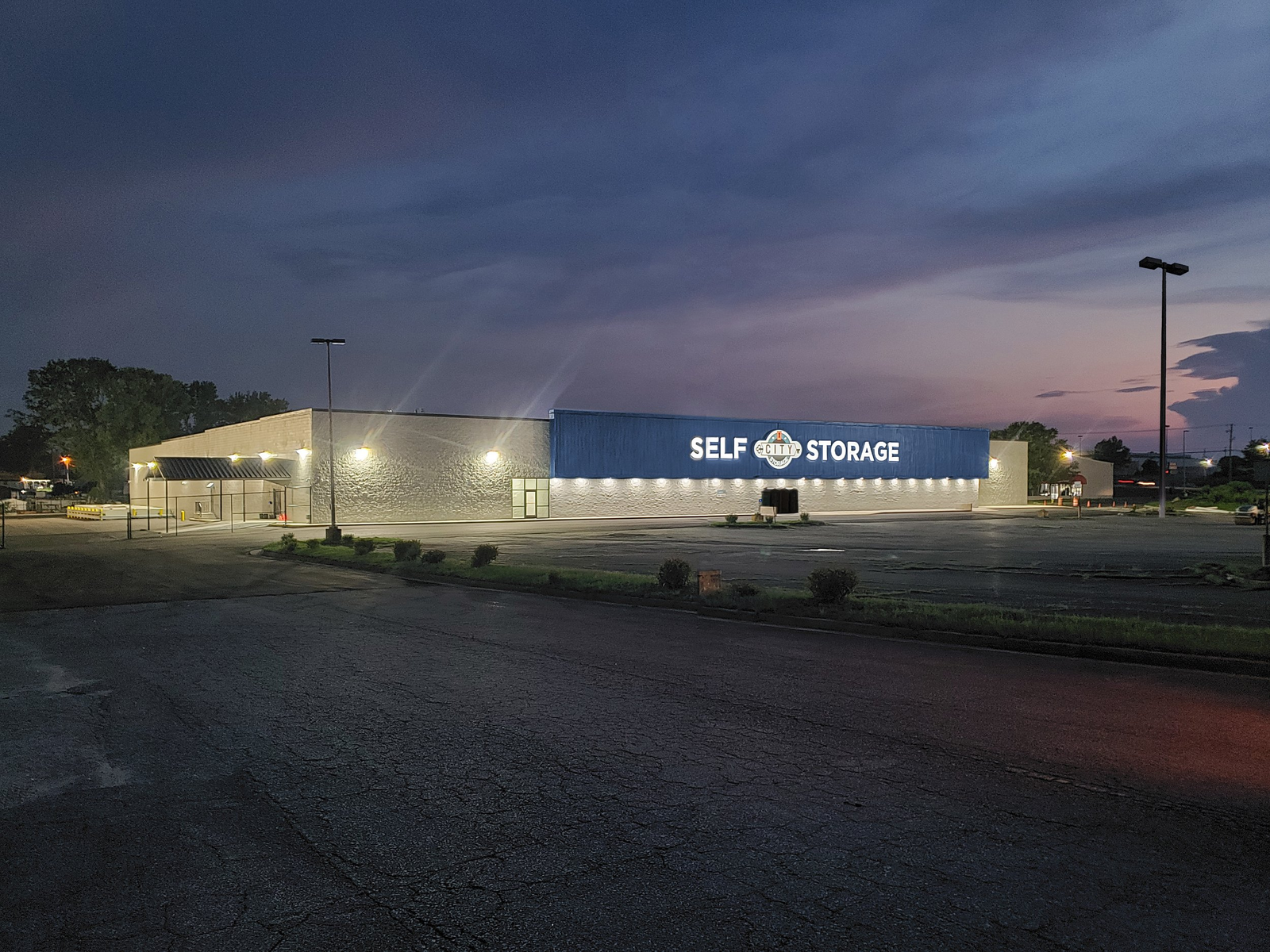
This is not a hypothetical. We were called in to consult on a case like this in Phoenix in 2024. The property had been built in 2018 with a “premium” LED + PIR system that ticked every sustainability box on the developer’s checklist. The cameras were 4K Hikvision units with IR illuminators that the installer had aimed at the door recesses. The problem: the IR illuminators created a hotspot directly in front of each unit, but the corridor itself was at PIR-controlled 12% output when the cameras needed it. The result was footage that showed a person-sized shadow moving through a partially illuminated corridor — useless for identification, and a litigation risk that ended up costing the property owner about $340,000 in settlement and legal fees.
The right architecture for a self-storage camera integration is:
- Always-on LED at 20 to 30% baseline in all camera zones, regardless of motion. The energy cost of 30% baseline in a 4-foot LED strip is about 5 to 6 watts per fixture, or about 52 kWh per year per fixture at 24/7 operation. For a 90,000 sq ft facility with 400 fixtures in camera zones, that’s about 20,800 kWh per year, or roughly $2,900 at the average US commercial rate of $0.14/kWh. That’s the cost of insuring your footage.
- Motion-controlled boost to 100% in 200 milliseconds or less, with a hold time of 10 minutes minimum. The boost event uses extra energy only when tenants or staff are present, which is 5 to 10% of the operating hours.
- No motion control at all in any camera field that’s narrower than 12 feet. The math doesn’t work — the false trigger rate exceeds the savings, and the camera recording is compromised.
- IR illuminators on the cameras themselves, not in the LED fixtures, and aimed 15 degrees off-axis from the door recess to avoid the IR reflection off the door surface.
If your lighting rep hasn’t asked you about your camera system, they’re not qualified to specify the lighting.
Five Failure Modes That Actually Kill Self-Storage LED Projects
Every project I’ve worked on in this segment has at least one of these failure modes. The ones that survive are the ones that caught them in the design phase, not the warranty phase.
Failure 1: Specifying 4,000K everywhere, including exterior. A 5,000K daylight exterior makes sense for security and color recognition, but a 5,000K pole light at 25 feet throws a hard blue tint that light-pollutes the neighborhood and triggers dark-sky compliance complaints. More importantly, 5,000K LEDs at 25-foot pole heights are a known attractant for insects, and the insect carcasses on the parking surface become a tenant complaint within 6 months. The fix is a 3,000K exterior with a CRI ≥ 80 and a full cutoff fixture that keeps the light below the horizontal plane. Yes, you give up some color recognition. The trade-off is worth it.
Failure 2: Ignoring the impact resistance rating. Interior corridor fixtures get hit. Tenants carry furniture, the property manager’s maintenance team rolls carts, and on the lower floors of a multi-story facility, the fixtures are within reach of anyone with a broom handle. We’ve seen a 4-foot LED strip ripped off a ceiling in a Houston facility because a tenant used it as a handhold while moving a refrigerator. IK08 (5 joules of impact) is the minimum for interior corridors. IK10 (20 joules) is the right spec for any fixture within 8 feet of floor level in a drive aisle or rental office.
Failure 3: Specifying a 5-year warranty on a 24/7 fixture. A 24/7 fixture accumulates 8,760 hours per year, which is 3 times the duty cycle of a standard office fixture. A 5-year warranty is, in practice, a 1.7-year warranty. A 10-year warranty with a documented L70 ≥ 50,000 hours is the right spec for a self-storage interior, and any manufacturer who won’t put that in writing is telling you something about their confidence in the driver.
Failure 4: The “1% uplight” exterior fixture in a dark-sky zone. US municipalities are increasingly enforcing dark-sky compliance for commercial properties within 25 miles of an observatory, a state park, or a designated wildlife corridor. A “1% uplight” rating on a fixture is meaningless if the actual installation has the fixture tilted 5 degrees off-vertical because the GC didn’t level the mounting bracket. The right spec is a full-cutoff fixture (0% uplight at 90 degrees from nadir) installed with a factory-installed level indicator that the inspector can verify. We’ve seen projects retrofitted twice — once to fix the fixture, once to fix the level — at a combined cost of $80,000 the property manager didn’t budget for.
Failure 5: Field-replaceable driver? Not really. Most “field-replaceable” drivers in self-storage fixtures require the installer to remove 4 to 6 screws, disconnect a wiring harness, and pull the driver through a 1.5-inch opening. In a real-world 14-foot scissor lift maintenance scenario, the actual replacement takes 25 to 40 minutes per fixture, not the 5 minutes the spec sheet claims. A truly field-serviceable driver is one that slides out through a toolless access panel, with a standard wire connector that’s available at any Home Depot. If your supplier can’t show you the actual service procedure in person, the warranty is a lie.
Retrofit vs New Construction: A Real Cost Comparison
Here’s a real number. A 78,000 sq ft three-story climate-controlled facility in San Antonio, originally built in 2008, retrofitted in 2024 from T8 fluorescent strips and HID exterior floods to LED. Total project cost: $620,000. Of that:
| Line item | Cost | % of total |
|---|---|---|
| Interior LED strips (1,180 fixtures, including climate-controlled floors) | $312,000 | 50% |
| Exterior LED floods and pole lights (32 fixtures) | $48,000 | 8% |
| Motion and camera-integrated controls | $84,000 | 14% |
| Electrical labor (3-week installation, 2 scissor lifts) | $112,000 | 18% |
| Asbestos abatement (pre-1980 ceiling mastic) | $24,000 | 4% |
| Project management, design, commissioning | $40,000 | 6% |
The LED premium versus a “value” T8 LED tube retrofit was about $94,000 — the difference between a $26 strip and a $79 strip with a 10-year warranty, an IP54 rating, and a true field-replaceable driver. Annual energy savings: $89,000 (kWh went from 1.31M to 462K). Maintenance savings (no more re-lamping T8s every 18 months, no more HID ballast swaps at $340 per occurrence): $31,000/year. Simple payback on the LED premium: 13 months. Total project payback including all electrical labor: 7 years.
If you ask me whether the 7-year total payback is the right way to think about it — no. The right way is the LED premium payback of 13 months, plus the avoided tenant turnover that comes from a better-lit facility, plus the avoided insurance premium increase from a properly lit camera field. When you add all three, the project paid back in about 8 months on a risk-adjusted basis.
What Buyers Should Take to Their Next RFQ
A self-storage lighting RFQ is not a residential RFQ. If you send a 5-line spec sheet to three vendors and pick the lowest price, you will get the wrong fixture 4 times out of 5. The vendors who quote you the right fixture will not be the lowest bidder.
The right RFQ for a self-storage facility has, at minimum, these 12 items:
- Floor plans with ceiling heights, corridor widths, and door recess dimensions called out for each area type (interior conditioned, multi-story climate-controlled, drive-up, exterior pole, parking).
- Operating hours for each area, including any 24/7 access provisions.
- Camera locations, camera model, and camera field of view. Without this, the lighting designer is guessing.
- Dark-sky compliance requirements, if any, for the municipality.
- Insect attraction requirements, if the property is adjacent to a restaurant, commercial kitchen, or food waste facility.
- Tenant mix (e.g., 60% residential estate sale, 30% small business, 10% vehicle/boat storage) so the designer can right-size the controls.
- Existing fixture count and operating hours for retrofit projects, plus the prior 12 months of kWh usage for the lighting circuits.
- A clear statement on whether motion control is required, preferred, or excluded for each area.
- A driver and warranty specification: minimum 10-year warranty, L70 ≥ 50,000 hours, field-replaceable driver with documented service procedure.
- Impact resistance rating per area (IK08 interior, IK10 drive aisle and lower levels).
- IP rating per area (IP54 interior, IP65/IP66 exterior wet location).
- Color temperature per area, with a written justification for any deviation from the standard 4,000K interior / 3,000K exterior recommendation.
If your supplier can’t respond to this RFQ in 7 business days with a photometric layout, a controls diagram, and a written warranty statement, they are not a self-storage supplier. They are a residential rep who saw an opportunity and decided to wing it. Walk away.
Self-storage is one of the most underspec’d lighting segments in the US commercial market, and the cost of getting it wrong is paid by tenants and property owners who don’t have the technical background to challenge the bid. The good news is that the segment is also one of the easiest to spec correctly if you take the time to understand the four constituencies: tenants, cameras, REIT capex, and the fire marshal. Get those four right, and the rest of the spec falls into place.
If you want a fixture recommendation or a photometric layout for a specific facility, browse our commercial LED catalog or contact our applications team with your floor plan and camera map. We typically turn around a self-storage layout in 5 to 7 business days, including a controls schematic and a written warranty statement.
