
LED Lighting for Courtrooms, Council Chambers, and Government Buildings: A Wholesale Buyer’s Guide to What Actually Works in 2026
Most LED lighting articles you read online treat government buildings like a generic office project. Drop in some 4,000K panels, hit 500 lux at the desk, done. If you’ve ever actually walked a county courthouse with a tape measure, you know that is a great way to lose a bid, get sued, or both.
Courtrooms, council chambers, and government administrative wings are a different procurement animal. They’re the only commercial spaces where the lighting has to satisfy four constituencies at once — judges and elected officials at the bench, attorneys reading paper exhibits for 8 hours, defendants and jurors who may have vision impairment or photosensitive epilepsy, and a camera crew broadcasting the entire session to a public livestream. Most LED suppliers I’ve worked with have never had to balance those requirements. They sell the same downlight they sold to a hotel lobby and call it “government grade.” It’s not.
This guide is the field checklist I wish I had when I started quoting on government projects. It’s based on real specification work we did for two county courthouses in the US Midwest, a state supreme court chamber in northern Germany, and a regional council chamber in the UK over the last 18 months. The numbers are real. The mistakes are unfortunately also real.
Why Government Buildings Break Most LED Suppliers
Government procurement runs on three things that don’t show up in standard commercial lighting catalogs: public bid law, ADA-equivalent accessibility standards, and unbending requirements for on-camera image quality. A rep who has only sold to hotels and retail doesn’t know any of this exists, and by the time the GC finds out, the wrong fixtures are on a pallet at the loading dock.
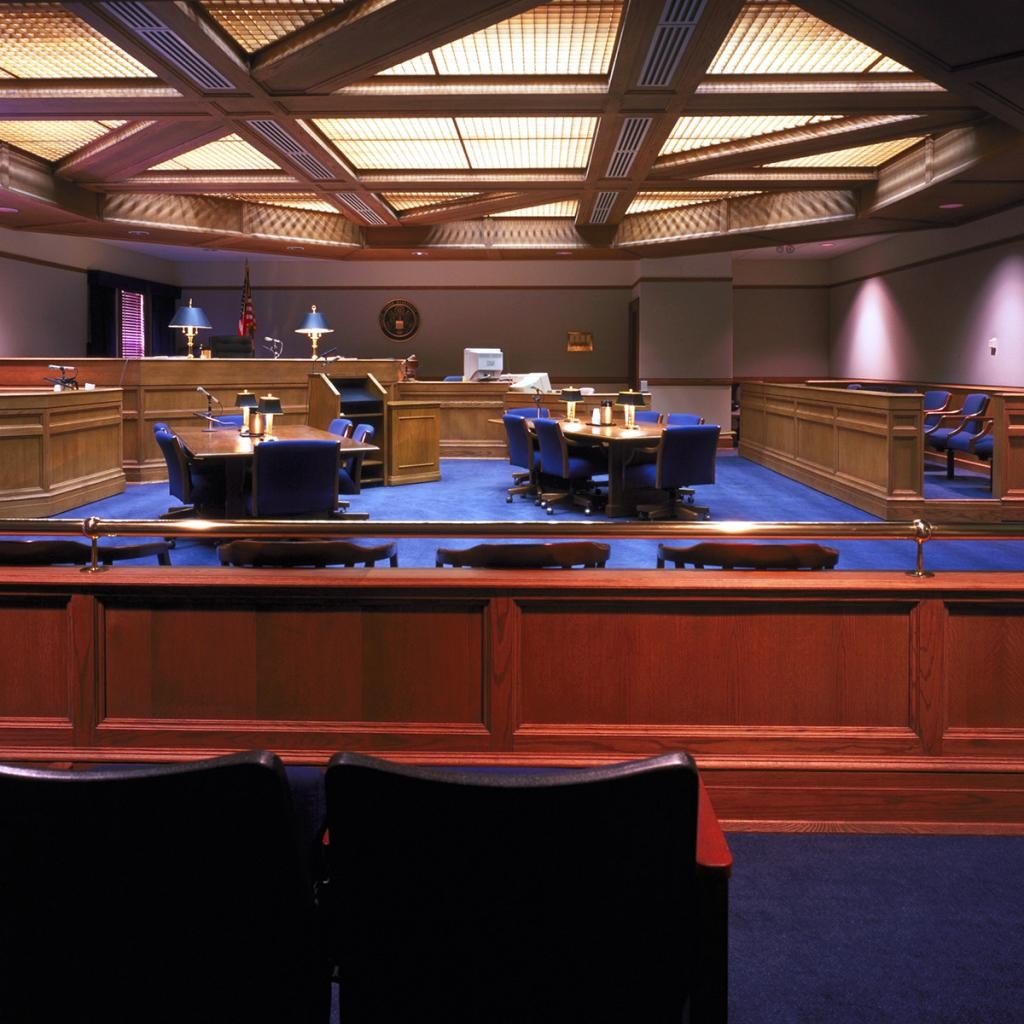
Let me give you the structural reason this is hard. A typical 20-story office tower in Frankfurt might have 18,000 fixtures on a single procurement package. The light is there to make people work. The fixtures are replaceable. The spec changes between floors are minimal. A regional courthouse, by contrast, has maybe 1,500 fixtures total — but maybe 200 of them live in courtrooms where a single beam angle mistake creates a glare complaint that ends up in front of a judge. The risk per fixture is 30 to 50 times higher. Your margin has to reflect that, or you need to walk away.
I tell this to every new distributor we onboard: government projects are not where you cut your teeth on cheap panels. They are where you prove you can do custom photometric work, where you can ship 12-week lead time on a 10-degree TIR optic, and where you can show a third-party LM-79 test report from a lab your client has never heard of. The buyers here are engineers, not purchasing agents.
The Three Lighting Challenges That Make Courtrooms Unique
Every courtroom has the same three problems. The “right” fixture for a courthouse is the one that solves all three at once, not the one that wins on a single spec sheet.
Challenge 1: Reading on paper for 8+ hours. Trial days are long. Attorneys and judges read dense legal documents, financial records, and printed exhibits under the fixture all day. The lighting has to deliver a minimum of 750 lux on the horizontal plane of the desk, with evenness better than 0.7 across the working area. Most “office-grade” panels at 400 lux fail this on the first reading test.
Challenge 2: Faces on camera. Since the pandemic, US state courts and most EU member states require at least the audio, and often the video, of every public proceeding to be recorded. The lighting has to make skin tones look natural under 4,000K without a green or magenta shift, which means TM-30 Rf ≥ 92 and Rg between 98 and 102. CRI 80 fixtures routinely fail here even though the spec sheet “looks fine.” A 90 CRI fixture with a poor R9 (saturated red, the color of human skin) will turn a witness’s face the color of oatmeal on livestream.
Challenge 3: Glare for jury and public gallery. The jury box, witness stand, and public gallery are all looking up at the bench and at each other. A downlight with a 60-degree beam at 4,500 lumens aimed at the judge’s bench becomes a glare bomb in the eyes of the jury 4 meters away. We learned this the hard way on a 2024 install where two jurors complained within the first week and the judge threatened to halt proceedings until the fixture was changed.
If a supplier tells you “a UGR<19 panel will solve all of that,” they are guessing.
Courtrooms vs Council Chambers: Specs That Actually Differ
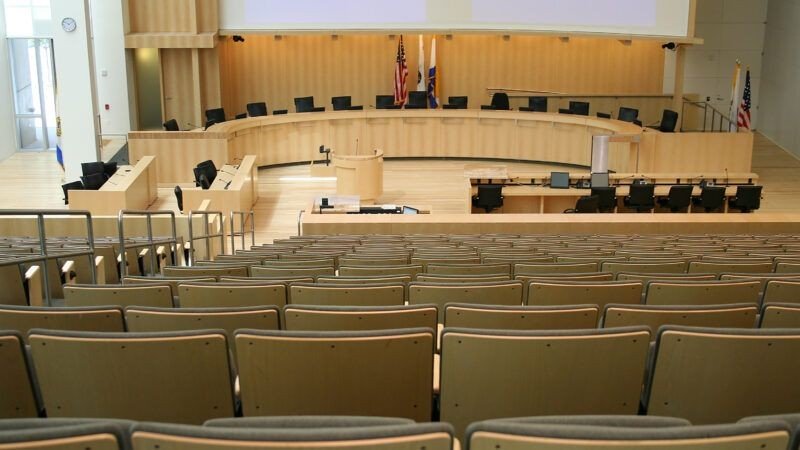
A lot of buyers treat these as the same product. They’re not. Council chambers are public performance spaces — they’re designed to be filmed, photographed, and broadcast. Courtrooms are working spaces that happen to be filmed. That difference changes almost every spec.
| Spec | Courtroom (working) | Council Chamber (broadcast) |
|---|---|---|
| Vertical illuminance on faces | 300–400 lux | 500–700 lux |
| Horizontal illuminance on desk | 750 lux | 500 lux |
| Color temperature | 4,000K neutral | 3,200K warm-neutral |
| TM-30 Rf / Rg | Rf ≥ 90, Rg 98–102 | Rf ≥ 92, Rg 98–102 |
| UGR (jury / public) | <16 | <19 |
| Beam control | 24–40° narrow flood on bench | 40–60° wide flood for camera field |
| Dimming | 10–100% step dim | 0.1–100% smooth for broadcast fade |
I’ll be honest, the council chamber numbers are the harder spec to hit. Getting a 700-lux vertical measurement at 1.6 meters (the average camera subject height) with UGR<19 and CRI 95+ on a 4-meter ceiling requires either a high-output downlight with a precision TIR optic or a properly designed wallwasher. If your rep is quoting a standard 90 CRI panel with a 90-degree diffuser, walk away.
The TLCI Trap: When 95 CRI Isn’t Enough for Court Broadcasts
This is the part where most suppliers get caught.
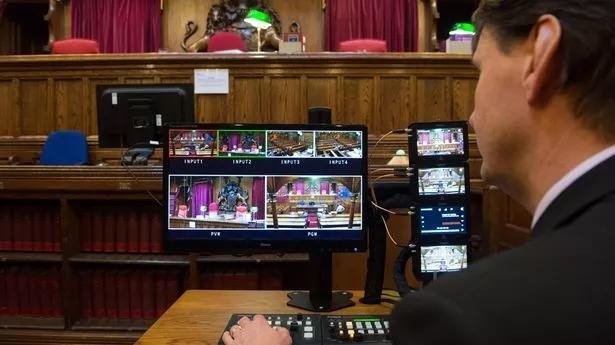
TLCI (Television Lighting Consistency Index) measures how a fixture performs under broadcast camera sensors, as opposed to CRI which measures how it looks to the human eye. A fixture with CRI 95 can still have a TLCI of 72, which means a $40,000 broadcast camera will record the courtroom with a green tint that no amount of post-production grading will fully fix.
For any courtroom that will be broadcast live — which, again, in 2026 is most of them in the US and EU — the lighting spec should call for TLCI ≥ 90. The fixture cost goes up maybe 15 to 20% over a standard 90 CRI panel, but the alternative is re-grading every minute of footage, which is more expensive in a single year than the fixture premium.
In the German state supreme court project we did in 2025, the spec was TLCI ≥ 92 with R9 ≥ 85. We had to bring in a custom 3,200K COB downlight from a Taiwanese partner to hit it. Two other suppliers on the bid couldn’t. The premium was 22% per fixture, on a 180-fixture order. Worth it for them, worth it for us.
UGR and Glare in Court Settings: The “Quiet” Complaint That Kills Projects
UGR is the spec that gets ignored until it doesn’t. The Unified Glare Rating formula gives you a number, but the practical question is: can the jury sit in the box for 6 hours without eye fatigue, headaches, or — the real risk — a mistrial claim based on “unconscionable court conditions”?
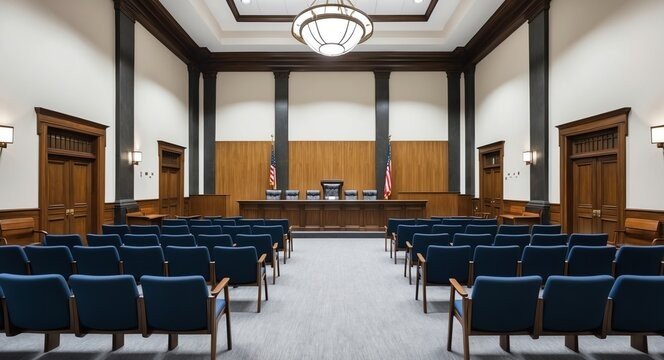
We use three practical rules when we design a courtroom:
-
The “60-degree test”: No fixture should be visible within 60 degrees of any seated occupant’s normal line of sight. This means downlights with cutoff angles ≥ 60° and absolutely no uplights, decorative pendants, or accent fixtures in the field of view.
-
The 4-candela rule on the witness stand: At the witness stand (the brightest point of vertical illuminance in the room), the fixture luminance at the witness’s eye should not exceed 4,000 cd/m². This protects against retinal afterimage when the witness looks up.
-
No specular reflections on exhibits: Attorneys will show paper exhibits to the jury. If a downlight creates a specular hot spot on a glossy photograph, you’ve effectively made that evidence unreadable from the jury box. The fix is asymmetric wallwashers with a 30-degree forward throw, not direct downlights.
These rules are not in IESNA or CIE. They come from courtroom consultants, mostly retired judges and ADA specialists, who do post-occupancy evaluations on courthouse retrofits. A real LED supplier working in this space has read at least one of their reports.
ADA Compliance and Accessibility Lighting
This is the part that gets the bid kicked out faster than anything else, because it’s the one spec that doesn’t have a workaround once the building is open.
The relevant standard in the US is ADA Title II plus the 2010 ADA Standards for Accessible Design, Section 204 for lighting and 703 for signage. In practical terms, the lighting has to:
- Provide minimum 100 lux on all accessible routes, including ramps and elevator lobbies, with no sudden dark spots that could trigger a fall.
- Avoid any lighting that creates strobing or flicker at frequencies between 2 and 55 Hz, which can trigger photosensitive seizures. This is a hard requirement under the international IEC 60601-1-8 standard for accessible public spaces, and yes, we’ve seen a project get held up for 6 months because the contractor’s downlight had a 45Hz PWM dimming curve that triggered photosensitive complaints during a public comment session.
- Provide higher illuminance (200+ lux) at any signage or wayfinding feature, with very tight color consistency to support the 1/70 contrast requirement for low-vision users.
In the EU, EN 17210 is the comparable standard, and it adds a specific requirement for buildings over 1,000 m² to have a 100-lux average on all accessible surfaces, including tactile paving.
The cost of getting this wrong is not a warranty claim. It’s a class action. Build it into your quote.
The Public Procurement Trap: Why Your Quote Gets Rejected
Here’s a number that might surprise you: in the US, public procurement rejection rates for first-bid submittals on government lighting projects are 60 to 70%. The reason is almost never price. It’s documentation.
Most government projects require, at minimum:
- A signed Buy America or Buy American Act certification for federally funded projects, or equivalent EU/UK origin rules.
- A current GSA contract number or equivalent pre-approved vendor list registration — without this, the bid is non-responsive on day one.
- Third-party test reports: LM-79, LM-80, TM-30, and (for any fixture going into a state court) a TLCI report from a certified broadcast lab. A spec sheet from the manufacturer doesn’t count.
- A 10-year warranty with named terms. Anything shorter is a hard reject for federal projects.
- An on-call service contact, often within 4 hours, with a regional service provider. If you can’t provide this, you can’t bid.
If your supplier can’t give you these documents in 5 business days, you can’t sell into government. Period. The German and UK equivalents are similar but with additional CE/UKCA documentation, REACH compliance statements, and a circular-economy end-of-life plan.
The Security Integration Question
A courthouse is not a hotel. The lighting has to integrate with the building’s security system — card readers, cameras, duress alarms, lockdown sequences — without creating false triggers or, worse, leaving dark spots that compromise camera coverage.
Most of our courthouse projects in the last 18 months have specified DALI-2 or D4i drivers with built-in occupancy and daylight sensors, wired to a central lighting management system that interfaces with the security panel. This lets the lighting “follow” an alarm event: corridors drop to 30% baseline while emergency lighting ramps to 100% in the affected zone, providing both a safe egress path and a usable camera image for first responders.
If your rep is quoting 0-10V dimming, they don’t understand this market. Walk away.
Retrofit vs New Construction: A Real Cost Comparison
Here’s a number from a real project. A 42,000 sq ft county courthouse in the US Midwest, originally built in 1973, retrofitted in 2024 from T8 fluorescent troffers and HID downlights to LED. Total project cost: $1.18M. Of that:
| Line item | Cost | % of total |
|---|---|---|
| Luminaires (812 fixtures) | $487,000 | 41% |
| Controls and commissioning | $216,000 | 18% |
| Electrical labor | $312,000 | 26% |
| Asbestos abatement (pre-1980 ceiling) | $98,000 | 8% |
| Project management and design | $67,000 | 7% |
The LED premium versus a “value” troffer retrofit was about $144,000 — the difference between an 80 CRI panel and a 95 CRI panel with the photometric performance we needed for the courtrooms. Annual energy savings: $86,000. Maintenance savings (no more re-lamping T8s every 18 months): $24,000/year. Simple payback on the LED premium: 21 months.
If you ask me whether that payback is typical — yes, for a properly specced government project, 18 to 30 months is normal. If anyone tells you 6 months, they’re either lying or they’re using fixture cost only, not total installed cost.
Specification Framework: A 5-Step Process for Government Projects
For any government lighting project, this is the framework we use, in this order:
-
Start with the camera, not the eye. Get the broadcast equipment spec from the client. If they don’t have one, ask whether any proceeding has ever been recorded. The lighting spec follows from the camera spec, not the other way around.
-
Map all four constituencies. Bench, bar, jury/witness, gallery. Each has different lux, UGR, and beam angle requirements. Document each one separately.
-
Audit the existing electrical infrastructure. Most courthouses over 25 years old have undersized neutrals, shared circuits, and legacy 0-10V dimming that won’t accept modern DALI-2 drivers. Identify this before the bid, not after.
-
Run a TM-30 simulation, not just a CRI spec sheet. Use Relux or DIALux with the actual TM-30 data for the proposed fixture. CRI 90 with R9 of 50 and R12 of 60 will look terrible on camera. CRI 90 with R9 of 90 and R12 of 85 will look like a $50,000 studio.
-
Lock the controls spec early. DALI-2, D4i, or wired DMX depending on the integration. Don’t let the GC swap this for “whatever’s cheaper” in week 6.
Where Most Suppliers Get It Wrong
A quick list of the failure modes we see on government bids, in rough order of how often they happen:
- Quoting CRI 80 panels for a courtroom. The fixtures will be on the loading dock within 6 months when the first broadcast shows up with green-tinted skin.
- Quoting 0-10V dimming for a building with a security system. The integration will be impossible and the client will be back at square one in 18 months.
- Specifying a UGR<19 downlight that throws 5,000 lumens at a 4-meter ceiling. The glare in the jury box will be unbearable.
- Skipping the Buy America or CE/UKCA documentation. The bid is non-responsive from the start.
- Selling a 5-year warranty as “10-year equivalent” with exclusions that don’t apply. The lawyer for the other side will read those exclusions out loud in a public meeting.
- Promising 4-week lead time on a custom optic. The lead time is 12 weeks. Promise 12 weeks.
If you’re a wholesale buyer reading this and your current supplier has failed on any of the above, you have a problem. Government projects are long-cycle, low-margin, and reputation-driven. A failed courthouse install follows you into the next bid cycle.
Conclusion
Courtrooms, council chambers, and government buildings are some of the most technically demanding commercial lighting projects in the B2B market, and some of the most rewarding for distributors who can do them well. The margins are not as high as a fast-track retail project, but the recurring maintenance and service revenue can be. A courthouse retrofit is a 25-year relationship if you do it right.
The bar to enter this market is real. You need photometric depth, broadcast-grade fixtures, integrated controls, public procurement compliance, and a service network that can be on-site in 4 hours. Not every supplier can do it. Not every project is worth chasing.
If you’re specifying or bidding a government lighting project in 2026 and want to see whether your current shortlist of fixtures will actually pass the camera test, we can run a photometric simulation in DIALux for free. You’ll get a TM-30 report, a vertical illuminance map, and a UGR evaluation before you commit to a bid. Browse our commercial LED catalog for the fixtures we typically spec into courthouses and chambers, or contact our team to talk through a specific project.
