
LED Lighting for Senior Living Communities and Nursing Homes: A Wholesale Buyer’s Guide to What Actually Works in 2026
I’ve been specifying lighting for senior living facilities for about seven years now — independent living apartments, assisted living residences, memory care units, and skilled nursing homes. And if there’s one category that gets the lighting spec wrong more consistently than almost any other, it’s senior living. Not because facility designers are careless — most of them are deeply committed to their residents’ quality of life. It’s because the same building houses at least five zones with completely contradictory lighting requirements, and most LED catalogs only solve one or two of them at a time.
A 140-bed assisted living community outside Hamburg that I worked with in 2023 is a textbook case. The architect had specified a single warm-dim downlight package across the entire facility — bedrooms, common areas, dining room, activity rooms, and corridors. The fixtures were technically rated for hospitality use, came with a 5-year warranty, looked fine at the punch-list walkthrough, and gave the space a “cozy” feeling. Six months in, the fall rate in the corridors had actually increased 18% versus the previous fluorescent system, the dining room was so dim that residents with macular degeneration were refusing to eat, and the night-shift caregivers were reporting a 30% increase in resident agitation between 6pm and 10pm. The community spent about €95,000 over the following year adding task lighting, corridor nightlights, and a separate dining room circuit to fix the problems that should have been solved at the spec stage.
This is the guide I wish the lighting industry handed to senior living buyers five years ago. It’s opinionated. It’s specific. And it’s built around the five-zone reality of every senior living facility, and the very specific visual needs of adults over 75.
Why Senior Living Lighting Is a Different Engineering Problem
Adults over 75 have visual needs that are radically different from the 30-year-old engineer who wrote the IES recommendations and the 45-year-old lighting designer who specified the project. Three physiological changes drive almost every decision:
Pupil responsiveness drops sharply. The pupil of a 75-year-old transmits about one-third as much light to the retina as the pupil of a 25-year-old under the same ambient conditions. This is the single biggest reason “300 lux at the task plane” — a perfectly adequate specification for an office — leaves a 75-year-old resident unable to read a menu in a senior living dining room. The rule of thumb: multiply any “office” spec by 2–3x for a senior living common area, and by 3–5x for any task performed by a resident with documented low vision.
Contrast sensitivity falls off a cliff. The ability to distinguish a white plate on a white tablecloth, a clear glass of water on a light countertop, or a dark object on a dark carpet — all of these visual tasks become difficult or impossible for older adults. The lighting spec needs to support contrast, not just brightness. This means higher vertical illuminance (light hitting the side of objects, not just the top), shadow management (no single harsh overhead source), and color rendering that doesn’t compress the value scale (CRI 90+ minimum, R9 > 70).
Glare sensitivity increases dramatically. Cataracts (even mild, unoperated cataracts), lens yellowing, and macular changes all increase the eye’s sensitivity to glare. A UGR of 19 — perfectly fine in an office — can be physically painful to a resident with early cataracts. The spec needs UGR < 16 in any resident-occupied space, with deep-recessed or indirect fixtures as the default, not the exception.
Add to this the circadian disruption common in dementia (60–80% of memory care residents have disrupted sleep-wake cycles), the fall risk that increases 40% in low-light corridors, and the caregiver task lighting that has to coexist with resident comfort lighting, and you have a spec problem that is genuinely different from any other commercial category.
The Five-Zone Spec That Actually Works
Walk into any senior living community and you’ll see what looks like one consistent “homelike” interior. As a lighting specifier, you actually need to design for five distinct zones, each with its own lux level, color temperature, control system, and fixture type.
Zone 1: Resident Apartments and Bedrooms
The residential bedroom in a senior living community is a long-stay living space, not a hotel room. The spec needs to support three distinct activities: daytime task (reading, grooming, dressing), evening wind-down, and nighttime navigation. A single fixture on a single circuit cannot do all three.
The actual spec you need:
-
Bedside task lighting at 500+ lux on the reading plane, with CRI 90+ and R9 > 70. A wall-mounted swing-arm LED reading light, individually switched, with a warm-dim range from 2,700K (full brightness) to 2,200K (dimmed to 10%). The CRI 90+ requirement is non-negotiable — the difference between 80 and 90 CRI for an 80-year-old reading a paperback is the difference between “comfortable” and “I can’t read for more than 10 minutes without eye strain.”
-
Ambient room lighting at 200–300 lux, 3,000K, UGR < 16. Anti-glare downlight or indirect cove lighting, deep-recessed or shielded. The 3,000K is the right choice for senior living bedrooms — 2,700K is too dim for grooming and reading, 4,000K is too cold and clinical for a residential space. Wall-mounted fixtures at 1.2m height provide better task lighting for residents in bed than ceiling fixtures, because they eliminate the overhead glare and put the light where the resident actually needs it.
-
Nighttime path lighting at 5–10 lux along the bed-to-bathroom route. This is the most underspecified part of any senior living spec, and the most important fall-prevention measure. The standard “motion-activated nightlight” sold at retail is not adequate — it’s typically 1–2 lux at floor level, and it’s only triggered by large movement. A properly specified nightlight system uses under-bed or toe-kick LED strips at 5–10 lux, low-CCT 2,200–2,700K (to avoid circadian disruption), and continuous operation from sunset to sunrise. The cost is about $150–$300 per bed. The cost of one hip fracture from a nighttime fall is about $40,000 in medical costs and a 25% increase in one-year mortality. The math is obvious.
-
Bathroom lighting at 300+ lux at the vanity, 4,000K, CRI 90+. Bathrooms are the highest-fall-risk room in any senior living apartment. The lighting needs to be bright, color-accurate (for skin tone assessment, medication management, and grooming), and shadow-free. A single ceiling fixture is the wrong answer. The right answer is a vanity fixture at 1.8m height providing vertical illuminance on the face, plus a ceiling fixture for general room lighting, plus a shower light at IP65 minimum.
-
Manual-on / auto-off controls with no motion-sensor shutoff in the bedroom. Motion sensors that turn off the light when the resident is sitting still (reading, napping) are a common source of falls and frustration. The control should be manual-on (resident or caregiver turns the light on) and auto-off after a long delay (30+ minutes of no occupancy). This is a small detail that has a measurable impact on resident satisfaction and fall rates.
Zone 2: Corridors and Common Circulation
The corridor is where most senior living facilities under-light the space, and where the consequences of under-lighting are most measurable. Falls in corridors account for 30–40% of all resident falls, and inadequate lighting is a contributing factor in about a third of those events.
The spec that works:
-
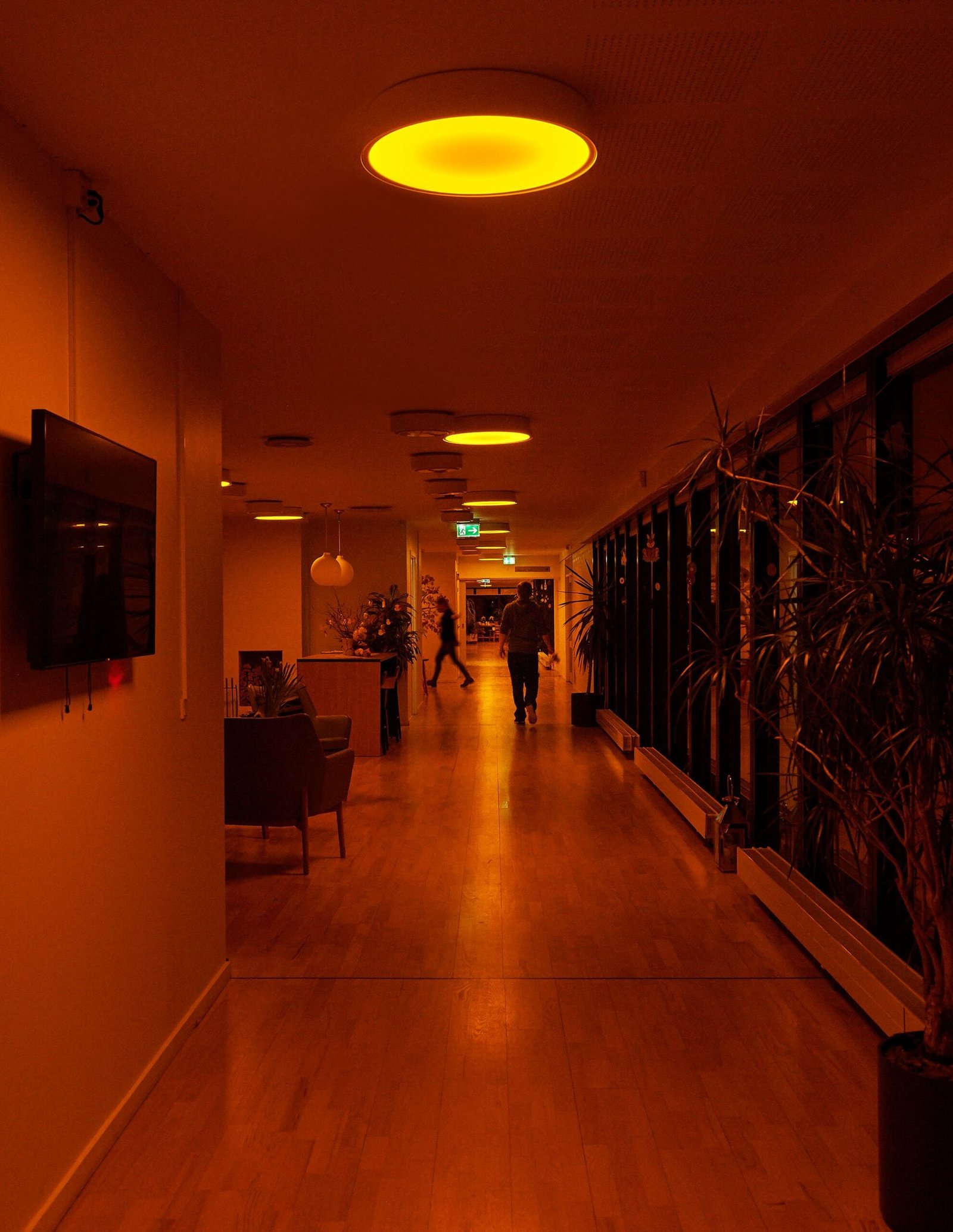
Daytime corridor lighting at 200–300 lux at floor level, 4,000K, UGR < 16. Brighter than most hospitality corridors, cooler than most residential corridors, and glare-controlled. The 4,000K is critical — residents moving from a 2,700K apartment to a 4,000K corridor and then to a 3,000K dining room need the visual transition to support their circadian rhythm and their visual adaptation. All-warm corridors feel “cozy” but contribute to the fall rate.
-
Nighttime corridor lighting at 50–100 lux at floor level, 2,700K, with continuous operation or motion activation. A corridor that drops to 1–2 lux at night (the common “emergency lighting only” approach) is a fall waiting to happen. The right answer is a two-mode system: bright daytime, dim warm nighttime, with smooth transitions (no abrupt step changes that create temporary blindness for adapted eyes).
-
Handrail-integrated LED lighting as the primary nighttime source. An LED strip integrated into the top of the corridor handrail at 30–50 lux provides light exactly where the resident needs it (at the hand that grips the rail) without creating glare for residents looking forward. This is more expensive than ceiling-mounted lighting (about $80–$150 per linear meter installed), but it measurably reduces falls and is the design choice for any new-build senior living community that takes fall prevention seriously.
-
Wall-mounted wayfinding signage with integrated backlighting at 200+ lux contrast ratio. Standard printed signs on corridor walls are nearly invisible to residents with macular degeneration or cataracts. Backlit signs with high-contrast text and symbols are not a luxury — they’re an accessibility requirement. The cost premium over a printed sign is about $200 per sign, and the improvement in resident navigation and reduced caregiver “where’s my room” call volume is measurable.
Zone 3: Dining Room and Activity Spaces
The dining room is the most underspecified and most over-engineered room in most senior living communities. The spec mistake I see most often is “hospitality dining lighting” — warm, dim, romantic — which is exactly the opposite of what residents need. A 2,200K dining room at 100 lux is unappealing to a 30-year-old but functionally disabling to an 80-year-old.
The right spec:
-
Dining table lighting at 500+ lux at the table surface, 3,500K, CRI 90+. This is significantly brighter than typical hospitality dining, and slightly cooler. The 3,500K is the right balance — it provides enough coolness to support visual acuity and food recognition, without the clinical feel of 4,000K. The CRI 90+ requirement is for food appearance — a 80-year-old who can’t tell the difference between beef and chicken because the lighting has compressed the value scale will eat less and lose weight. This is a documented malnutrition pathway in senior living.
-
Pendant fixtures at 1.8–2.0m height over each table, individually dimmable. The reason for the lower-than-standard mounting height is the seated eye level of a resident (about 1.2m). A pendant at 1.8m is in the resident’s primary visual field and provides the vertical illuminance on the face and the plate that the spec needs. Standard hospitality pendant mounting at 2.4–2.7m puts the light source out of the visual field and reduces the effective table illuminance.
-
Activity room lighting at 500+ lux, 4,000K, CRI 90+, with full-range dimming to 100 lux. The activity room needs to support a wide range of activities — crafts, cards, reading, group meetings, exercise — and the lighting needs to support all of them. A 4,000K, 500 lux baseline with smooth dimming to 100 lux covers the range from “crafts” to “movie night.” The CRI 90+ requirement supports color recognition for crafts and for the cognitive engagement that color provides.
Zone 4: Memory Care and Dementia Units
Memory care is the one zone where the lighting spec has genuine clinical evidence behind it, and where getting it wrong has measurable health consequences. Studies from the Netherlands (the Hogeweyk dementia village), Denmark (the Chromaviso circadian lighting studies), and the UK (the Lighting Research & Technology studies on dementia-friendly environments) all show the same thing: properly specified circadian lighting reduces agitation, improves sleep, reduces falls, and reduces antidepressant use in dementia residents.
The spec that the evidence supports:
-
Circadian-stimulating daytime lighting at 1,000+ lux at the eye, 5,000–6,500K, CRI 90+, full spectrum. The lux level here is not the lux on the table — it’s the lux at the resident’s eye, which is roughly the average vertical illuminance in the space. 1,000 lux at the eye, achieved with ceiling and wall-mounted fixtures, is the threshold for measurable melatonin suppression and circadian entrainment. Below 1,000 lux, the circadian effect drops off rapidly.
-
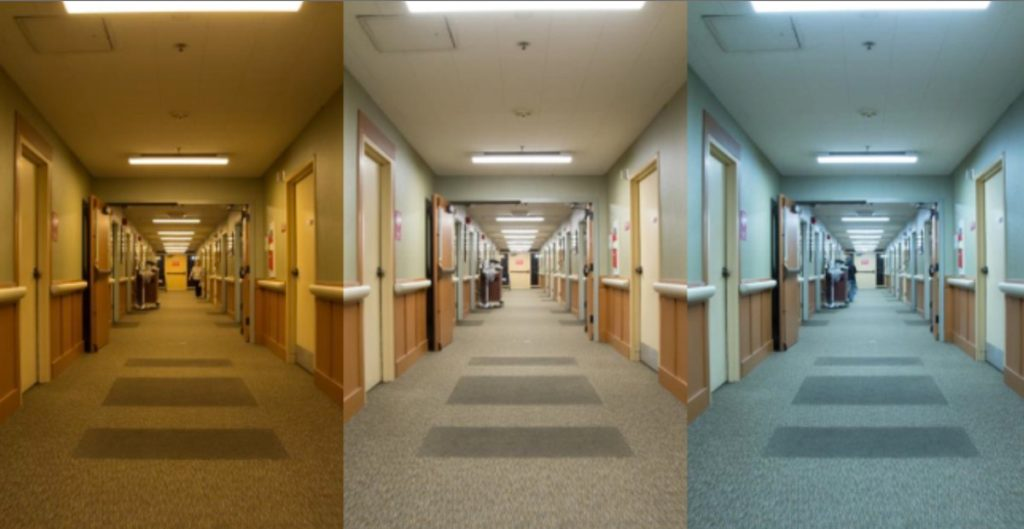
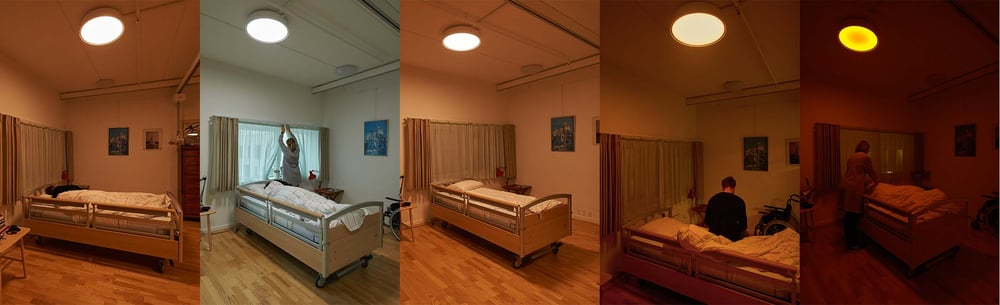
Smooth CCT and intensity transition over the day, ideally via tunable-white LED with DALI or 0-10V control. The transition should run from 6,500K / 1,000 lux at noon to 2,700K / 100 lux at 8pm, with a 1–2 hour ramp on each side. The control system should be centrally managed (not resident-controlled), with override capability for caregivers. The cost premium over a static-white system is about 40% on the fixture side and 80% on the control side, but the clinical benefit is significant.
-
Night lighting at 50 lux, 2,700K, with no blue content below 480nm. The “no blue below 480nm” spec is critical — blue light at night suppresses melatonin and disrupts the circadian rhythm that the daytime spec is trying to establish. The fixture should use a 2,700K phosphor with documented low-blue-content spectral power distribution, or a filtered fixture that removes the 460–480nm peak.
-
Glare control (UGR < 16) is non-negotiable in memory care. Residents with dementia have impaired glare adaptation and increased confusion in response to bright/dark transitions. Anti-glare fixtures, indirect lighting, and matte finishes on all surfaces are the right answer.
Zone 5: Caregiver Work Areas
Caregiver work areas (nursing stations, medication rooms, treatment rooms) need office-grade task lighting at 750+ lux, 4,000K, CRI 90+, with no compromises for resident comfort. These are clinical workspaces, and they need to perform like clinical workspaces.
The right answer is to spec these zones independently from the resident areas, with separate circuits, separate controls, and a visual transition (a door, a curtain, a different ceiling height) that signals the shift from “residential lighting” to “clinical lighting.” The mistake I see most often is trying to make the nursing station look “homelike” to match the residential design intent — which compromises the caregiver’s ability to do clinical work, and ultimately compromises resident care.
Where Most Buyers Get It Wrong
After a dozen senior living projects, here are the five spec mistakes I see over and over:
-
Spec’ing hospitality-grade downlights across the entire facility. “Cozy” 2,700K at 100 lux is a hospitality spec, not a senior living spec. The fall rate will tell you within six months.
-
Skipping the nighttime path lighting to save $200 per bed. The cost of one hip fracture is about $40,000 in medical costs plus a 25% one-year mortality increase. The payback on nighttime path lighting is measurable in any facility that tracks falls.
-
Putting motion sensors on bedroom lights. Motion sensors turn off the light when the resident is reading, napping, or just sitting still. This is a falls risk and a satisfaction disaster.
-
Treating memory care as a “residential” zone. Memory care is a clinical environment with documented circadian benefits from proper lighting. The spec is more rigorous, not less.
-
Forgetting the bathroom. Bathrooms are the highest-fall-risk room in the apartment, and the most under-lit. A single ceiling fixture at 100 lux is not adequate. Vanity lighting, shower lighting, and nighttime path lighting are all required.
The Wholesale Buyer’s Shortlist
If you’re sourcing senior living lighting for a project in 2026, here’s the shortlist of specs to ask your supplier about:
- CRI 90+ with R9 > 70 across all resident-occupied spaces
- CCT 3,000K bedrooms, 4,000K corridors, 3,500K dining, tunable-white 2,700–6,500K memory care
- UGR < 16 in all resident-occupied spaces, UGR < 19 in caregiver work areas
- Nighttime path lighting at 5–10 lux, low-CCT, continuous or motion-activated with long delay
- Circadian-supporting lighting in memory care at 1,000+ lux at the eye, 5,000–6,500K daytime
- Manual-on / auto-off controls in bedrooms, no motion-sensor shutoff
- CRI 90+ R9 > 70 food-color rendering in dining rooms at 500+ lux
If you want to see how a serious-spec’d senior living facility actually looks in 2026, browse our commercial lighting project catalog or contact our team for a photometric layout specific to your facility. Most senior living projects are straightforward to spec once you separate the five zones and treat each one with the right level of engineering rigor.
The bottom line: senior living lighting is one of the few commercial categories where the spec mistakes are both measurable (in falls, malnutrition, agitation, and caregiver turnover) and completely fixable. The manufacturers who specialize in this category have spent years learning the failure modes. The smart move is to specify their products, run their photometric layouts, and not try to save 15% on the fixture cost by using a hospitality catalog.
