School & University LED Lighting in 2026: What Facility Managers Actually Specify
When I started working with educational institutions 15 years ago, lighting was simple—get something bright, get it cheap. Nobody talked about circadian rhythms, visual comfort indexes, or how LED spectrum affects student test scores. Now? Every procurement officer I talk to has an opinion, and half of them are wrong.
Here’s what actually matters when you’re spec’ing LED for schools and universities in 2026.
The Budget Reality Nobody Talks About
Your K-12 district probably has $0.50 per square foot per year for lighting maintenance. Multiply that by 100,000 square feet—that’s $50K annually. Most districts don’t realize that upgrading to LED can cut that number by 70%, but only if you spec the right products upfront.
The mistake I see constantly: buyers chase initial cost instead of lifecycle cost. A $40 troffer looks attractive next to a $85 one. But when the cheap driver fails at year 2 and you need to replace 300 fixtures across 12 buildings, that “savings” evaporates fast.
What to specify:
– Minimum 50,000 hour L70 rating (L/B designation matters—demand B50, not B10)
– Driver MTBF > 100,000 hours
– Thermal protection: operating range minimum -20°C to +45°C (classrooms near windows get brutal in summer)
The Classroom Lighting Problem Nobody Addresses
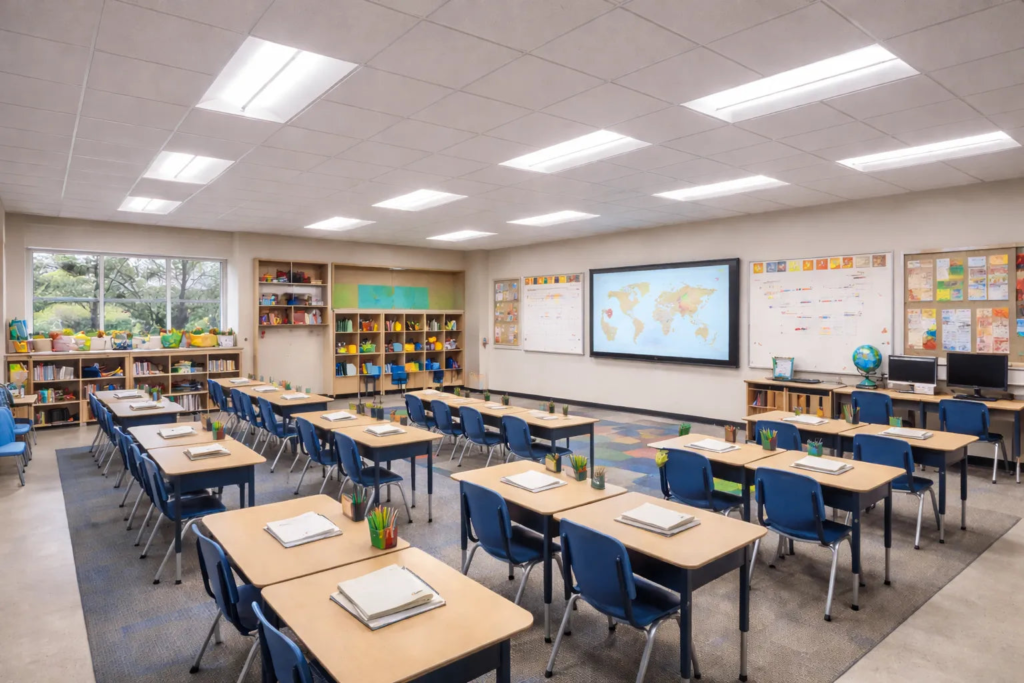
Here’s a scenario I’ve encountered at least 20 times: new LED installation, building looks fantastic, teachers complain students are tired by 2pm.
Cause? Overhead uniformity that’s too perfect.
Human eyes evolved under dynamic light—clouds shifting, shadows moving. A completely uniform 500 lux ceiling creates visual monotony. Your brain interprets this as late afternoon. Students get drowsy.
The fix isn’t complicated: zoned lighting with 20-30% variation in illuminance across the classroom. Task areas at 500 lux, peripheral zones at 350-400 lux. This mimics natural conditions and actually keeps students alert.

Spec traps to avoid:
– Anything under 80 CRI for general classrooms (90+ CRI for art/ labs)
– Fixed 4000K across all spaces ( cafeterias need 3500K, labs need 5000K-6500K for precision work)
– On/off controls only—demand 0-10V dimming minimum, DALI for larger installations
The University Retrofit Challenge
University campuses present a different beast: legacy infrastructure. Most major universities have buildings from the 1960s-1980s with T12 or early T8 systems. The maintenance staff knows these systems inside-out.
Here’s what facility directors don’t tell you: the real challenge isn’t the technology, it’s change management.
I’ve seen $2M LED retrofits fail because the controls were too complex for night custodial staff. Fixtures stayed at full brightness 24/7 because nobody understood the scheduling interface.
My recommendation for university retrofits:
1. Start with 2 buildings, not the entire campus
2. Choose controls platforms that integrate with existing building automation (BACnet/IP, not proprietary)
3. Train custodial staff BEFORE the retrofit, not after
4. Build a 90-day adjustment period into the project timeline
Sports Facilities: The Hidden Energy Hog
Gymnasiums, natatoriums, and athletic fields consume 3-4x more energy per square foot than classroom buildings. Yet they often get the least attention in lighting upgrades.
For gymnasiums, the spec priorities:
– High bays with 150+ lumens per watt (reduces fixture count)
– IP65 rating minimum (dust from athletic activities degrades unprotected fixtures)
– Modular design for easy re-lamping (these fixtures are 40-50 feet up)
Natatoriums add complexity: chlorine environments accelerate corrosion. Demand stainless steel hardware, corrosion-resistant coatings, and sealed optical chambers. The $20 premium per fixture saves thousands in early replacement costs.
Controls: Where Schools Get Burned
The market is flooded with “smart” lighting controls that aren’t actually smart—they’re just connected. There’s a massive difference between:
Dumb connected: WiFi bulb you can turn on with an app. Fails when the network hiccups. No integration capability.
Actually smart: DALI-2 or Casambi mesh with occupancy sensing, daylight harvesting, and building automation integration. Communicates failures proactively. Supports code-mandated testing protocols.
For schools, I strongly recommend DALI-2. The protocol is open, interoperable between manufacturers, and has 15+ year support track records. BACnet integration is standard, which means your facilities team can manage everything from one platform.
The Specification Sheet Reality Check
Before you finalize your LED spec, run through this checklist:
| Requirement | Minimum | Recommended |
|---|---|---|
| Lumen Maintenance | L70 @ 50,000h | L70 @ 75,000h |
| Driver MTBF | 100,000h | 150,000h |
| CRI | 80 | 90+ |
| CCT Consistency | 3-step MacAdam | 2-step MacAdam |
| Controls | 0-10V | DALI-2 |
| Warranty | 5 years | 10 years |
| IP Rating (damp) | IP44 | IP54 |
One more thing: demand LM-80 test data from manufacturers. This isn’t optional. LM-80 is the only standardized method for verifying LED lumen maintenance claims. If a supplier can’t provide it, walk away.
Working with Chinese Manufacturers: The Practical Side
For educational purchasing departments, the elephant in the room: can you actually source quality LED from China and meet procurement requirements?
The answer is yes, with caveats:
-
DLC listing matters: If your district receives federal funds (Title I, etc.), fixtures must be on the DesignLights Consortium Qualified Products List. Many Chinese manufacturers have DLC-certified product lines.
-
Labeling compliance: All fixtures need ETL/cETL or UL certification for US installation. Verify the label, not just the certificate—counterfeit marks exist.
-
Sample testing is non-negotiable: Order 3-5 samples. Run them for 2,000 hours. Measure lumen output before and after. Any lumen depreciation over 3% tells you the thermal management is inadequate.
At YoubeeLight, we’ve worked with educational institution procurement departments across North America. Our LED catalog includes specific product lines rated for educational environments, and we provide LM-80 reports and DLC documentation for every qualifying product.
The bottom line: quality educational lighting doesn’t require paying European brand premiums. It requires knowing what to specify and demanding documentation.
What to take away:
– Calculate lifecycle cost, not just initial cost
– Uniform light creates monotony—spec zoning
– Controls complexity kills retrofits—invest in training
– Demand LM-80 data and DLC listing
– Chinese manufacturers are viable with proper verification protocols
