
Hospital Lighting in 2026: What Healthcare Facility Buyers Actually Need to Know
Most buyers approach hospital lighting the same way they’d approach office lighting: pick some high-CRI fixtures, make sure they’re dimmable, done. That approach works for offices. It fails spectacularly in healthcare settings.
I’ve spec’d lighting for hospitals in four countries over 15 years. The mistakes I see overseas buyers make aren’t about quality—they’re about context. Hospital lighting isn’t a product category. It’s a system with biological, operational, and regulatory dimensions that interact in ways most general commercial lighting specifiers never encounter.
Why Hospital Lighting Is a Different Discipline
The fundamental difference: hospital lighting affects patient outcomes, not just visual comfort.
There’s actual peer-reviewed research on this. Circadian rhythm disruption in patients has been linked to increased delirium in ICU settings, longer recovery times, and worse sleep quality. For staff, poor lighting contributes to fatigue and errors. The light in a hospital room isn’t just making things visible—it’s a clinical variable.
That changes how you spec.
The Room-by-Room Reality
Patient Rooms
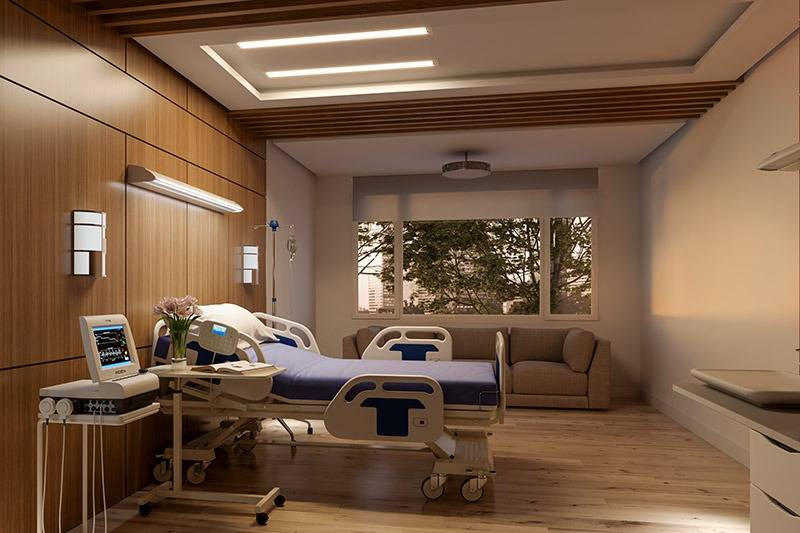
Patient rooms need to serve three distinct functions: general ambient lighting, examination lighting, and nighttime circulation lighting. These require different color temperatures, different light levels, and critically, different control strategies.
General ambient: 3000K warm white at 100-150 footcandles (depending on age of patient population—older patients need more). Dimmable from 100% to 10% minimum.
Examination mode: 4000-5000K, 500+ footcandles at the bedside. Nurses need to see skin tone accurately during assessments. This means high CRI (90+) with specific R9 values (deep red rendering). Standard CRI 80 LEDs often have poor R9—you’ll know it when you see a patient’s lips look gray during an exam.
Nighttime mode: This is where most hospital lighting fails patients. The nighttime light should be low enough to allow navigation without disturbing the patient—typically 5-20 footcandles at bed height, with the light source positioned to minimize direct view. Many budget patient room fixtures skip this mode entirely. That’s a patient sleep quality problem.
My practical advice: Specify fixtures with tunable white capability (2700K to 5000K) for patient rooms. The cost premium over fixed-CCT fixtures is typically 15-25%, but you’re buying flexibility for two distinct use cases in one fixture.
Operating Rooms
OR lighting is its own specialized category. I won’t pretend to be an OR lighting engineer—it’s a niche within a niche—but from the procurement side, here’s what matters.
The primary surgical light needs to provide 40,000-160,000 lux at the surgical site with minimal shadowing. Shadowing in an OR is a serious issue—cables, the surgeon’s head, and instruments all cast shadows. High-quality surgical lights use multiple LED arrays with offset positioning to minimize shadow formation.
Color temperature in ORs is typically 4000-4500K. Higher CRI (95+) is essential for tissue differentiation. Some surgical specialties prefer slightly warmer 3800K for reduced eye strain during long procedures.
What overseas buyers consistently underestimate: the infrastructure around the light. The mount, the arm system, the controls, the camera integration if they’re going digital. These add significant cost. A surgical light fixture might cost $8,000-$25,000, but a complete OR lighting system with boom arms, controls, and integration can run $40,000-$80,000 per room.
ICU and Critical Care
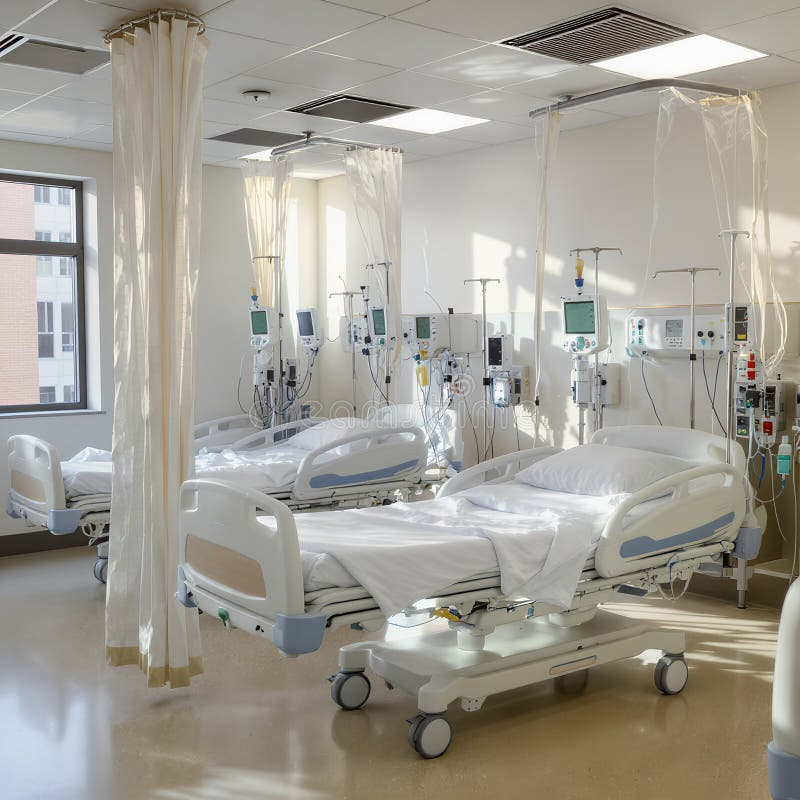
ICU lighting is where circadian research has the clearest practical implications. Critically ill patients often can’t leave their rooms. Their only exposure to natural circadian cues comes through the lighting.
Current best practice in ICU design includes:
– Windows with external views (and yes, that affects room orientation and floor plan)
– Daytime light levels up to 1000 lux at patient eye level
– Gradual dimming toward evening
– Nighttime levels below 50 lux
This is a controls challenge as much as a fixture challenge. The lighting needs to be programmable by patient condition and time of day. DALI-based systems with tunable white fixtures are the most common approach in new ICU builds.
For overseas buyers sourcing ICU lighting from Asian manufacturers: verify that the tunable white drivers support the specific dimming curves and color temperature ranges your specifications require. Not all tunable white drivers are created equal, and “supports 2700K-6500K” in a spec sheet doesn’t mean it transitions smoothly through that range.
Emergency Departments
EDs have a specific lighting challenge: they need to shift from high-activity trauma lighting (1000+ lux for procedures) to calmer, lower light for patients in waiting or treatment areas—all within the same space.
Static lighting can’t handle this. The ED needs zoning and scene-setting capability. DALI with scene presets works well. Some newer facilities are using human-centric lighting with automatic circadian programming for waiting areas.
One thing many buyers miss in ED specs: antimicrobial properties. In high-infection-risk areas, fixture surfaces matter. Some manufacturers offer fixtures with antimicrobial coatings or housing materials with silver ion technology. This isn’t a substitute for cleaning protocols, but in high-turnover emergency settings, it adds a layer of protection.
The Controls Integration Problem
Hospital lighting almost always needs to integrate with building management systems (BMS), nurse call systems, and sometimes surgical equipment. This is where lighting procurement becomes a systems engineering problem.
The most common protocol for hospital lighting integration is DALI, specifically DALI-2 with part 207 (lighting control gear) and part 209 (color control). If the BMS integration requirement is present, verify that the lighting manufacturer can provide BACnet gateway support or DALI-to-BACnet integration hardware.
For a hospital project I worked on in the UAE, the specification required all lighting to be on a single BACnet network. The fixtures we initially sourced used a proprietary wireless protocol. The integration took an additional six weeks and cost the client $40,000 in gateway hardware that wasn’t in the original budget. Verify integration requirements early.
Documentation and Certification
Hospital lighting in most markets requires specific certifications beyond standard commercial lighting requirements:
USA: UL 1598 (luminaires), UL 924 (emergency lighting), many states require specific biomedical electrical safety certification depending on the application.
European Union: EN 60598 series, EN 1838 (emergency lighting), and for some applications, the Medical Devices Directive (93/42/EEC) if the lighting is classified as a medical device—yes, some surgical task lights fall into this category.
Middle East: SASO certification, and for Saudi Arabia specifically, SFDA (Saudi Food and Drug Authority) approval for lighting used in clinical settings.
Australia: AS/NZS 60598 series, with specific requirements for medical facility lighting in some states.
The certification path affects lead time significantly. EU and US certifications are relatively straightforward if you have the test reports. Middle Eastern certifications often require in-country testing or witness testing, which can add 8-16 weeks to procurement timelines.
My Practical Recommendations
-
Don’t spec hospital lighting like office lighting. The biological dimension changes everything.
-
Tunable white is worth the premium in patient rooms. Budget for it. The ability to shift from warm evening light to cool daytime light has clinical relevance.
-
R9 matters as much as general CRI in healthcare settings. Deep red rendering affects how clinicians assess patient condition. Specify CRI 90+ with R9 > 50.
-
Verify BMS integration requirements before ordering. This is where projects blow timelines and budgets.
-
Start the certification documentation process early. Documentation for hospital projects takes longer than the products themselves.
-
Don’t skip the nighttime mode requirement in patient rooms. It’s not optional in modern healthcare design.
At YoubeeLight, we supply hospital and healthcare facility lighting that meets international standards. Our /led-catalog/ includes high-CRI tunable white fixtures suitable for patient room and clinical applications. Visit /about-us/ to discuss your specific healthcare lighting project requirements.
