
DALI vs 0-10V vs DMX: Choosing the Right Dimming Protocol for Your Project
Here’s a question I get at least once a month from clients: “Should I use DALI, 0-10V, or DMX for my project?”
My answer is always the same: It depends. And “it depends” is genuinely unhelpful without understanding what you’re actually trying to achieve.
Let me break this down in a way that actually helps you make a decision.
The Fundamental Differences
These three protocols are not competitors—they serve different use cases. Comparing them directly is like comparing a bicycle, a motorcycle, and a cargo ship. They all transport you, but the experience is wildly different.
0-10V is the simplest. It’s an analog protocol. When you send 10V to a driver, it runs at full brightness. 5V is 50%. 0V could mean either full off or minimum dimming level, depending on the manufacturer (this inconsistency drives me crazy).
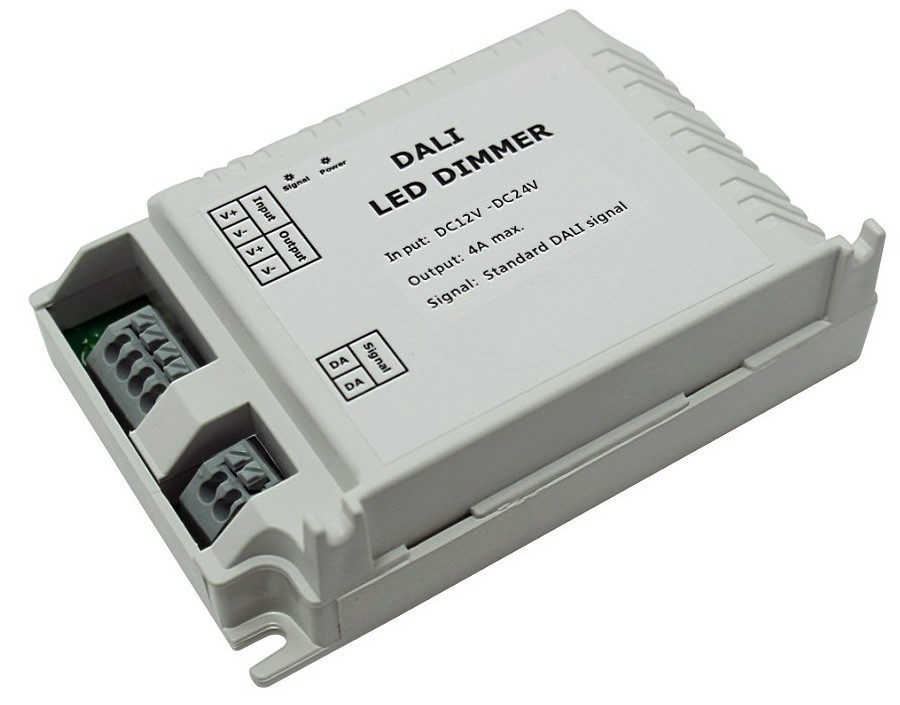
DALI is digital and addressable. Each fixture gets a unique address. You can query its status, group it with other fixtures, and control it individually or as a system. It’s designed specifically for lighting control.
DMX is primarily for entertainment. Originally developed for stage lighting, it excels at dynamic, fast-changing effects. RGB color control, moving heads, special effects—DMX is king here.
When 0-10V Makes Sense
0-10V is the workhorse of commercial lighting. It’s everywhere because it’s simple, reliable, and cheap.
The good:
– Universally supported by virtually all LED drivers
– Two-wire connection (plus power)
– Very reliable—analog signals don’t care about network issues
– Lowest cost option
– Easy to troubleshoot with a multimeter
The bad:
– One-way communication (you can’t query fixture status)
– Limited to single-room or single-zone control
– No individual addressing
– Long cable runs can have voltage drop issues
– Dimming range typically 1-100% (sometimes worse)
When I recommend 0-10V:
– Small to medium commercial spaces (under 2,000 sq ft of controllable area)
– Single-tenant buildings with straightforward lighting layouts
– Budget-conscious projects where advanced control isn’t required
– Retrofit situations where you want simplicity
A warehouse I spec’d last year used 0-10V dimming for the main aisles. They wanted basic daylight harvesting—lights dim when natural light increases—and 0-10V handles that perfectly without over-engineering the solution.
When DALI is the Right Choice
DALI costs more and requires more setup time, but for certain applications, the investment pays off.
The good:
– Individual fixture addressing and control
– Two-way communication—you can query status
– Easily reconfigured without rewiring (via software)
– 512 devices per DALI network
– Consistent dimming curves across manufacturers
– Supports scene setting and scheduling
The bad:
– More expensive than 0-10V (drivers, controllers, commissioning)
– Requires DALI-specific commissioning (or a qualified integrator)
– Slower response time than DMX (not suitable for dynamic effects)
– Can be overcomplicated for simple needs
When I recommend DALI:
– Multi-tenant commercial buildings where tenants need independent control
– Projects requiring daylight harvesting with multiple zones
– Buildings with HVAC integration for occupancy-based control
– Spaces where lighting needs may change (flex offices, adaptable retail)
– Healthcare facilities with specific lighting requirement scenarios
– Budget allows for proper commissioning
I worked on a senior living facility where each resident room needed independent control. With 120 rooms, 0-10V would have meant running separate wiring to each room. DALI allowed us to use a bus system and configure everything in software. The additional cost for DALI was about $15 per fixture. The wiring savings alone made it worth it.
When DMX Takes Over
DMX is misunderstood. People hear “digital” and “addressable” and assume it replaces DALI. It doesn’t. DMX fills a different niche entirely.
The good:
– Extremely fast response (under 20ms)
– Excellent for dynamic, synchronized effects
– Industry standard in entertainment lighting
– Large ecosystem of compatible products
– Precise control over RGB and RGBW fixtures
The bad:
– Not designed for general lighting (dwell time issues at 0%)
– Requires termination and proper wiring topology
– No two-way communication
– Limited addressing without additional equipment
– More complex to set up correctly
When I recommend DMX:
– Stage and theater lighting
– Nightclubs and entertainment venues
– Architectural color-changing installations
– Façade lighting with dynamic effects
– Any application where speed and color control matter more than reliable dimming to low levels
A hotel lobby we lit last year had a spectacular art installation: 200 suspended spheres that needed to change color in synchronized waves. DMX was the only real option. DALI couldn’t respond fast enough for the effect, and 0-10V has no addressing capability to create the wave pattern.
The Protocol Comparison
| Factor | 0-10V | DALI | DMX |
|---|---|---|---|
| Control type | One-way analog | Two-way digital | One-way digital |
| Addressing | None | Up to 64 devices | Up to 512 channels |
| Dimming range | 1-100% typical | 0.1-100% typical | 0-100% (dwell issues at low end) |
| Response speed | Instant | ~100ms | <20ms |
| Wiring | 2 wires + power | 2 wires + power | 3 wires + power (or Cat5) |
| Cost per fixture | $3-8 driver | $8-25 driver | $10-30 driver |
| Commissioning | Minimal | Moderate to high | Moderate |
| Retrofit difficulty | Medium | Low | High |
A Decision Framework That Actually Works
Instead of memorizing technical specs, ask yourself these questions:
1. How many independent zones do you need?
– 1-5 zones, basic control → 0-10V
– 5-50 zones, may need adjustment → DALI
– Complex, multi-area, or entertainment → DMX (or DMX + DALI hybrid)
2. Will lighting needs change in 5-10 years?
– Probably not → 0-10V
– Likely yes (tenant changes, renovation) → DALI
3. Do you need to know if a fixture fails?
– No → 0-10V or basic DMX
– Yes → DALI with monitoring capability
4. What’s your budget for controls?
– Controls are a small part of the budget → DALI
– Tight budget, basic needs → 0-10V
5. Is this an entertainment or dynamic effect application?
– Yes → DMX (or hybrid)
– No → 0-10V or DALI
The Hybrid Reality
Here’s what most consultants won’t tell you: many commercial projects actually use multiple protocols together.
Large office buildings often have:
– 0-10V in storage and utility areas
– DALI in open offices and meeting rooms
– DMX in the lobby for architectural lighting
This isn’t ideal from a simplicity standpoint, but it’s often the most cost-effective approach. Each area gets the control complexity it actually needs.
My Practical Recommendations
After years of mixing these systems on projects, here’s what works:
For standard commercial offices and retail:
Start with DALI if the project is over $100K in lighting. The additional cost for DALI drivers ($10-15 per fixture) and a basic gateway ($500-2000) is typically under 10% of total project cost. The flexibility pays dividends when tenants change or renovation happens.
For warehouses and industrial:
0-10V with basic occupancy sensors. Don’t overengineer. The workers are focused on their jobs, not the lighting. Simple, reliable, dimmable when daylight is available.
For hospitality:
DALI for guest rooms and public areas, DMX for lobby and restaurant. Hospitality guests notice lighting. DMX lets you create memorable experiences. DALI gives you the reliability and flexibility for a 24/7 operation.
For any project:
Document your control intent before specifying products. The protocol choice matters less than understanding how the system should behave. “Users in zone A can adjust lights; zone B is scheduled; zone C responds to occupancy” is more useful than “we’re using DALI.”
Unsure which dimming protocol fits your project? YoubeeLight supplies LED drivers compatible with 0-10V, DALI, and DMX control systems. Visit our /led-catalog/ to explore options, or /about-us/ to discuss your specific requirements with our technical team.
