
Why Your Commercial Outdoor Lighting Project Keeps Failing: A 15-Year veteran’s Honest Take
I’ve seen outdoor lighting projects implode in ways that have nothing to do with the actual lighting. Wrong IP ratings. Photometric distributions that create light pollution complaints. Fixtures that look great in the catalog but disintegrate in year two.
Here’s the uncomfortable truth: most outdoor lighting failures aren’t about light quality. They’re about treating outdoor fixtures like indoor fixtures with extra weatherproofing.
They’re not.
The IP Rating Reality Check
IP65. IP66. IP67. Suppliers throw these numbers around like they’re selling smartphones. But here’s what those numbers actually mean—and where the confusion lives:
IP65 = Dust tight + protection against water jets from any direction. Fine for covered outdoor areas, covered parking structures, under-canopy installations.
IP66 = Dust tight + protection against powerful water jets. This is what you want for exposed facades, loading docks, car dealership displays.
IP67 = Dust tight + protection against temporary water immersion. Relevant only if your fixtures might actually sit in water (flood-prone areas, drainage issues).
The mistake I see constantly: projects in temperate climates specifying IP67 when IP66 would suffice. You’re paying extra for waterproofing you don’t need, and sometimes sacrificing luminaire performance or thermal management for it.
Conversely, I’ve seen IP65 fixtures specified for Florida coastal installations where salt spray destroys them in 18 months. Know your environment.
Photometrics Matter More Than You Think
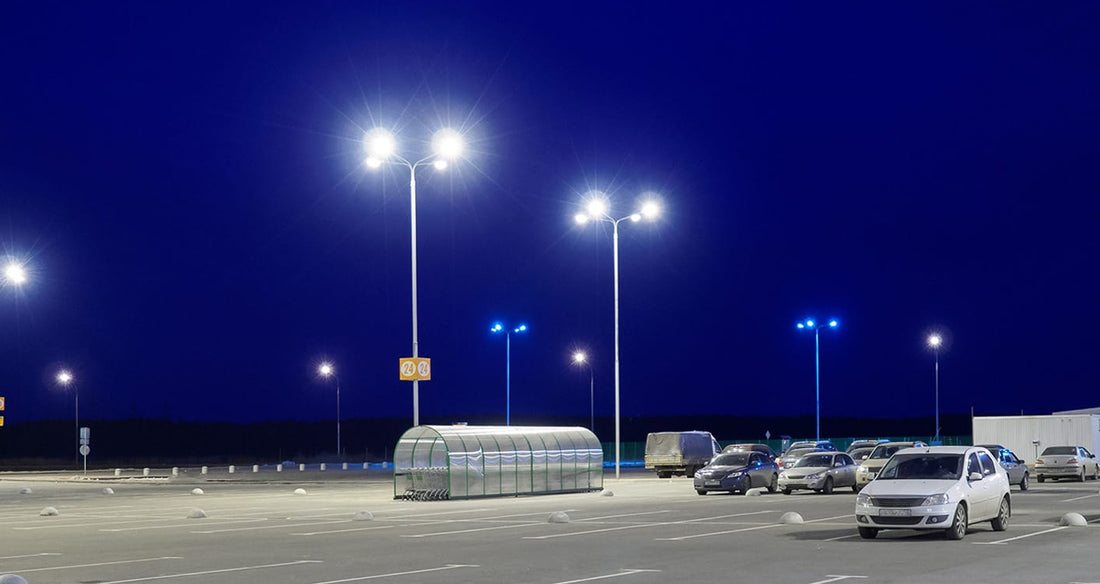
Indoor lighting is relatively forgiving. You can usually add more fixtures, adjust spacing, or compensate with controls. Outdoor lighting is different—once a pole is set, a fixture is mounted at height, a concrete base is poured, you’re stuck with those photometric decisions.
Common mistakes:
Over-specifying throw distance: Suppliers love to quote maximum throw numbers. But throw distance means nothing without knowing the required foot-candles at target. A fixture that “throws 50 meters” might deliver 0.1 foot-candles at that distance—useless for security or aesthetics.
Ignoring light trespass requirements: Your LED floodlight illuminating the building next door isn’t just annoying—it’s a potential code violation and liability. Modern LED optics make tight cutoff distributions achievable. Use them.
Forgetting color temperature in context: That 5000K cool white fixture that looks brilliant in a warehouse? It looks harsh and institutional on a historic building facade. For architectural outdoor lighting, 3000K-4000K typically reads better, especially in residential-adjacent areas.
I’ve walked through projects where the electrical engineer spec’d everything perfectly, but the fixtures arrived with completely different photometric distributions than the submittals. Now the customer’s building looks like an airport landing strip instead of the warm, inviting space they expected.
Controls: Where Outdoor Lighting Gets Interesting
Outdoor lighting controls have evolved dramatically, and the ROI case is stronger than most people realize.
Occupancy sensors: Obvious for parking garages and low-traffic areas. Less obvious for building perimeter lighting where 30-40% energy savings are achievable during unoccupied hours.
Photocells and astronomical time clocks: These aren’t old technology. Astronomical time clocks (which calculate sunrise/sunset based on location) eliminate photocell failures and adjustment drift. For permanent installations, they’re usually the better choice.
Dimming and tunable control: Here’s where it gets strategic. Many commercial properties can justify premium dimmable fixtures by programming dramatic scenes for special events, holidays, or tenant events. The fixtures cost 10-15% more but create marketing moments.
Networked controls (DMX, DALI, 0-10V): If your project is large enough to justify the infrastructure cost, networked controls enable centralized monitoring, individual fixture addressing, and integration with building management systems. For 50+ fixture projects, the monitoring and maintenance savings often justify the upfront investment.
The Salt Air Problem Nobody Talks About
If your project is within 10 miles of a ocean coastline, normal IP-rated fixtures will fail faster than expected. Standard powder coating, aluminum housings, and even stainless steel hardware degrade rapidly in salt air environments.
Marine-grade specifications matter:
– Marine-grade aluminum or 316 stainless steel housings (304 stainless isn’t enough)
– UV-resistant polymers for lenses and gaskets
– Hot-dip galvanizing or marine-grade powder coating
– Sealed wire nuts or gel-filled wire connectors
I’ve seen parking structures at Florida coastal hotels where fixtures needed replacement at 18-24 months despite being “IP66 rated.” The IP rating was fine. The salt air corrosion wasn’t.
If you’re bidding coastal projects, push your customers to specify marine-grade fixtures even if they’re more expensive. The replacement and maintenance costs otherwise make “cheap” fixtures extremely expensive.
Maintenance Access: The Forgotten Factor
Outdoor fixtures need maintenance. Lenses get dirty, drivers fail, LEDs depreciate. Yet most specifications I’ve seen treat fixture mounting like indoor recessed lighting—mount it and forget it.
Questions to answer before specifying:
– Can a service technician safely access the fixture at height?
– Is there a lift requirement, or can it be reached from a ladder?
– How long does driver replacement take?
– Are replacement drivers still available in 5 years?
Fixture mounting height dramatically affects lifecycle cost. A fixture at 15 feet might cost $150 to service (bucket truck rental). The same fixture at 35 feet might cost $800-1,500 per service visit. Over 10 years, that fixture height difference could cost more than the fixture itself.
I always tell customers: “Budget 10-15% of fixture cost annually for maintenance. If that’s not acceptable, either spec fixtures with longer-lasting components or plan for higher lifecycle costs.”
Specifying Outdoor Lighting That Doesn’t Embarrass You
After 15 years of projects, here’s my spec checklist:
- IP rating matched to environment — not maximum, appropriate
- Photometric distribution verified — request IES files, model in AGi32 or DIALux
- Color temperature appropriate to context — warm for residential adjacencies, can be cooler for industrial/commercial
- Controls specified with clear sequences — who programs? Who maintains?
- Marine-grade for coastal — non-negotiable within 10 miles of salt water
- Maintenance access planned — mounting height, service requirements, ladder vs. lift
- 10-year component availability — avoid proprietary drivers or discontinued platforms
The best outdoor lighting projects I’ve seen share one trait: the specifier understood that “it lights up” is table stakes. What makes the difference is how the lighting performs over years, not just the night of the grand opening.
Planning a commercial outdoor lighting project? Browse our catalog for IP66/IP67 rated fixtures, or connect with our team for project-specific consultation on specifications and component selection.
