
LED Linear Light vs Track Light: When Specifiers Actually Choose Each
After 15 years of specifying lighting for commercial projects, I’ve watched countless buyers make the same mistake—they default to track lighting because it’s familiar, then wonder why the space feels generic. Or they spec linear lights because it looks modern, then struggle with aiming flexibility six months later.
The choice between linear and track isn’t about trends. It’s about how the space will actually be used, who controls the lighting, and what happens when the tenant changes.
The Core Difference Nobody Explains Clearly
Linear lighting and track lighting solve different problems.
Linear lights are architectural elements. They define space, create visual continuity, and work best when you want a consistent glow across a ceiling or along a run. They’re permanent installations—once mounted, you’re not relocating them without serious labor costs.
Track lighting is adaptive. It’s a system where heads can slide, aim, and swap. Perfect for retail rotations, gallery rehangs, or any space where the “story” changes quarterly.
Here’s the judgment most suppliers won’t give you directly: if you’re specing for a landlord or multi-tenant building, linear almost always wins long-term. Track systems look great on day one, but tenants beat them up, heads disappear, and by year three you’ve got a patchwork.
When Linear Is the Obvious Call
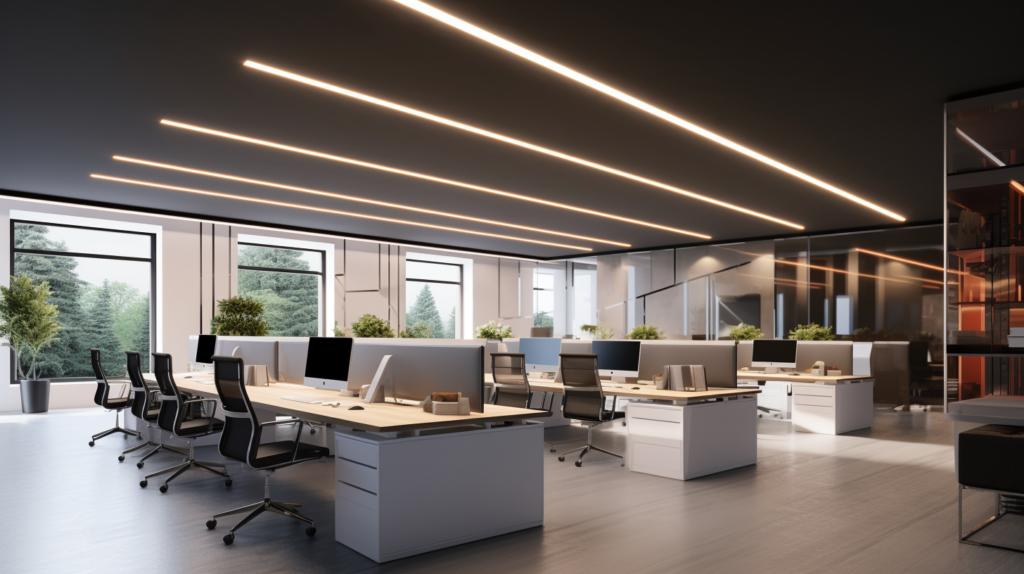
Open plan offices benefit most from continuous linear runs. The even illumination eliminates the “island of light” problem where workstations nearest fixtures get over-lit while corners fade into shadow. I’ve spec’d linear systems for 50,000 sq ft offices where the uniformity ratio hit 0.85—track can’t match that without serious head-count increases.
Corridors and transition zones are another linear stronghold. A continuous run of 4000K linear in a hospital corridor does double duty: wayfinding and ambient lighting in one. Track in these spaces looks like an afterthought.
Hospitality lobbies and food service spaces where the furniture layout changes but the lighting needs to feel intentional. Linear pendants over a dining table work whether that table seats four or fourteen.

When Track Makes More Sense
Retail environments where the merchandise mix rotates seasonally. A fashion retailer needs adjustable accent lighting to highlight display walls that change every eight weeks. Linear can’t do this without re-lamping entire runs.
Art galleries and museums are the clearest track use case. Curators need to aim light precisely at specific pieces, adjust beam spreads, and swap fixtures when collections change. The flexibility is the product.
Showroom floors for products that benefit from dramatic shadowing—automotive, furniture, high-end appliances. Track lets you create visual drama that repositioning a linear run simply cannot.
The Decision Framework I Actually Use
Before any spec, I ask three questions:
-
How often does the tenant change? If you’re lighting a multi-tenant office building, assume at least three different occupants over a ten-year window. Linear survives transitions; track systems get orphaned.
-
What’s the maintenance model? Track systems need quarterly head inspection—supplies walk off, aim gets bumped. If the facilities team is thin, linear wins by default.
-
Is this a design statement or a utility? If the client is paying for an architectural statement and the budget reflects that, linear justifies itself. If they’re trying to illuminate 100 foot-candles on a warehouse-to-office conversion, track with LED heads will save 30% on upfront costs.

The Hidden Cost Nobody Quotes
Here’s what suppliers rarely disclose: track systems have a “complexity tax.”
Each track run needs:
– Proper feed points (not every track head location can be a feed)
– Compatible drivers if mixing LED and legacy sources
– Regular cleaning of the conductor rails in dusty environments
– Replacement of proprietary connectors when manufacturers EOL a line
Linear systems, by contrast, wire once and run for 15 years with minimal intervention. The LED driver is accessible, standard, and replaceable without disturbing the fixture position.
My Verdict After 15 Years
For commercial wholesale buyers stocking inventory: linear fixtures outsell track 3:1 in spec-driven projects once you control for retail-specific applications. The market is telling you something.
For project specifiers: if you can’t articulate why the space needs adjustable aiming, default to linear. The ceiling is not the place to preserve optionality—that’s what furniture, area rugs, and movable partition systems are for.
The one exception: any space where the product on display changes more frequently than twice a year needs track, period. Trying to spec linear in a rotating retail environment is false economy—you’ll spend more on relamping and repositioning than the track premium ever cost.
YoubeeLight supplies commercial-grade linear LED systems and track-compatible LED heads for wholesale and project orders. Browse our LED catalog or contact our specification team for project pricing.
