
Introduction
When you purchase commercial LED luminaires, what determines whether they deliver their advertised 50,000-hour lifespan? The answer lies largely in thermal management—the science of keeping LED junction temperatures within acceptable limits. Poor heat dissipation is the primary cause of premature LED failure, lumen depreciation, and color shifting.
For procurement professionals and lighting designers, understanding thermal management isn’t just technical trivia—it’s essential for making informed purchasing decisions that protect your investment and ensure client satisfaction.
Why Heat is the Enemy of LED Performance
The Science Behind LED Heat Generation
Unlike traditional incandescent bulbs that radiate most energy as heat, LEDs generate light through electroluminescence—a highly efficient process. However, LEDs still produce significant heat as a byproduct, particularly in the semiconductor junction where light is generated.
Key temperature thresholds for LED performance:
Consequences of Poor Thermal Design
When LEDs operate above recommended temperatures, several degradation mechanisms accelerate:
1. Lumen Depreciation: LEDs lose 30-50% of initial output faster than rated
2. Color Shift: Warm white LEDs shift toward blue/violet
3. Accelerated Failure: Thermal runaway can cause immediate LED death
4. Driver Damage: Heat affects electronic driver components
5. Warranty Claims: Manufacturers void warranties for thermal abuse
Key Components of LED Thermal Management Systems
1. Heat Sinks: The Primary Cooling Solution
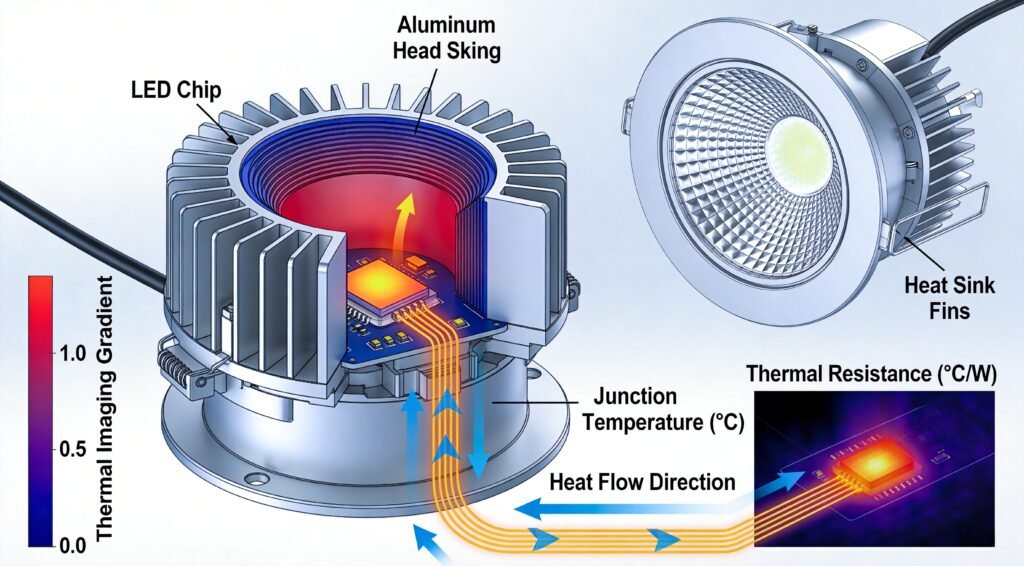
Heat sinks are passive cooling devices designed to dissipate heat from LED modules into the surrounding air.
Common heat sink materials:
Fin design considerations:
– Fin density: More fins = more surface area but reduced airflow
– Fin spacing: Minimum 4mm for natural convection, 6mm for forced air
– Fin thickness: Thicker = better heat spreading
– Surface treatment: Anodizing adds 5-15% thermal emissivity
2. Thermal Interface Materials (TIM)
TIM fills microscopic air gaps between the LED module and heat sink, dramatically improving thermal transfer.
Types of thermal interface materials:
3. Thermal Vias and PCBs
For COB (Chip on Board) LEDs and high-power modules, the PCB design critically affects thermal performance.
Key PCB thermal features:
– Metal-core PCBs (MCPCB): Aluminum or copper substrates
– Thermal vias: Plated holes transferring heat to背面
– Copper thickness: Thicker copper = better heat spreading
– Trace design: Wide traces on inner layers for heat transfer
Evaluating Thermal Performance: What to Look For
Thermal Resistance Specifications
Quality manufacturers specify thermal resistance in their datasheets:
– Junction-to-Case (Rjc): LED chip to package
– Junction-to-Ambient (Rja): Total system thermal resistance
– Thermal resistance per watt: °C/W rating
Example calculation:
If an LED produces 10W of heat with Rja of 15°C/W:
Real-World Testing Methods
#### 1. Thermal Imaging
#### 2. Thermocouple Measurement
#### 3. LM-80 Testing
Questions to Ask Your Supplier
Before placing orders, request these thermal specifications:
2. “Can you provide LM-80 test reports for the LED chips used?”
3. “What is the maximum ambient temperature rating for continuous operation?”
4. “Has thermal modeling been validated with actual measurements?”
5. “What thermal interface material is used, and what is its expected lifespan?”
[Contact YoubeeLight for detailed thermal specifications](https://youbeelight.com/contact/) on our commercial lighting products.
Common Thermal Design Mistakes to Avoid
Mistake #1: Oversized LED Modules in Small Housings
More LEDs don’t mean more light if thermal limits throttle output. Always match LED power to available thermal mass.
Mistake #2: Ignoring Airflow Restrictions
Enclosed fixtures, dust accumulation, and proximity to thermal barriers all reduce effective cooling.
Mistake #3: Relying on Specs Alone
Some manufacturers use unrealistic test conditions (25°C ambient, open air) that don’t reflect actual installations.
Mistake #4: Overlooking Driver Heat
LED drivers also generate heat—factor driver thermal design into your total thermal budget.
Industry Standards and Certifications
Design Standards for Thermal Management
ENERGY STAR Thermal Requirements
ENERGY STAR certified products must demonstrate:
Best Practices for Procurement
Specifying Thermal Requirements
Include these requirements in your RFQs and purchase specifications:
1. Maximum junction temperature the product is designed for
2. Minimum thermal resistance from LED to ambient
3. Operating temperature range with performance guarantees
4. Required thermal test reports (LM-80, thermal imaging)
5. Warranty conditions related to thermal operation
Sample Evaluation Checklist
Conclusion
Thermal management is not an afterthought—it should be a primary consideration in your commercial lighting procurement decisions. Products with superior thermal design deliver:
When evaluating LED luminaires, ask the hard questions about thermal performance. Quality manufacturers like YoubeeLight provide comprehensive thermal testing data and stand behind their products with realistic performance guarantees.
For professional guidance on thermal management in commercial lighting applications, [request a quote from YoubeeLight](https://youbeelight.com/contact/). We help global importers source products designed for real-world performance, not just marketing specifications.
Frequently Asked Questions
Q: How can I verify thermal performance without specialized equipment?
A: Simple methods include checking if the fixture feels unusually hot after extended operation, reviewing manufacturer-provided thermal test data, and requesting LM-80 reports for LED components.
Q: Does higher wattage always mean more heat problems?
A: Not necessarily. Modern high-efficiency LEDs produce less heat per lumen than older designs. However, higher absolute wattage always means more absolute heat that must be dissipated.
Q: What’s the relationship between thermal management and energy efficiency?
A: Better thermal design allows LEDs to operate cooler, which improves efficiency. LEDs become more efficient at lower temperatures, creating a positive feedback loop with good thermal management.
Q: How does ambient temperature affect LED lifespan?
A: Every 10°C increase in junction temperature approximately halves LED lifespan. This is why thermal management becomes critical in hot climates or poorly ventilated installations.
Q: Are there active cooling solutions for commercial lighting?
A: Yes, some high-end applications use fans, thermoelectric coolers, or liquid cooling. However, these add complexity, failure points, and maintenance requirements. Passive cooling through proper heat sink design is preferred for most commercial applications.
—
*Need help evaluating thermal performance in commercial lighting products? [Contact YoubeeLight](https://youbeelight.com/contact/) for technical consultation.*
