
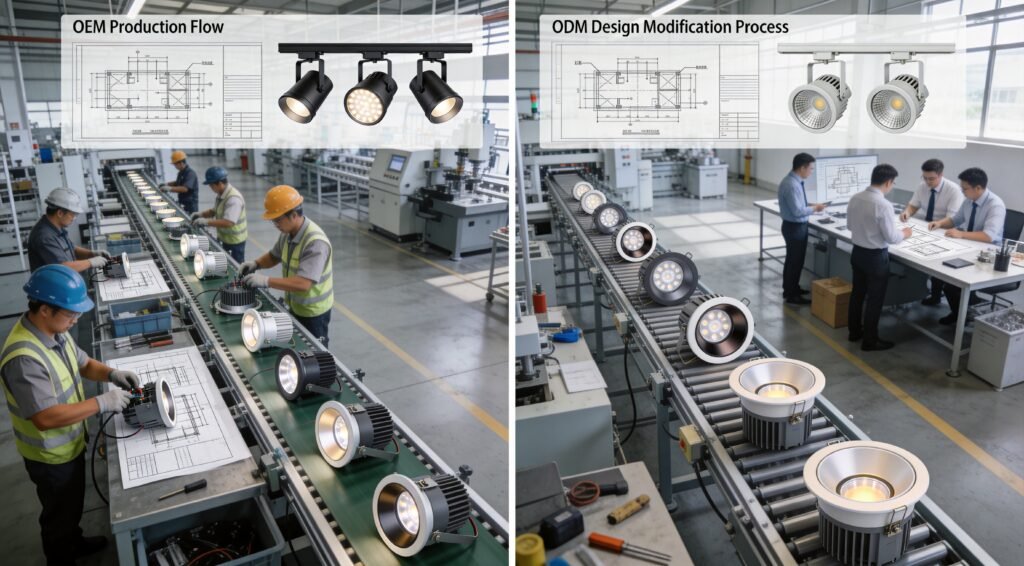
Introduction
Choosing between OEM (Original Equipment Manufacturing) and ODM (Original Design Manufacturing) is one of the most critical decisions lighting brand owners and procurement managers face when sourcing from China. This choice impacts your product quality, time-to-market, intellectual property protection, and ultimately your bottom line.
In 2026, with evolving US tariffs, shifting supply chain dynamics, and increasing competition in the commercial lighting sector, the OEM vs ODM decision carries more weight than ever. This comprehensive guide breaks down everything you need to know to make the right choice for your business.
Understanding OEM and ODM in Lighting Manufacturing
What is OEM Lighting Manufacturing?
OEM (Original Equipment Manufacturing) means you provide the manufacturer with your own designs, specifications, and technical requirements. The factory produces products according to your exact blueprints while you maintain full control over intellectual property.
OEM works best when:
What is ODM Lighting Manufacturing?
ODM (Original Design Manufacturing) means you work with a factory’s existing product designs and modify them to fit your brand. The manufacturer offers “off-the-shelf” designs that you can customize with your logo, packaging, and minor specifications.
ODM works best when:
Key Differences: OEM vs ODM for Lighting Products
Cost Analysis: OEM vs ODM for Commercial Lighting
OEM Cost Structure
With OEM manufacturing, your costs typically include:
– NRE (Non-Recurring Engineering) fees: $5,000-$50,000 depending on complexity
– Mold/tooling costs: $3,000-$30,000 per product
– Certification costs: $8,000-$25,000 for UL/CE/DLC certifications
– Per-unit manufacturing cost: Usually 15-25% lower at scale
Total investment for a new OEM track light: $20,000-$80,000 before production begins.
ODM Cost Structure
ODM manufacturing reduces upfront costs significantly:
– Sample fees: $200-$1,000 per product
– Customization fees: $500-$3,000 for logo/packaging changes
– Certification reuse: Often possible with factory’s existing certifications
– Per-unit manufacturing cost: Slightly higher than OEM due to shared development
Total investment for an ODM track light: $1,000-$5,000 before production begins.
Which Model Suits Your Business Profile?
Choose OEM If You Are:
A lighting brand launching in North America or Europe with:
Choose ODM If You Are:
A startup, regional distributor, or project-focused buyer with:
The Hybrid Approach: OEM-ODM Flexibility
Many successful lighting importers use a hybrid model in 2026. You might:
1. Start with ODM to test product-market fit quickly
2. Transition to OEM once you identify winning products
3. Use ODM for standard products and OEM for flagship items
[Contact YoubeeLight for OEM pricing](https://youbeelight.com/contact/) to discuss your specific requirements.
Quality Control Considerations
OEM Quality Management
With OEM, you must implement rigorous quality control:
– Pre-production inspection: Verify raw materials and components
– During production inspection (DPI): Monitor assembly processes
– Pre-shipment inspection (PSI): Final quality verification
– Lab testing: Third-party certification verification
ODM Quality Management
ODM quality control focuses more on:
– Incoming material inspection: Factory should provide test reports
– Function testing: All products should undergo full electrical testing
– Visual inspection: Check for cosmetic defects and branding accuracy
– Random sampling: Statistical quality assurance
IP Protection Strategies
Protecting Your OEM Designs
When working with OEM manufacturers:
Managing ODM IP Risks
With ODM products:
Conclusion: Making Your Final Decision
The OEM vs ODM choice depends on your specific business circumstances, market position, and growth strategy. There’s no universally correct answer—what matters is matching the manufacturing model to your actual needs.
Key takeaways:
For professional guidance on choosing the right manufacturing model for your commercial lighting products, [request a quote from YoubeeLight](https://youbeelight.com/contact/). Our team has 15 years of experience helping global importers find the optimal sourcing solution for their lighting business.
Frequently Asked Questions
Q: Can I switch from ODM to OEM after starting with ODM products?
A: Yes, many manufacturers allow this transition. You would typically pay additional NRE fees to create your own tooling and designs based on lessons learned from the ODM product.
Q: What’s the typical MOQ difference between OEM and ODM?
A: OEM MOQs typically start at 500-1,000 units per SKU, while ODM products often have MOQs of 100-300 units, making ODM more accessible for smaller importers.
Q: Can ODM products receive my own certifications?
A: Sometimes. If the base product already has certifications, you may be able to add your brand to the certification or obtain a separate certification for your specific model through a lab test.
Q: How do tariffs affect OEM vs ODM decisions in 2026?
A: Higher tariffs on Chinese imports make efficiency increasingly important. OEM’s lower per-unit costs may offset higher upfront investments, while ODM’s flexibility allows for easier supply chain diversification.
—
*Ready to discuss your OEM or ODM lighting needs? [Contact YoubeeLight](https://youbeelight.com/contact/) today for personalized consultation.*
