
The indoor farming boom isn’t slowing down. By 2026, the vertical farming market hit an inflection point—technology matured, energy costs stabilized, and more importantly, operators stopped listening to manufacturers’ marketing claims and started demanding real performance data.
I’ve been helping commercial grow operations source lighting for three years now. Here’s what actually matters when you’re buying grow lights for a 10,000+ square foot facility.
The Spectrum Myth (and Why It Matters)
Every grow light manufacturer claims “full spectrum.” Most are lying, or at least stretching the truth.
“Full spectrum” in grow lighting means the light covers PAR (Photosynthetically Active Radiation) wavelengths: 400-700nm. This includes what plants actually use for photosynthesis. But here’s what manufacturers don’t tell you:
Red and blue LEDs are more efficient than white LEDs for plant growth. A fixture with 70% red + 30% blue diodes will outperform a “full spectrum white” fixture of equal wattage in most fruiting/flowering applications.
Why white full spectrum still makes sense:
- Better working conditions (pink/purple grow rooms cause headaches)
- Allows human visual inspection of plant health
- Required for retail environments where customers browse the growing area
- Some research suggests supplementary green light improves leaf structure
For leafy greens (lettuce, basil, kale): Pure red/blue or “vegetative spectrum” works great.
For fruiting crops (tomatoes, peppers, strawberries): Need more red + far-red (700-750nm) for flowering response.
For cannabis: The most demanding application, requires fine-tuned spectrum control.
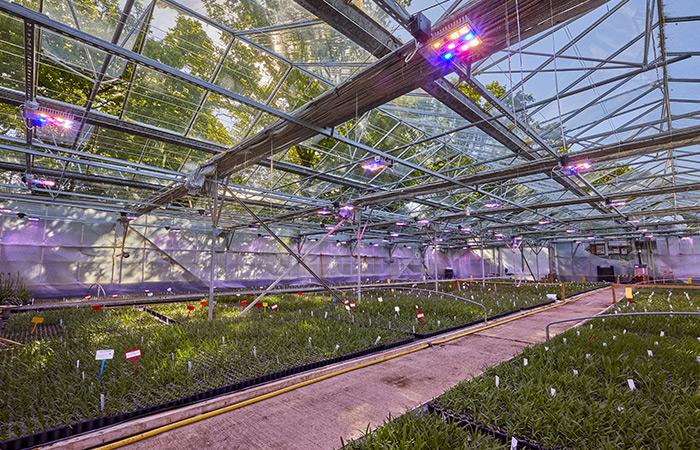
PPFD and DLI: The Metrics That Actually Matter
This is where most buyers get confused, and where the real money gets made or lost.
PPFD (Photosynthetic Photon Flux Density): Measured in μmol/m²/s. This tells you how much light hits a specific point on your canopy. Not how bright the fixture looks—how much PAR light reaches the plants.
DLI (Daily Light Integral): Measured in mol/m²/day. This is the total amount of light plants receive over a 24-hour period. This is what actually drives growth.
Different crops have different DLI requirements:
- Lettuce: 12-17 mol/m²/day
- Basil: 20-25 mol/m²/day
- Tomatoes (fruiting): 30-40 mol/m²/day
- Cannabis (vegetative): 28-35 mol²/day
- Cannabis (flowering): 45-65 mol/m²/day
The math: If your fixture delivers 300 μmol/m²/s at canopy and you run lights 18 hours, your DLI = 300 × 18 × 3600 / 1,000,000 = 19.44 mol/m²/day. Adjust hours or fixture height to hit your target DLI.
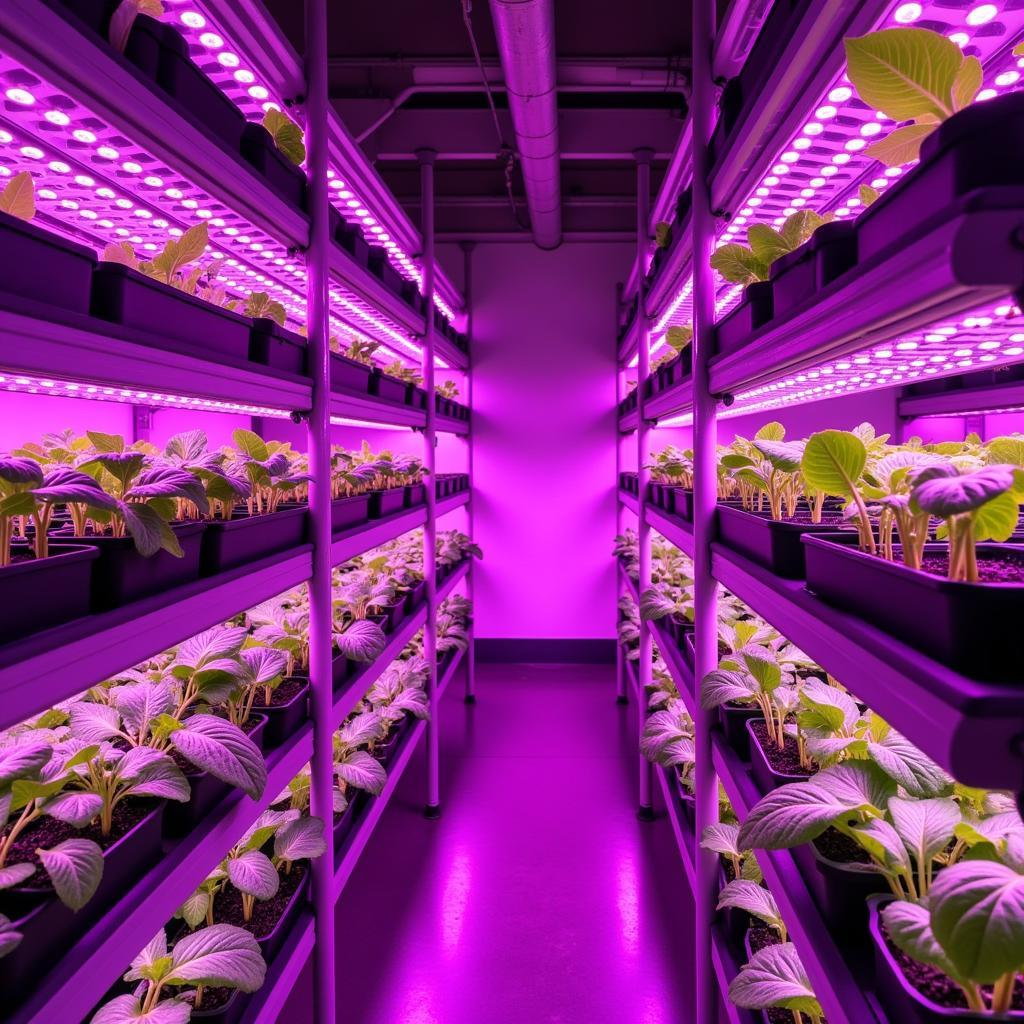
fixture Design for Commercial Scale
The hanging height problem:
Residential grow tents work at 12-18 inches from canopy. Commercial racks often have 18-24 inches between shelves. This changes everything about fixture selection.
- Low-profile fixtures (< 2″ height) for tight vertical rack spacing
- Higher output fixtures with better beam angle for 24″+ hanging height
- Consider light beam uniformity—fixtures that concentrate light in center create uneven growth
Thermal management:
LED grow lights produce heat at the fixture, not the bulb like HPS. This is generally better for indoor growing (heat is more controllable when it’s at the top vs. throughout the growing space).
But fixtures still need adequate thermal management:
- Active cooling (fans): Better performance, shorter lifespan due to fan failure
- Passive cooling (heatsinks): Longer lifespan, works well in climate-controlled environments
- For commercial facilities: I recommend passive cooling unless your facility runs hot
Driver quality:
The LED driver is often the weakest link. Commercial-grade drivers from Mean Well, Inventronics, or Sosen will last 50,000+ hours. Budget drivers from unknown manufacturers might fail in 10,000 hours—right when you’ve scaled up and can’t afford downtime.
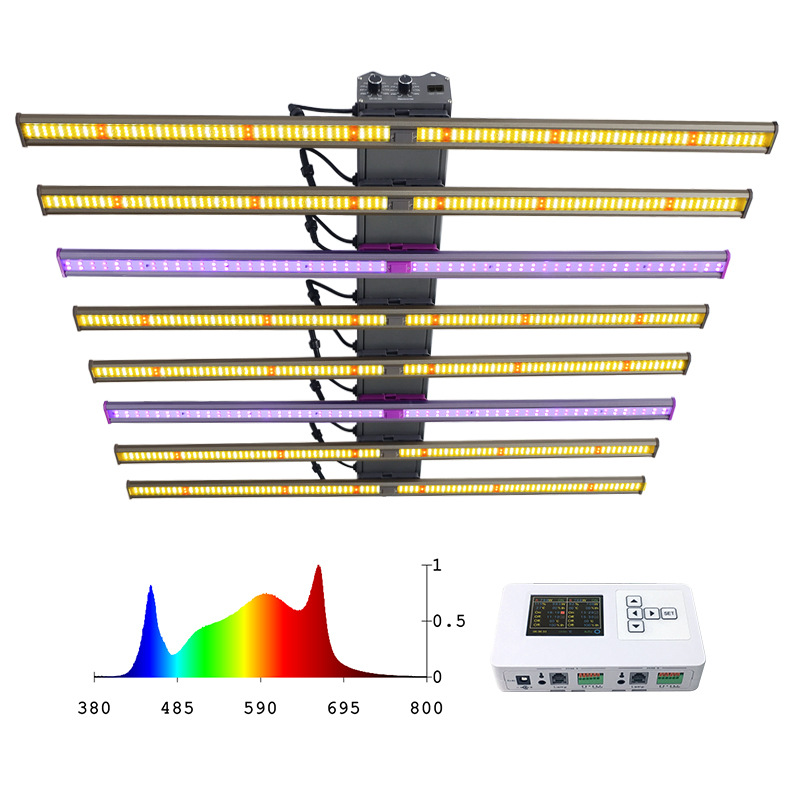
Calculating ROI for Commercial Grow Lighting
Here’s where you make the business case for quality fixtures.
Example calculation for a 5,000 sq ft leafy greens operation:
- Old fixture: 650W HPS, 1.2 μmol/J efficiency, $350/fixture
- New fixture: 480W LED, 2.7 μmol/J efficiency, $850/fixture
- Electricity: $0.12/kWh, 18 hours/day, 365 days/year
- Current yield: 8 harvests/year
- Retrofit: 150 fixtures
Annual electricity savings:
– HPS: 150 × 650W × 18h × 365 / 1000 × $0.12 = $51,327
– LED: 150 × 480W × 18h × 365 / 1000 × $0.12 = $37,886
– Savings: $13,441/year
Payback period:
– Cost difference: ($850 – $350) × 150 = $75,000
– Simple payback: $75,000 / $13,441 = 5.6 years
Add in HVAC savings (LEDs produce less heat = less cooling load), longer fixture lifespan, and increased yield from better spectrum control, and the numbers get compelling fast.
The hidden costs nobody talks about:
- HPS bulb replacement: $50-80 per bulb every 2-3 grows
- Labor to replace bulbs across 150 fixtures
- Yield loss during bulb changeover
- Environmental control costs from HPS heat load
What to Ask Your Grow Light Supplier
Before you place a commercial order, get answers to these:
- PPFD maps: Ask for measured PPFD readings at different hanging heights (12″, 18″, 24″, 36″) with coverage area
- Driver specifications: Brand name, warranty period, operating temperature range
- LM-80 test reports: Verifies LED chip performance over 6,000+ hours
- IES TM-33-18 photobiological safety certification: Required for commercial installations in many jurisdictions
- Photometric files: .ies files for lighting design software (if doing professional layout planning)
- DLC certification: For utilities rebates in North America
- Referrals: Ask for 2-3 commercial installations of similar scale you can contact
The Future: Tunable Spectrum
We’re starting to see tunable spectrum fixtures that adjust light recipes based on growth stage. This is real technology, not vaporware—several commercial manufacturers now offer fixtures with adjustable red/blue/white ratios via app or control system.
For operations growing multiple crops or managing different growth stages, tunable spectrum can:
- Optimize vegetative growth (more blue)
- Trigger flowering/fruiting response (more red + far-red)
- Fine-tune for specific crop characteristics
The premium is significant (30-50% over fixed spectrum), but for high-value crops like cannabis or specialty herbs, the yield improvements justify the investment.
Bottom Line
Commercial grow lighting is a serious capital investment. The difference between a $400 fixture and an $800 fixture isn’t just build quality—it’s spectrum accuracy, driver reliability, thermal management, and manufacturer support.
Do your homework on DLI requirements for your specific crops. Get PPFD maps from your supplier. Calculate real payback periods including hidden costs. And most importantly, talk to operators who’ve run these systems at scale before you commit.
Looking for commercial grow lighting suppliers? YoubeeLight’s product catalog includes LED fixtures designed for agricultural applications with detailed performance specifications. Contact our team to discuss your vertical farming or greenhouse lighting requirements.
